

Category: Solar Info
Solar panels are becoming increasingly common in New York City, and for good reason. They pay for themselves through electric bill savings and, as Con Ed rates continue to rise, so does the return you’ll see on your investment in solar panels.
Still, installing solar panels is a big decision. If you have questions, Brooklyn SolarWorks is here to help. We specialize in solar installation for NYC homes and have installed thousands of systems throughout all five boroughs.
Keep reading for answers to the most common questions we hear from homeowners thinking about installing solar panels in NYC.
1. How Easy Is It to Install Solar Panels in New York City?
Installing solar panels in New York City involves unique, complex challenges like navigating tightly spaced buildings, strict fire codes, and complex layers of permitting.
For an experienced solar panel installer, the process can be smooth and simple for homeowners, even when the process itself isn’t exactly easy. This is exactly why choosing an experienced local partner is so important. At Brooklyn SolarWorks, we know NYC’s solar code inside and out. We handle all the applications, custom designs, and logistics for you. We’ve spent years developing custom solar solutions for city homes, including flat roofs, small rooftops, and landmarked buildings, and we manage the complexities so your solar installation can be easy and stress-free.
2. What Types of Roofs Work for Solar Panels in NYC?
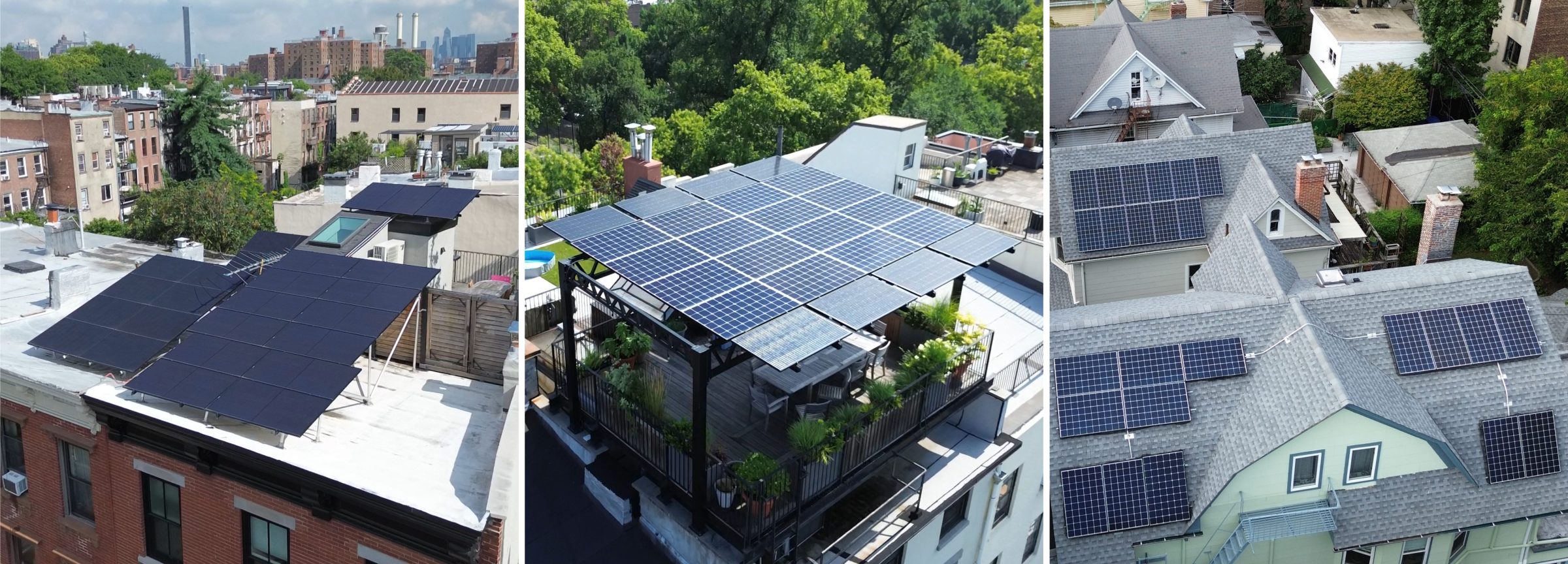
The short answer is: any type of roof can work for solar panels, as long as the solar system is designed to conform to your roof, and not the other way around!
We believe solar should be accessible to everyone, which is why we’ve designed custom installation options that make solar possible on the many common NYC roof types, including:
- Flat Roofs: Creative design is needed to navigate rooftop equipment and fire codes, often solved by a system like our patented Solar Canopy.
- Small Roofs: Space-saving systems are necessary to make solar a worthwhile investment, even for small homes with low electricity usage.
- Historic Homes: Custom, low-profile systems are used to comply with preservation standards.
- Co-Ops & Condos: Tailored systems are designed to account for both shared common areas and individual unit usage.
- Pitched Roofs: Solar panels can be easily installed on houses with pitched roofs using traditional solar mounting systems.
3. What Are the Permitting Requirements for Solar Panel Installation in NYC?
To install solar panels in NYC, you need to comply with strict building and fire codes. If you’re installing solar on a Landmarked home, you will need additional approvals.
Exact permitting requirements can vary by project, but most solar installations in NYC require:
- Alteration Type 2 Permit: You will need a construction permit and an electrical work permit from the Department of Buildings.
- Fire Pathway Compliance: To receive your permit, your system’s design must comply with fire regulations that ensure clear roof access and a 6 foot fire path.
- Landmark Approval: If your home or building is in a historic district, approval is needed from the Landmarks Preservation Commission.
Navigating this red tape is complex, but it’s our specialty. We know the permitting requirements inside out and handle every step of the process for you. Plus, we track progress in our customer portal, so you can easily follow along.
4. Are There Incentives for Solar Panels in NYC?
There are excellent incentives for solar panel installation in New York City. You could get up uto 60% of your cost covered!
Here’s a quick look at what’s available:
- New York Solar Tax Credit: Claim a $5,000 credit on your state income taxes.
- NYC Property Tax Abatement: Claim 30% of your solar installation costs as a property tax abatement, significantly reducing your property taxes over a 4-year period.
- Historic Homeownership Rehabilitation Tax Credit: Claim an additional 20% tax credit if you live in a qualifying historic district.
- Net Metering: Automatically export the extra electricity your solar panels generate to the main grid. You receive credits in exchange, which offset the cost of the grid power you use when your solar panels are not producing electricity. You can think of it like the electric grid acting as a battery that stores your solar power for later use. This is ideal, because solar batteries are not allowed in NYC.
5. How Long Does the Solar Installation Process Take in New York City?

Installing solar panels in New York City takes less time than you may think. The installation often just takes 1 day for a standard residential home solar installation. The entire process usually takes 2-3 months from your initial consultation to final inspection approval.
Have More Questions? We Have Answers!
If you’re researching solar panels for your home and have additional questions, we would love to hear from you. Reach out to us today to schedule a free, 30-minute phone consultation. We’ll talk to you about your options, answer your questions, and help you decide whether solar makes sense for you.
Call 929-977-0058 or schedule your free solar consultation online today.
Solar energy is becoming increasingly affordable in New York City, thanks to a variety of unique incentives available to homeowners across the five boroughs. With the right combination of state and federal incentives, installing a solar energy system can be an excellent investment for your home.
One of the most valuable incentives is the New York State Solar Tax Credit, which can significantly reduce the cost of your solar installation. Read on to explore how you can take advantage of this fantastic opportunity.
What is the New York State Solar Tax Credit?
The New York State Solar Tax Credit, also known as the Solar Energy System Equipment Credit, is a powerful incentive for residential solar projects. This credit allows homeowners to claim 25% of their solar energy system costs, up to a maximum of $5,000, as a state income tax credit. This tax credit is designed to make solar energy more accessible and affordable for New York residents, encouraging the adoption of clean energy.
For Co-op or multifamily owners, this credit is even more generous. Co-ops and condos can claim a 25% tax credit against their buildings solar investment, capped at $5,000 per person with no overall gross cap. This credit can be divided among individual shareholders or owners on a prorated basis.
For example, if a 12 unit co-op has a solar project cost of $150,000, each of the 12 co-op unit owners would receive their fare share of the $37,000 as a credit against their taxable income.
Am I eligible to claim the New York State Solar Tax Credit?
Not every homeowner in NYC qualifies for the NYS Solar Tax Credit, determining your eligibility for this tax credit involves understanding several key factors:
Qualifying Expenses
To be eligible for the New York State Solar Tax Credit, your expenses must be related to the purchase or leasing of solar energy equipment used for heating, cooling, hot water, or electricity for residential use. This includes solar panels, inverters, mounting equipment, and other essential components.
Income Tax Liability
To claim the credit, you must have an income tax liability in New York State. This means that if you do not owe any state income taxes, you cannot use this credit to receive a refund. However, any unused credit can be carried forward to offset future tax liabilities.
Building Type
This credit applies exclusively to residential buildings. Whether you own a single-family home, a townhouse, a brownstone, or a condo, you can benefit from the credit as long as the solar energy system is installed for residential use on your primary residence.
Ownership of Solar System
The New York State tax credit for solar panels is available for systems that are purchased, leased, or acquired through power purchase agreements (PPAs). This flexibility makes it accessible to a broader range of homeowners.
Installation Location and Timeline
The solar energy system must be installed at your primary residence in New York State. You can claim the credit when you file your taxes for the year the system was installed. For example, if your system is installed in 2026, you’ll claim the credit on your 2026 tax return.
When can I claim the credit?
You can claim the New York State Solar Tax Credit for the tax year in which your solar energy system was installed. If the full amount of the credit cannot be used in one year, it can be carried forward for up to five years. This means you can still benefit from the credit even if you don’t have enough tax liability in the year of installation.
Want to use this tax credit this year? There’s still time to get solar installed for your home in 2026! Start your solar journey today with a free consultation.

Is the NYS solar tax credit refundable?
The New York State Solar Tax Credit is not refundable. However, it can be carried forward for up to five years if you cannot use the entire credit in one tax year. While there has been recent advocacy to make this credit refundable to increase accessibility, it has not yet been passed.

Senator Pete Harckham has proposed increasing the solar tax credit cap from $5,000 to $10,000, making it refundable, removing the cap on energy system sizes, and including energy storage projects for credit eligibility. As of March 2026, the bill is still going through the legislative process and has not yet passed.
How much can I save with New York solar incentives?
In New York City, you can save up to 60% on your solar installation when combining the New York State Solar Tax Credit with other incentives. Here’s a list of other available incentives:
- NYC Property Tax Abatement: The NYC Property Tax Abatement for solar allows NYC homeowners to claim 30% of solar energy system costs as a property tax abatement with the NYC Department of Finance. When you go solar, your property taxes are significantly reduced over a 4-year term, separated into abatements of 7.5% each year.
- NYSERDA Solar Rebate: The New York State Energy Research and Development Authority (NYSERDA) contributes a cash rebate to solar installations through the NY-Sun program. This rebate is paid directly to your solar company and reduces your upfront project cost. The rebate amount varies depending on geographic location.
- Net Metering: As an NYC solar owner, you’ll be able to reduce or even eliminate your electric utility bill through Con Edison’s net metering program. Through net metering, you’ll receive retail energy credits on your monthly bills for any excess energy that your system exports to the grid. These credits are used at times when your system isn’t producing as much energy, like at night or in the winter.
How to Claim the New York State Solar Tax Credit
To claim the New York Solar Tax Credit, you will need to file Form IT-255, Claim for Solar Energy System Equipment Credit, when you do your taxes. It’s advisable to consult with your accountant or tax advisor to ensure you’re maximizing your savings and complying with all requirements.
New York State Solar Tax Credit for New York City Homeowners
The New York State Solar Tax Credit offers a tremendous opportunity for New York City homeowners to save on solar installations. By combining this credit with other available incentives, you can significantly reduce your out-of-pocket costs and enjoy the benefits of clean, renewable energy.
If you’ve been considering solar, now is the time to flip the switch. Take advantage of solar tax incentives at their peak. Schedule a free consultation to get started today.


Brooklyn SolarWorks Installs New York City’s First Residential Battery Energy Storage System
Partnership with Briggs & Stratton serves as a trailblazer for New York City’s permitting framework for the siting and installation of residential energy storage.
Brooklyn, NY, March 25, 2026 – Brooklyn SolarWorks, New York City’s leading solar developer and installer, has successfully installed the first residential battery energy storage system (BESS) within city limits. Located in Chinatown, the landmark project pairs a 19.6 kilowatt-hour battery system with a solar canopy and represents a monumental step forward for clean energy and urban resilience.
The Briggs & Stratton® AccESS™ energy storage system, the only residential storage system permitted for installation on New York City’s rooftops, was installed as a complimentary feature on an existing solar canopy – Brooklyn SolarWorks’ patented design that maximizes solar production in urban settings.
New York City’s notoriously restrictive permitting guidelines for residential BESS systems have held back residential BESS, making this project a significant victory for the industry and for homeowners seeking energy independence. This trailblazing system came online after a nearly eight-year effort by Brooklyn SolarWorks and Briggs & Stratton to not just navigate the city’s complex regulatory hurdles but assist in developing the city’s permitting framework surrounding the siting and installation of residential energy storage in New York City.
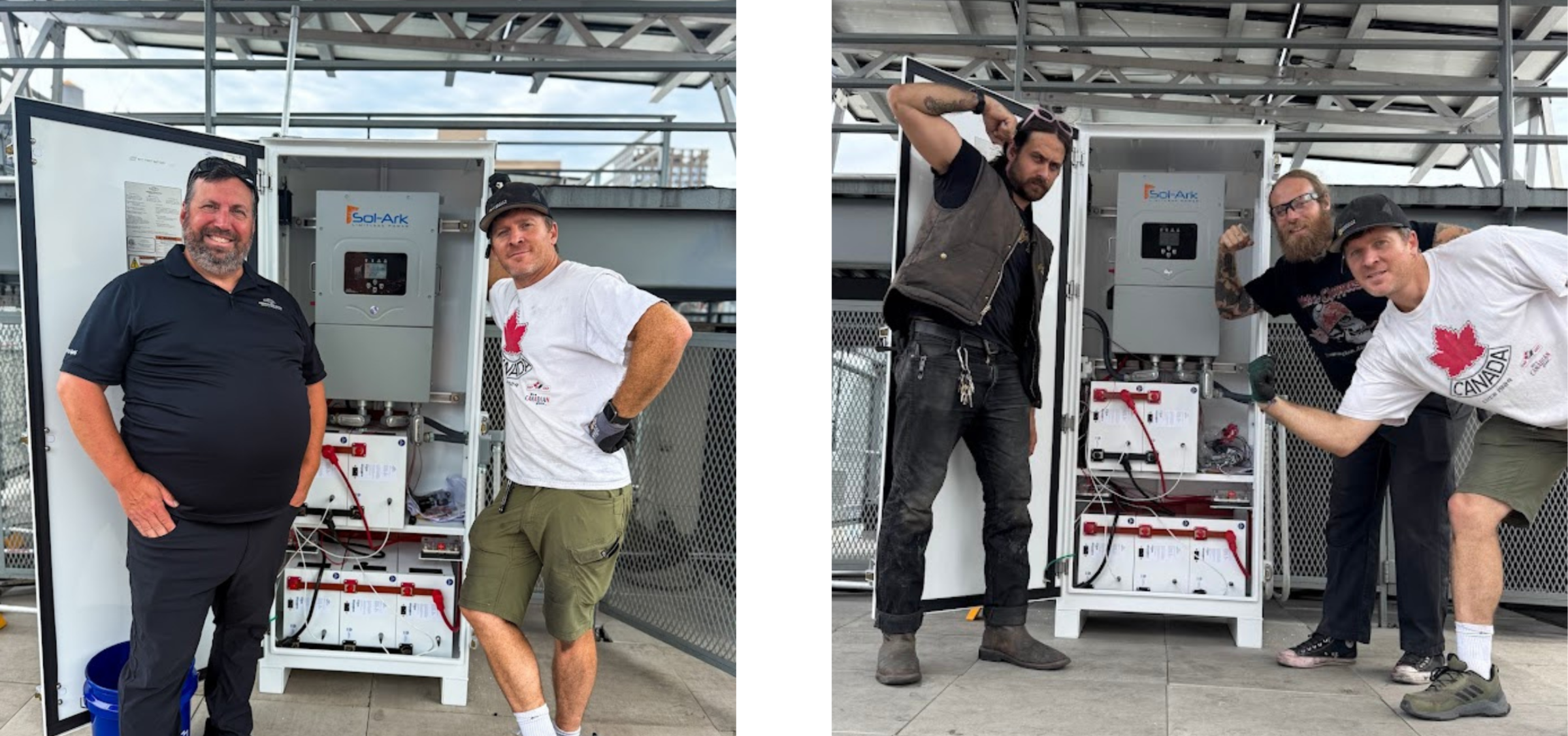
“We’ve spent years working with the Fire Department of New York (FDNY) and New York City government agencies to enable residential battery storage for New Yorkers,” says Sequoya Cross, Vice President of Energy Storage for Briggs & Stratton Energy Solutions. “Our AccESS system is the only residential ESS to receive a Certificate of Approval (COA) from the Fire Department of New York (FDNY). The COA is significant since New York has some of the most stringent fire safety rules for energy storage systems anywhere in the world. Since they produce very little heat and have a reduced risk of thermal runaway, our batteries don’t require additional fire suppression systems or cooling or ventilation measures.”
With distributed energy sources contributing a growing share of power, BESS serves as a cornerstone of grid stability. Homeowners with BESS could soon be financially incentivized to discharge their batteries during peak demand, ensuring the grid’s stable operations. Even now, these systems offer homeowners crucial protection against outages.
“This installation is a testament to our commitment to bringing innovative, clean energy solutions to New York City, “said Brooklyn SolarWorks founder and CEO, T.R. Ludwig. “Our team led the charge on rooftop solar in this city a decade ago and now we have the opportunity to lay the groundwork for BESS infrastructure, which the city will need as energy demand continues to rise. We are incredibly proud to have made this groundbreaking project a reality.”
“Energy storage, when combined with solar, makes New York City’s homes more resilient and strengthens our city’s grid,” says building owner, Bruce Langone. “This project has laid the groundwork for millions of families in the five boroughs to take control of their energy needs. It’s an honor to host the city’s first residential battery system, and I am grateful to Brooklyn SolarWorks and Briggs & Stratton for their persistence in bringing this vision to life.”
With this installation, Brooklyn SolarWorks and Briggs & Stratton created the framework for battery energy siting in New York City. Their heavy lifting has opened opportunities for residents across the five boroughs to pursue BESS installations for their homes, offering a new level of energy security for homeowners and strengthening the resilience of the city’s energy grid.
About Brooklyn SolarWorks
Founded in 2015, Brooklyn SolarWorks is a solar design and installation company servicing New York City, with more than 3,000 residential and commercial installations completed within the five boroughs. The company specializes in custom installation and design methods, including its patented Brooklyn Solar Canopy, which elevates panels above obstructions commonly found on NYC rooftops to maximize solar potential. Brooklyn SolarWorks’ hyperlocal focus has allowed them to expertly navigate complex permitting requirements and remain on the forefront of solar policy in the city and state.
For more information, visit brooklynsolarworks.com.
About Briggs & Stratton
Briggs & Stratton, headquartered in Milwaukee, Wisconsin, provides innovative products and diverse power solutions to help people get work done. Briggs & Stratton is the world’s largest producer of engines for outdoor power equipment and is a leading designer, manufacturer and marketer of lithium-ion batteries, standby generators, energy storage systems, lawn and garden, turf care and job site products through its Briggs & Stratton®, Vanguard®, Ferris®, Simplicity®, Snapper®, Billy Goat®, Allmand® and Branco® brands. Briggs & Stratton products are designed, manufactured, marketed and serviced in more than 100 countries on six continents.
For more information visit energy.briggsandstratton.com.
One of the biggest myths about solar panels is that they don’t work in the winter. Solar panels need light, not heat, to produce electricity, which means they can still power your home through every season—even in the colder winter months.
Of course, there’s less daylight in the winter, which reduces the amount of electricity solar panels can generate. But solar panels are still very efficient in the wintertime, and a great way to reduce your energy bills throughout every season. And in New York City, net metering helps even things out even more.
Here’s a closer look at what you can expect from your home solar panels during the winter in NYC.
Will You Still Save on Your Electric Bills in the Winter?
Solar panel performance varies by season. In the winter, you’ll likely see the lowest output that you do all year due to the shortened days and overcast skies. But even though your output will drop, you’ll likely still save money on your electric bills every month. It’s possible that they’ll even be as low, or close to as low, as they are in the summer. This is because solar panels continue to produce electricity all year-round, and because of net metering.
How Net Metering Keeps Solar Savings Steady Year-Round
Net metering is a NYC solar incentive that allows you to use the electric grid to store solar energy, kind of like a big battery.
Here’s how it works:
- During the long, sunny summer days, your solar panels often generate more electricity than your home needs.
- The excess power is automatically sent back to the electric grid.
- You earn utility credits for the extra electricity you send to the grid. Anything you don’t use rolls over month to month.
- In the winter, when your system produces less power, your home draws electricity from the grid as needed.
- Con Edison automatically applies your banked net metering credits to your bill, helping keep your costs low year-round.
The great thing about net metering is that it all happens automatically. A special electric meter will keep track of what you send to the grid, and Con Ed will apply your credits to your account when you need them.
It’s even easier when you go solar with Brooklyn SolarWorks. We handle all the setup for you so you can start earning net metering credits the minute we turn your system on.
What Impacts Winter Solar Performance?
A few key factors impact solar panel performance in the winter, including:
-
Limited Daylight Hours
Solar panels use light to generate electricity, not heat. That means they’ll continue to produce power no matter how cold it is outside. However, the days are shorter in the winter, which means your solar panels have less time to generate electricity than they do in the summer.
-
Overcast Skies
There are more cloudy days in the summer, which impacts performance. Solar panels still work on cloudy days, but output is lower than it is when there’s direct sunlight.
-
Snow on Panels
In the winter, snow can accumulate on your solar panels and block sunlight, reducing their output. But this isn’t as big a problem as people tend to think. Panels are sloped and slippery, allowing snow to slide off easily, and because of their dark color, they tend to melt snow relatively easily.
-
Cooler Temperatures Boost Efficiency
Surprisingly, the cold is actually good for solar panels. According to the Department of Energy, very high temperatures can actually cause a decrease in voltage, which reduces the amount of electricity a solar panel can produce.
Why Winter Is a Great Time to Go Solar
If you’re thinking about installing solar panels, winter is actually one of the best times to get started. The solar process typically takes 1-3 months from proposal to installation. If you start the process in the winter, your system will be up and running by the time the longer, sunnier spring and summer days roll around.
Plus, since fewer people are thinking about solar in the winter (even though they should be!), we tend to have a more flexible schedule. That makes scheduling easier and could result in a faster installation.
At the end of the day, however, there’s no bad time to go solar. The sooner you get started, the sooner you can start powering your home with clean, renewable energy and saving money on your electric bills.
See if solar is right for your home. Call 929-977-0058 or schedule your free solar consultation today!
If you’ve opened a utility bill lately, you know electricity costs are going up in New York City. The best way to avoid rising costs is by generating your own power with solar panels. But are they really worth it in the city?
Absolutely. New York City is one of the best places in the country to go solar thanks to rich incentives and a strong net metering policy.
At Brooklyn SolarWorks, we work around challenges like flat roofs and shade from surrounding buildings to make solar a smart investment for NYC homeowners. Our customers save an average of $80,000 or more on electricity costs with solar panels!
Here’s a closer look at the cost, benefits, and incentives you can expect from solar panels in NYC in 2026.
How Much Do Rooftop Solar Panels Cost in New York City?
The cost to install solar panels in New York City starts at $30,000 before incentives, but varies for each home. Luckily, NYC is one of the most incentive-rich areas in the country. You could save up to 65% on your installation costs with local incentives.
What Are the NYC Solar Incentives for 2026?
There are excellent incentives for rooftop solar installation in NYC in 2026, including:
- New York State Solar Tax Credit – You can claim 25% of your solar installation costs, up to $5,000, as a credit on your state income taxes.
- NYC Property Tax Abatement – Going solar reduces your property taxes. You’ll save 30% of your system’s eligible installation costs over 4 years.
- NYS Historic Homeownership Rehabilitation Tax Credit – If you live in a qualifying historic district or Landmarked home, you can claim an additional 20% tax credit.
- Net Metering – You earn utility credits for the excess electricity your solar panels send to the grid, essentially using it as a virtual battery.
Is There Net Metering in New York City?
Yes, New York City has one of the best net metering policies in the country! It allows you to use the electric grid as a virtual battery. When your solar panels produce more electricity than you need, the excess is automatically sent to the grid. Con Edison credits you for every kWh you send them at the full retail price of electricity. Your credits are then automatically applied to offset the cost of grid electricity you use when your solar panels are not producing power, like at night.
What Are the Benefits of Solar Panel Installation in NYC?
Save Money on Electric Bills
Electricity rates have shot up 26% in NYC since 2020. By generating your own electricity with solar panels, you’ll significantly reduce your electric bills. Over time, these savings add up, offsetting the initial cost of installation and providing a rich return on your investment.
Want a free estimate of your potential savings? Schedule a quick phone consultation today!
Avoid Rising Electricity Rates
Over the past 10 years, energy prices have increased by an average of 3% per year. In 2025, the average Con Ed rate was $0.36 per kWh. If the 3% increase stays steady, we’ll be paying $1.09 per kWh in 30 years.
With solar panels, you’re essentially buying that next 25-30 years of energy in bulk and locking in a lower cost per kWh for decades.
Do Your Part for the Planet
Solar power is a clean, renewable energy source that reduces our reliance on fossil fuels. By installing solar panels on your home in NYC in 2026, you can help decrease greenhouse gas emissions and contribute to a healthier, more sustainable environment.
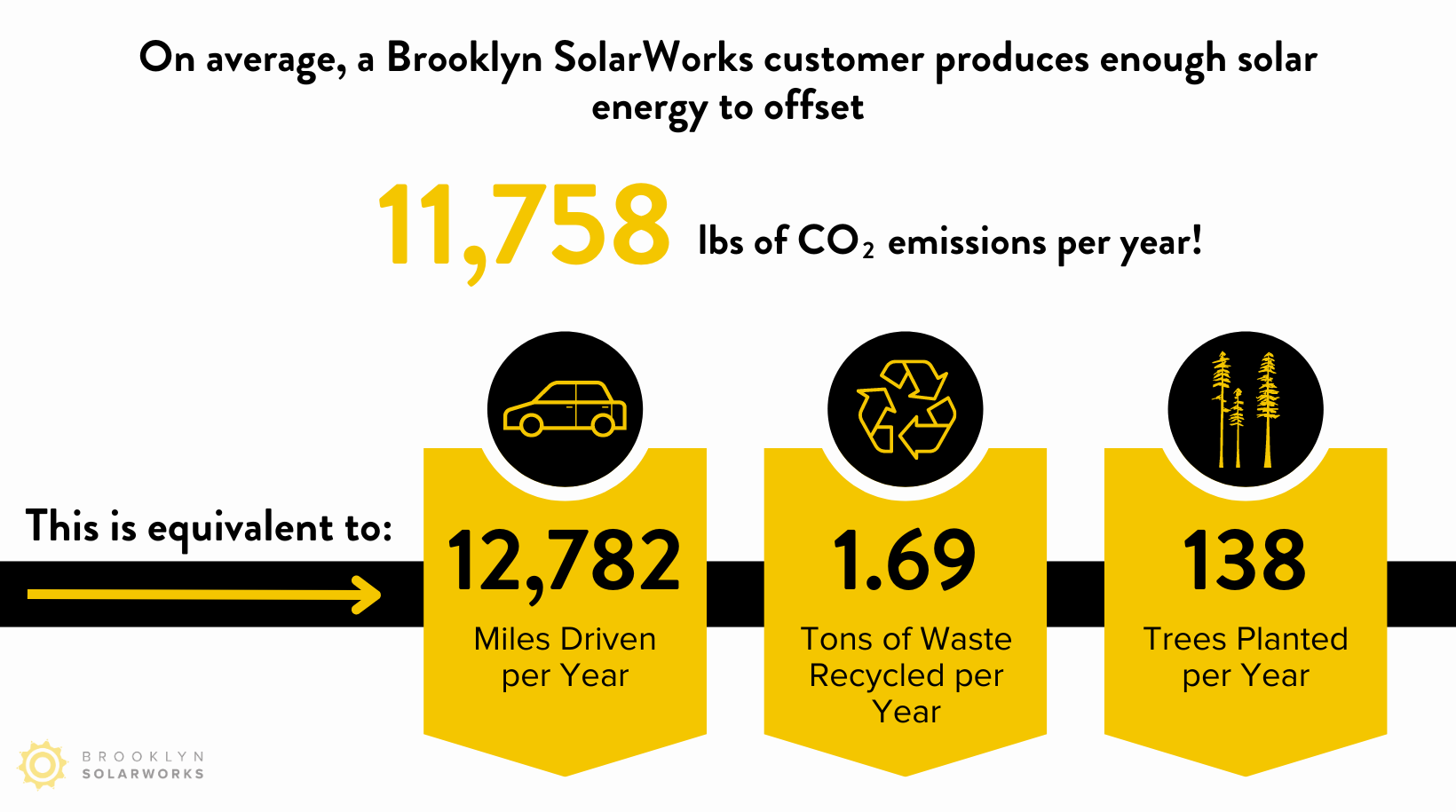
With every solar system installed in NYC, we become that much closer to reaching our climate goals.
Increase Your Home’s Value
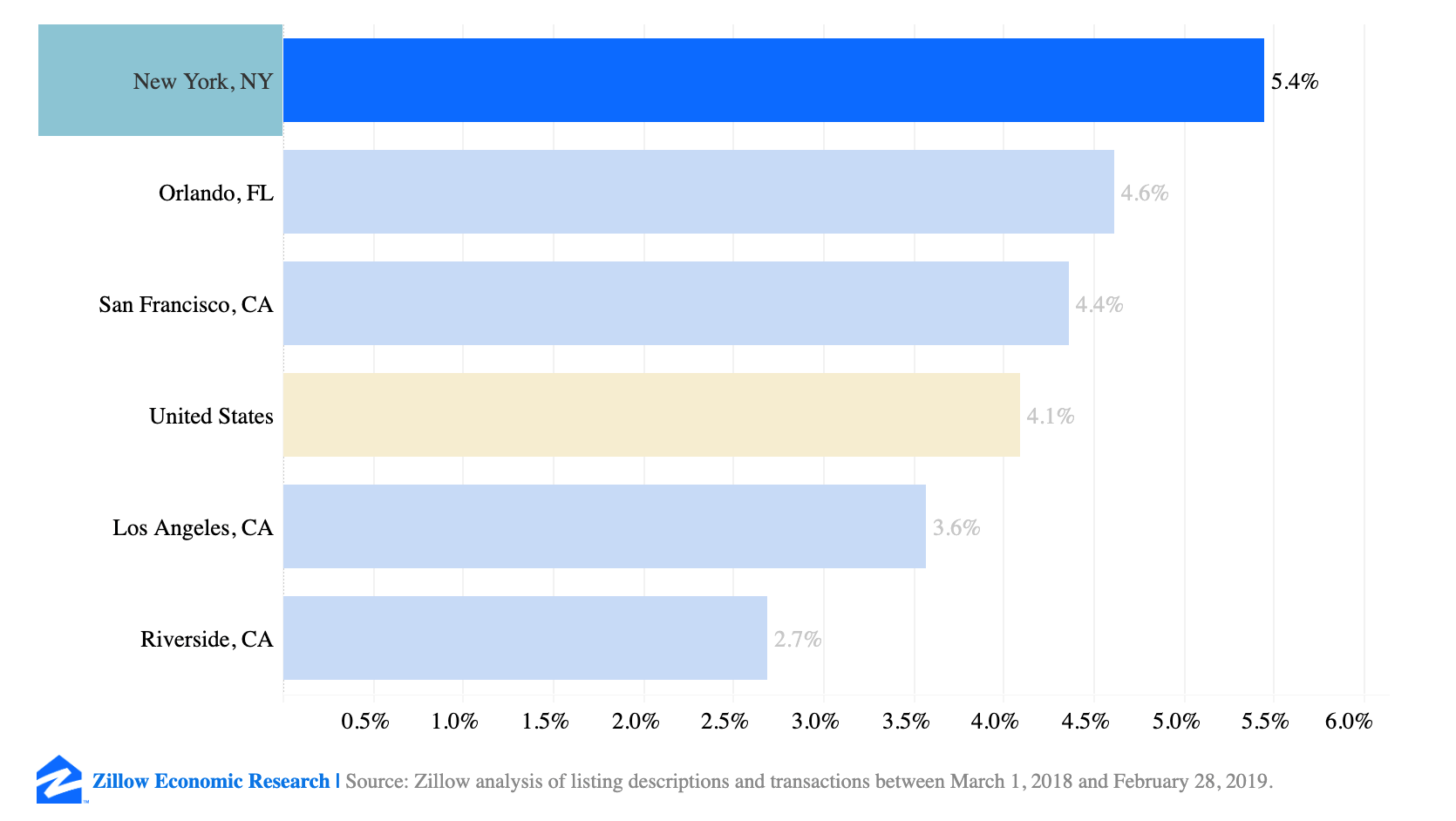
Homes and businesses with solar power systems often see an increase in property value. Zillow reports that homes with solar panels in NYC sell for 5.4% more on average than comparable homes without them. That translates to an additional $43,193 on the median sale price in NYC.
Support Job Creation in NYC
The solar industry is a growing field that creates jobs in installation, maintenance, manufacturing, and more. By going solar, you’re not only benefiting yourself but also contributing to local economic growth.
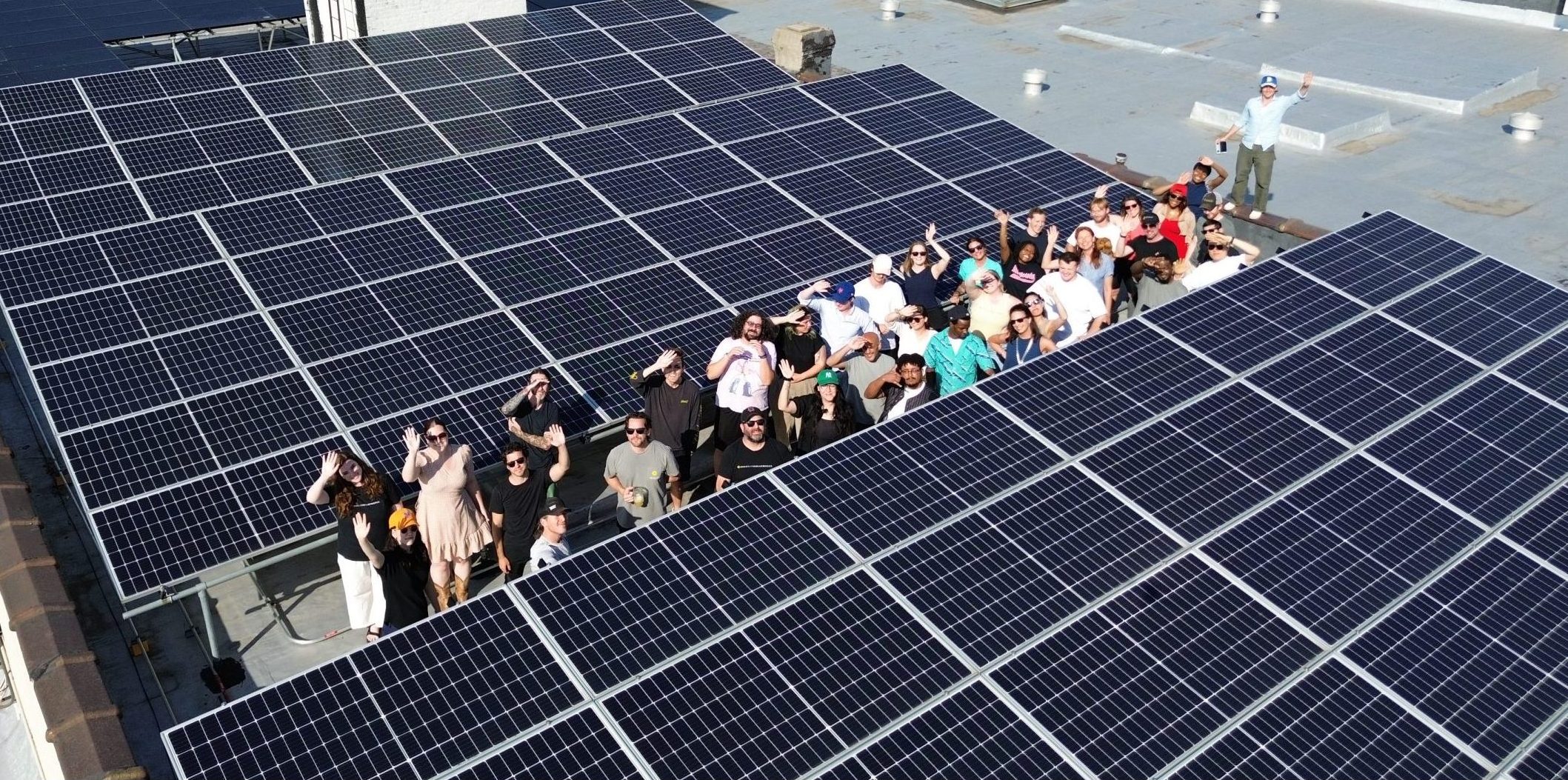
Our growing team is made up of 80 of your fellow New Yorkers. When you support a local installer like us, you’re supporting the local economy, too.
Are Solar Panels Worth It for Your Home in NYC?
Solar power is definitely worth it, but every building is different and therefore has different solar potential.
How to Tell if Your House Is Good for Solar
Here are the factors we consider when evaluating your roof for solar panel installation in NYC.
-
Sun Exposure
For solar panels to be effective, they need adequate sun exposure. In NYC, tall buildings can create shading issues, reducing the efficiency of your solar panels. Our solar canopies solve this problem by lifting your panels up and out of the shade.

To find the best position for your solar panels, we use special tools to measure sun exposure at various locations on your roof.
-
Roof Type
Many homes in New York City have small or obstructed roofs, with skylights, fire escapes, hatches, and HVAC equipment. On top of this, there are strict fire codes to adhere to.
With so many obstacles to work around, many solar installers won’t or can’t install solar panels in the city. At Brooklyn SolarWorks, however, we make the impossible possible with solutions like:
- Solar Canopies – We designed our own, patented solar canopy to make solar possible on flat, crowded roofs. It elevates your panels above obstacles and keeps fire paths clear while lifting your panels out of shade from surrounding buildings.
- Tilt Racks – Tilt racks put your panels in the best position to capture sunlight. They’re also low-profile and hard to see from the street, making them perfect for historic homes in NYC.
- Ballast Racks – Ballasted solar panels are held down with weights instead of screwing into your roof. They’re great for buildings with large roofs, like co-ops.
- Traditional Mounts – If you have an angled roof in Brooklyn or Staten Island, a traditional mounting system works perfectly.

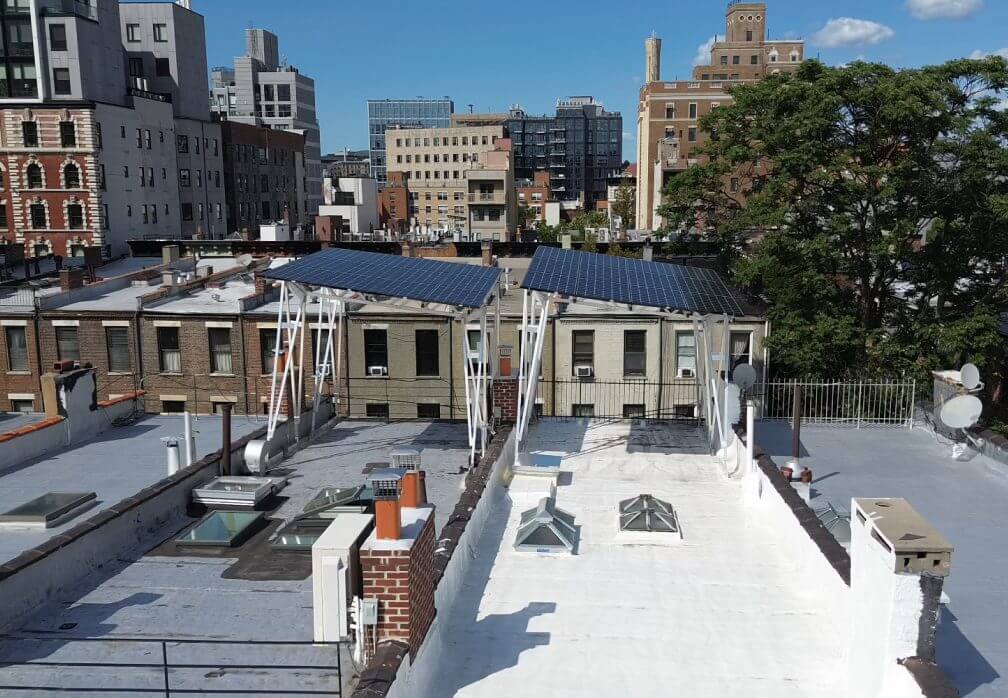
Two solar canopies in Harlem, New York.
-
Electricity Consumption
Your energy consumption plays a crucial role in determining the financial viability of solar power.
If your energy usage is low, many installers will tell you solar is not worth it because smaller-scale installations aren’t profitable for them. That doesn’t mean it isn’t profitable for you. At Brooklyn SolarWorks, we design custom solar systems for low-electricity homes that can cover 100% of your usage costs.
On the other hand, if you have high energy usage but limited roof space, it may also be challenging to achieve significant savings. Our systems are designed to maximize available space so you can generate more power, even on a small or crowded roof.
-
Building or Regulatory Restrictions
Depending on the type of home or building you live in, there may be some restrictions to consider.
- Condos & Co-ops – Boards and homeowner’s associations can complicate the decision-making process. We’ve installed solar on plenty of condos and co-ops and are happy to discuss concerns with decision makers.
- Landmarked & Historic Homes – NYC has strict regulations for landmarked buildings, where the solar installation cannot be visible from the street level. We install low-profile systems that meet code and make solar for historic homes in NYC possible.

How to Get Started with Solar Energy in NYC
Get Your Free Consultation
Schedule a free consultation with us to determine if your home is suitable for solar power. We’ll evaluate factors like sun exposure, roof space, and energy usage to provide a comprehensive assessment and see how much your home could save with solar.

Brooklyn SolarWorks site evaluators on a NYC rooftop!
Choose a Qualified Installer
New York City’s landscape for solar is unique compared to the rest of the country. This makes it essential to work with a reputable local installer who knows how to navigate the city’s strict regulations and building codes, rather than a national company. Choose Brooklyn SolarWorks to ensure a smooth and compliant installation process.
Go Solar in 2026 with NYC’s Local Experts
Ready to explore solar power for your home in New York City? Contact Brooklyn SolarWorks to find out if it’s a good candidate for solar energy. Our team of solar experts will guide you through the process, from assessment to installation, ensuring you collect all the solar benefits you can in New York City.
Call 929-977-0058 or schedule your free solar consultation today!
If you’re a Con Edison customer in New York City, going solar isn’t just possible—it’s easier than you might think, especially with an experienced local installer.
At Brooklyn SolarWorks, we specialize in solar panel installation for New York City rooftops and have connected thousands of systems to the Con Ed grid. We’ll handle the entire process for you, from submitting your interconnection application to coordinating the final inspections.
In this guide, we cover everything you need to know about going solar as a Con Ed customer.
What Happens When You Go Solar with Con Edison
When you go solar as a Con Edison customer, your solar panels—and your home—will be connected to the electric grid. This is called grid-tied solar.
You pay a basic service charge to maintain your grid connection, which means your bill will never be $0, even with solar panels (more on that below). The small charge, however, is worth it for two important reasons:
- It ensures that you always have access to electricity. At night, or if there’s ever a problem with your panels, you can buy power from the electric grid.
- It allows you to participate in net metering. Net metering is a billing arrangement that allows you to send the extra electricity your solar panels generate to the grid in exchange for credits on your bill. It’s like a virtual battery that lets you “store” the excess solar energy you produce to use at a later time. That means you’re benefiting from solar power even when your panels are not producing electricity.
The Con Edison Solar Interconnection Process
Getting connected to the Con Ed grid involves several steps. Our team will handle all of this for you, so you don’t have to worry too much about the details.
Here’s what the process includes:
- Interconnection Application – We submit a detailed application to Con Edison that includes your system design and electrical specs. This is required before we can begin installation.
- Inspection – Once your system is installed, Con Edison inspects it. We’ll schedule and facilitate the inspection for you.
- Permission to Operate (PTO) – After a successful inspection, you receive Permission to Operate. This is the final green light to turn your solar panels on.
Will My Solar Panels Work During a Con Ed Power Outage?
Unfortunately, your solar panels will not work during a Con Ed outage. All grid-tied solar panels shut down automatically during a power outage to prevent them from sending unexpected surges of electricity into the grid and putting utility workers at risk.
How Net Metering Works with Con Edison
Net metering is, essentially, selling solar-generated electricity to Con Ed in exchange for credits on your bill. When you generate more electricity than you need, it’s automatically sent to the grid. Then, when you need more than you produce, you take it from the grid. Your meter keeps track of what you take and what you send, and you pay the net difference every month.
Your credits roll over month to month, so you can bank them during the long, sunny summer days and use them to cover your higher electricity costs in the winter, when there’s less sunlight available for solar generation.
Where to Find Net Metering Information on Your Bill
Your net metering credits are tracked on your monthly Con Ed statement, under a section titled “Your Net Meter Summary.” You’ll see a log of credits for recent billing periods, the kWh you’re being billed for (if any—0 in the example below), and the total amount of credit being carried forward to the next billing period.

What’s the Customer Benefit Contribution (CBC) Charge?
In 2022, Con Ed introduced a new monthly fee for solar customers, called the Customer Benefit Contribution (CBC) charge.
This charge was implemented to ensure that solar customers contribute fairly to public benefit programs, including the Clean Energy Fund, utility energy efficiency programs, and utility low-income programs.
Your CBC charge is calculated based on your system’s size, and the rate varies by utility. In 2025, the CBC rate for Con Edison customers is $1.84 per kW a month. For a 7 kW system, that comes out to $12.88 a month.
Is Net Metering Going Away in New York City?
Because of the new CBC charge, as well as net metering changes in other states like California, there’s been some concern that net metering is going away in New York. Fortunately, this is not the case. Net metering is safe in NYC for the time being.
However, policy changes are always possible. If you’re interested in installing solar, your best bet is to do so now, before any potential changes are implemented. You’ll be locked into Con Ed’s current net metering policy for 20 years, so if net metering is eliminated in New York City in the coming years, your savings will be safe.
Reading Your Con Edison Bill After Installing Solar
As a Con Ed solar customer, you will still receive an electric bill every month. It will, however, be significantly lower.
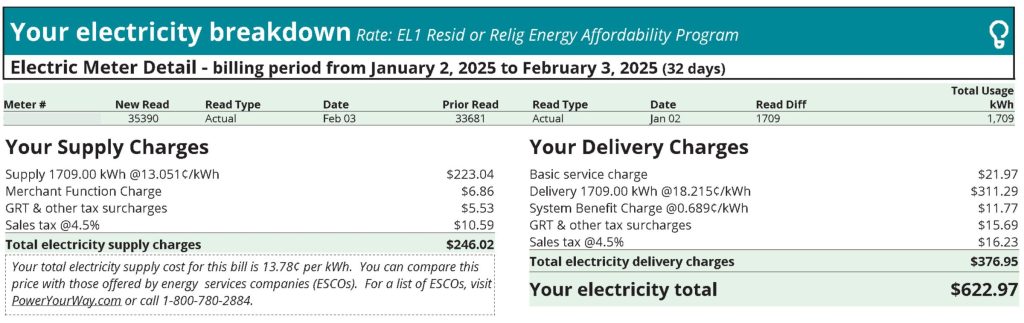
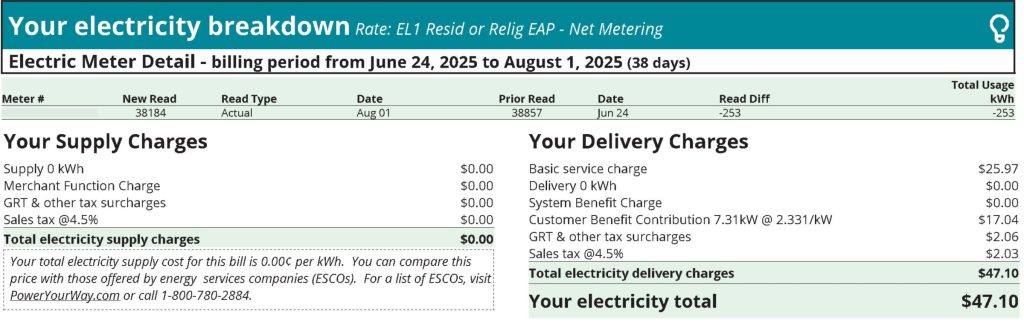
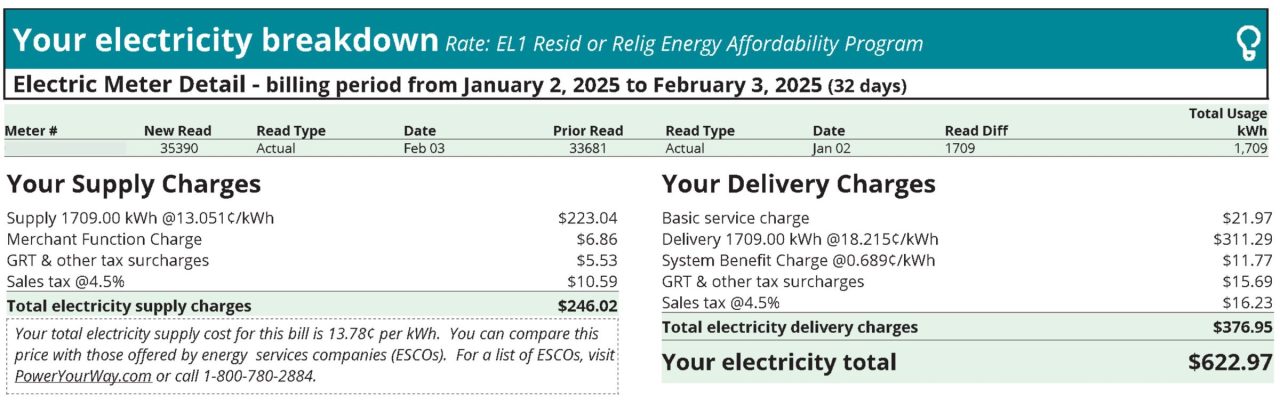
Here’s an example of an electric bill for a Brooklyn SolarWorks Customer before and after going solar. They still owe a small amount, but their total dropped from $622.97 before solar to just $47.10 after installing solar panels!
Why Do I Still Have Charges on My Con Ed Bill After Going Solar?
There are some charges that all Con Edison solar customers pay, even if you have solar panels. These include:
- Delivery charge – These charges cover the infrastructure costs of delivering electricity to and from your home. If your solar doesn’t fully offset your home’s usage and you’re pulling energy from the grid, you’ll pay this delivery fee at a set rate per kWh. Even though your solar system may cover most of your usage, you’re still connected to Con Edison’s grid and have to pay this fee.
- Customer Benefit Contribution (CBC) – This is a new charge that you’ll see on your bill after going solar. It’s a fixed monthly fee based on your system’s size that helps fund public energy programs.
- Basic Service charge – This is a type of delivery charge. It’s a standard monthly fee that connects you to the Con Ed grid and covers the cost of maintaining your electric account. It’s not based on how much electricity you use.
- Sales Taxes & other surcharges – These are also added to your bill as a percentage of any remaining charges on your bill.
- Supply Charges – This charge covers the cost of any electricity pulled from the grid. Think of it like the cost of the commodity “Energy,” whereas the delivery charges are the cost of bringing the energy to your home. If your solar doesn’t fully offset your home’s usage and you are pulling energy from the grid, you’ll pay this supply fee at a set rate per kWh.
Ready to Lower Your Con Ed Bill with Solar?
Electricity is already expensive, and rates are only going up. If you’re ready to take control of your Con Ed bill, reach out to Brooklyn SolarWorks today. We offer free, no-pressure consultations to help you decide whether solar panels make sense for your home in New York City.
Call 929-977-0058 or schedule your free solar consultation today.
Have you always wanted to install solar panels on your roof, but didn’t think it was possible in New York City?
For a long time, it wasn’t. Most city rooftops are flat and cluttered with obstacles like skylights and HVAC units, making traditional solar systems impossible to install. Strict fire codes add another layer of complexity, since standard solar setups block required fire paths.
At Brooklyn SolarWorks, we set out to make the impossible possible. We designed our patented solar canopy specifically for New York City homes. It lifts your solar panels up nine feet off your roof, meeting fire code and clearing obstacles while creating shaded, usable space underneath.
What Is a Solar Canopy?
A solar canopy is a raised structure that lifts solar panels above the surface of your roof. Unlike traditional solar arrays that are mounted directly on the roof, canopies elevate the panels to clear obstacles like HVAC units, hatches, and skylights while keeping your roof space open, shaded, and usable.
A solar panel canopy makes solar viable for flat city rooftops. But we wanted to make solar more than viable in New York City. We wanted to make it livable.
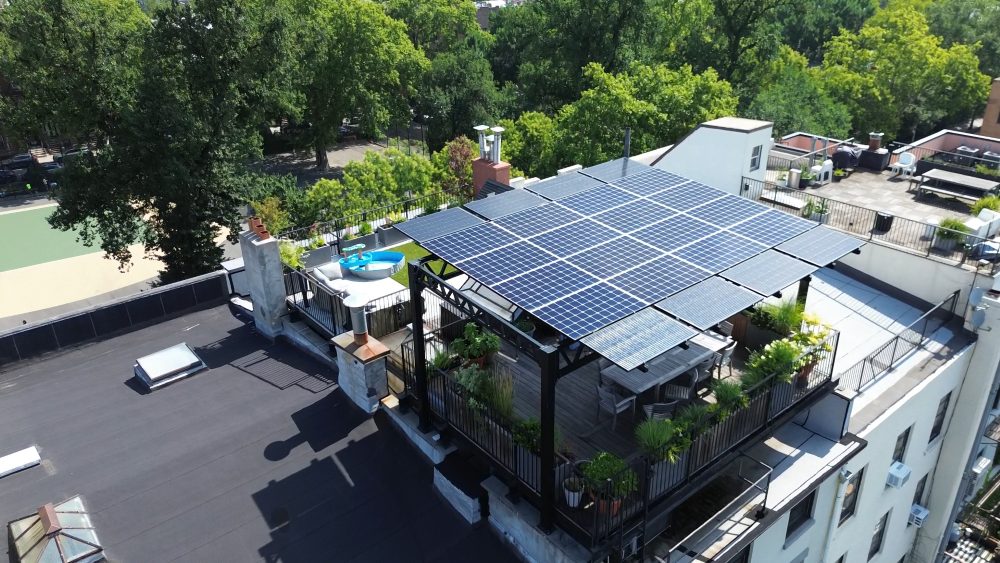
That’s why we designed our own residential solar canopy. Our patented design lifts your panels a full nine feet above your roof. That keeps fire paths clear, ensuring compliance with New York City building and fire codes, while giving you plenty of open space underneath. It’s also sleek, with fewer legs than alternatives, so it takes up less space and looks cleaner on your roof.
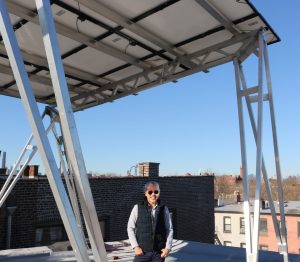
Want to see a solar canopy in action? Check out this canopy we installed on a Brooklyn brownstone to see how it transformed one homeowner’s roof.
What are the Benefits of a Rooftop Solar Canopy?
Our solar canopy makes rooftop solar possible for thousands of New Yorkers who otherwise couldn’t go solar.
Some of the biggest advantages include:
- Meeting Fire Safety Requirements – Our design complies with all NYC building and fire codes.
- Maximizing Solar Output & Savings – Elevated panels capture more sunlight, especially in the city where neighboring homes and buildings cast shade on your roof, helping you generate more power and increasing your electric bill savings.
- Keeping Your Roof Usable – With the panels raised overhead, your rooftop stays open for lounging, gardening, or hosting.
- Creating Shade – The canopy provides shade, making your rooftop even more enjoyable in the heat of the summer.
- Meeting Fire Safety Requirements – Our design complies with all NYC building and fire codes.
- Protecting Your Aesthetics – With sleek, clean lines, your solar canopy looks like an intentional design feature.
Is a Solar Canopy a Good Fit for Your Home in NYC?
Solar roof canopies are ideal for:
Flat Roofs
Solar canopies are ideal for houses with flat roofs. If you live in a brownstone, a townhouse, or a rowhouse, a solar canopy is likely your best option for solar panel installation. They’re also great for larger buildings, like co-ops and condos.
Rooftop Patios & Gardens
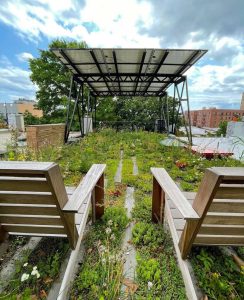
If you use your roof as a garden, patio, or outdoor living space, a solar canopy keeps it open and usable. Instead of losing your rooftop to solar panels, you gain shade and shelter while still producing clean energy.
Crowded Rooftops
Obstacles like HVAC equipment and skylights can make it impossible to install traditional solar panels. By lifting your panels up off the ground, a solar canopy easily clears these obstacles.
Dense Neighborhoods
In the city, houses and buildings are close together. It’s common for neighboring buildings to cast shade on your roof. If that’s your situation, a solar canopy can lift your panels up into a better position to capture sunlight.
FAQs About Solar Canopies
How Much Does a Solar Canopy Cost?
Our solar installation costs vary depending on many factors, including the size of the canopy and the complexity of the installation. In most cases, NY solar incentives will cover about 50% of your costs. If your home is Landmarked, the incentives can be even higher. Roof replacement is also covered by solar incentives in some cases. We’re happy to offer a free, personalized estimate. Request yours today!
Are Solar Canopies Worth It?
A residential solar canopy can significantly reduce your electricity costs by generating renewable energy for your home. It sits high above your roof, avoiding shade from neighboring buildings and maximizing your solar output. Over time, your savings will pay for the cost of your installation. After that, all the electricity they generate is free. For most NYC homeowners, the benefits are worth it. But the best way to know for sure is to speak with one of our solar consultants. They’ll evaluate your home and recommend the solar options that work best for your roof, budget, and energy needs.
Do Solar Canopies Qualify for Rebates?
Yes! Solar panel canopies are eligible for the same rebates and incentives that traditional rooftop solar panels qualify for. In New York City, incentives can cover about 50% of your upfront costs. Learn more about the local incentives you may qualify for.
Ready to Get Started with Solar in NYC?
Your roof doesn’t have to stop you from going solar! With a solar canopy, you can keep your roofspace usable and code-compliant while reaping the benefits of solar energy.
At Brooklyn SolarWorks, we make solar work where it was once considered impossible. We’ve installed thousands of solar energy systems throughout all five boroughs and can find a solution for almost any rooftop in the city.
Call 929-977-0058 or schedule your free consultation today and find out if a solar canopy is the key to making solar work for your home.
Thinking about installing solar panels for your home in New York City? With the right team by your side, it’s a seamless process.
At Brooklyn SolarWorks, we specialize in solar system installation for brownstones, townhouses, condos, and co-ops in New York City. Our team handles everything, from permitting and approvals to installation and inspections, making your transition to solar energy easy and stress-free.
This guide will walk you through every step of the solar installation process so you know exactly what to expect.
Step-by-Step Solar Installation Process
1. Free Assessment
The first step is a free, virtual assessment. During this call, one of our specialists will see if your home is a good fit for solar. We’ll discuss your electricity needs, tax incentives, financing options, and answer any other questions you have. Having your energy bill handy will be helpful during this call to get a sense of your energy needs.
2. Custom Proposal
We’ll create a custom proposal for your solar system, tailored to your home and electricity needs. You’ll learn how much electricity your solar panels will generate and what your expected payback period is. You’ll also see design details so you can visualize what your panels will look like on your roof. When you’re ready, you’ll sign a Letter of Intent and submit a refundable deposit to kick off your project!
3. Site Visit
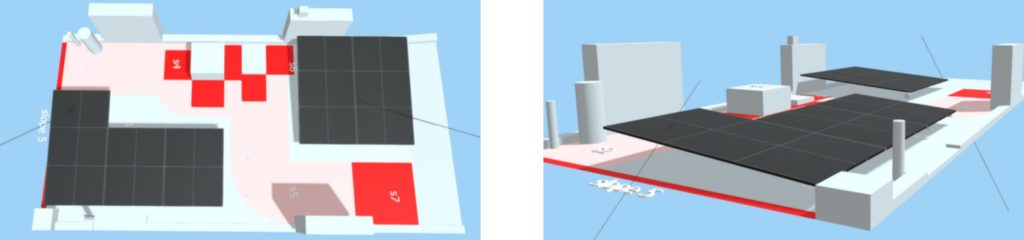
We will visit your home to do a quick in-person site visit to check for any changes we may need to make to the original design. We will also complete an in-depth engineering review to make sure that the system we design is compliant with FDNY regulations and DOB permitting regulations.
4. Final Design & Contract
With the information from the site visit, we will finalize the design and your financing options. When you’re ready to move forward, you’ll sign a contract, and we can begin permitting! At this stage, you will be assigned a project manager who will guide you every step of the way from permitting to installation and inspection.
5. Permitting
To go solar in New York City, you need building and electrical permits from the Department of Buildings. We handle this entire process for you.
If your home is landmarked, you’ll also need approval from the Landmarks Preservation Commission. We’ll handle this process for you as well. We’ve installed solar panels on hundreds of landmarked and historic homes with strategic designs like low-profile tilt racks that keep your solar panels invisible from the street.
Our customer portal tracks the entire permitting process, so you can follow along easily.
6. Installation
Our in-house team will arrive at the scheduled time to install your solar panels. We’ll need access to your roof, basement, and yard space for this step of the process. We work efficiently and complete most installations in just one day.
Once installation is complete, your system will be turned on and begin producing clean power right away. At this point, you’ll receive your final invoice.
7. Inspections
Although your system is already producing electricity after installation, it can’t receive net metering credits until it passes inspection with the Department of Buildings (DOB). We’ll handle scheduling and be present for the inspection day so you won’t need to worry. Once your system is approved with “Permission to Operate,” it can be interconnected with the electric grid.
At this stage, your home will start to benefit from net metering, which lets you bank kWh credits with ConEd so you can save on energy at night and in the winter months when the sun isn’t shining.
8. Tax Season
You claim your federal and New York state solar tax credits when you file your taxes for the year you install your solar panels. We’ll provide the forms and documentation you need, and recommend that you bring these to a tax professional. We will also file your NY Tax Abatement automatically for you, so you have one less thing to worry about.
Heads Up! The federal solar tax credit is expiring at the end of 2025. Time is running out to start your installation in time to claim your 30% credit. Don’t miss out on the opportunity—schedule your free consultation with Brooklyn SolarWorks today.
How Long Does It Take to Install Solar Panels?
We complete most residential installations in just one day. If your project is complex, it might take 2-3 days. The entire solar panel process typically takes about 3 months to complete. Most of this time is spent on permitting. The installation itself is quick.
What Happens After You Install Solar Panels?
Once your solar installation is complete, there isn’t much for you to worry about. Solar panels are low-maintenance and work behind the scenes to generate clean electricity for your home without much oversight.
Here’s what you can expect post-solar panel installation in New York City.
Immediate Electric Bill Savings
Before Installing Solar: January 2025 Electricity Bill with $622.97 Charge
After Installing Solar: July 2025 Electricity Bill with $47.10 Charge
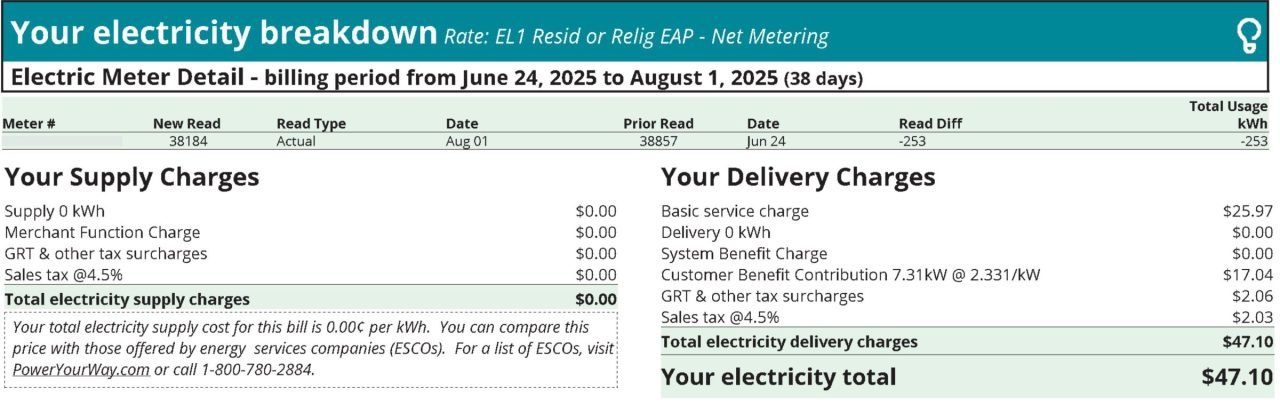
Your solar panels will start generating electricity as soon as we turn the system on. They’ll power your home directly, reducing the amount of electricity you have to buy from Con Ed and saving you money every month.
Any excess electricity your panels generate will be sent to the electric grid. A bi-directional electric meter keeps track of the power you send to the grid so you can receive your net metering credits. These credits offset the cost of electricity you buy from Con Ed when your solar panels are not producing electricity.
Easy System Monitoring
We’ll set your system up for monitoring the same day we install it. You can monitor your system in real time from any device with a WiFi connection. You’ll be able to see how much electricity you’re generating and, if a problem arises, you’ll be notified right away.
Long-Term Warranty Protection & Production Guarantee
We back your solar system installation with an industry leading 30-year warranty. Plus, we provide a 10-year production guarantee for added peace of mind. If your solar panels produce less than we promised, we’ll pay you the Con Ed rate for the difference for a full ten years.
Take the first step toward cleaner, more affordable electricity. Call 929-977-0058 or schedule a free assessment today.
If you’re planning a new building or major renovation in New York City, integrating solar is a smart move with long-term financial and environmental benefits. And, in some cases, it’s required by law.
At Brooklyn SolarWorks, we work directly with architects and project teams to design solar energy systems that integrate seamlessly with your plans, right from the start.
This guide covers everything you need to know to successfully incorporate solar into your next project.
Planning for Solar—When to Start and What to Expect
When to Bring on a Solar Partner
When it comes to solar panels for new construction and major renovations, our advice is: start early.
Bringing a solar design consultant to the table during the early planning stages allows you to integrate solar directly into the roof design. The result is a high-performing, code-compliant system that maximizes energy output and long-term savings.
If you wait too long to consider solar system design, you could end up having to work around avoidable issues like poorly placed HVAC equipment or bulkheads that eat up roof space and limit your solar options. You’re also more likely to run into permitting and approvals issues when you start late, which can result in expensive delays and rework.
What to Expect During the Design & Installation Process
Solar design and installation can fit smoothly into your workflow, especially with the right partner. At Brooklyn SolarWorks, we operate as an extension of your project team, coordinating directly with general contractors, engineers, and trades.
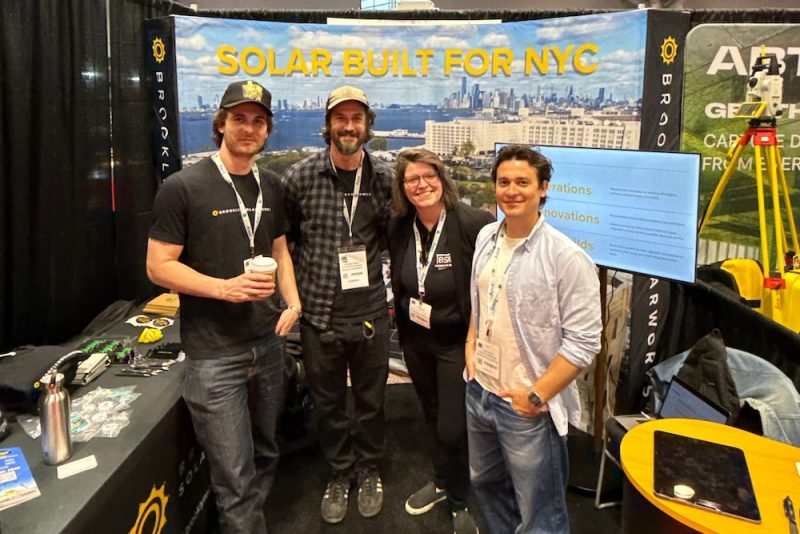
The Brooklyn SolarWorks Specialty Projects team at the NY Build Expo 2025
Here’s what you can expect:
- Assessment & Proposal – Our team will assess your plans and create a tailored proposal.
- Project Initiation – We’ll host a virtual kickoff with key stakeholders to align on design details, timelines, and expectations.
- Drafting & Permitting – We’ll draft the solar plan set, prepare and submit your permit application to the NYC Department of Buildings, and conduct site visits to confirm key dimensions.
- Site Preparation – We’ll prepare the roof for solar installation with internal conduits and roof attachments before insulation and the final roof membrane are installed.
- Installation – We’ll coordinate with your team to schedule installation, which typically takes 1 to 5 days.
- Inspections & Commissioning – During the electrical inspection, our team will confirm system commissioning and WiFi connectivity for monitoring.
- Project Sign Off – We’ll file for final approvals with Con Edison, NYSERDA, and the NYC Department of Buildings. Typically takes 6–8 weeks, or 8–10 weeks for landmarked properties.
- Tax Season – We’ll provide the necessary forms so the owner can claim their solar incentives when filing with their accountant. *Heads up, federal tax credits are expiring soon. Encourage your clients to start now if they want to claim valuable incentives.
Solar Requirements for New Construction & Renovations in NYC
New York City has enacted a series of climate laws that require solar panels or electrification for most new and renovated buildings. Navigating the requirements and how to best meet them can be challenging, but Brooklyn SolarWorks makes it easy. We have unmatched permitting and code expertise and will make sure your project is compliant from the start, preventing costly setbacks.
Here’s what’s currently required in NYC:
- Local Laws 92 & 94: Require that most new buildings and roof replacements include either solar or a green roof.
- Local Law 97: Sets emissions limits for buildings over 25,000 square feet. Installing solar panels is one of the easiest ways towards local law 97 compliance.
- Local Law 154: Mandates that new buildings be fully electric. Solar is the most affordable way to power electric appliances and is ideal for all-electric buildings. This law went into effect for buildings under seven stories in 2024 and will be required for taller structures starting in 2027.
Solar Design Options That Work in New York City
Worried that solar won’t work with your building design? The right system can blend in beautifully. We install custom solutions that complement your project’s architecture and can even be hidden from street view.
Take a look at what’s possible:
Solar Canopies
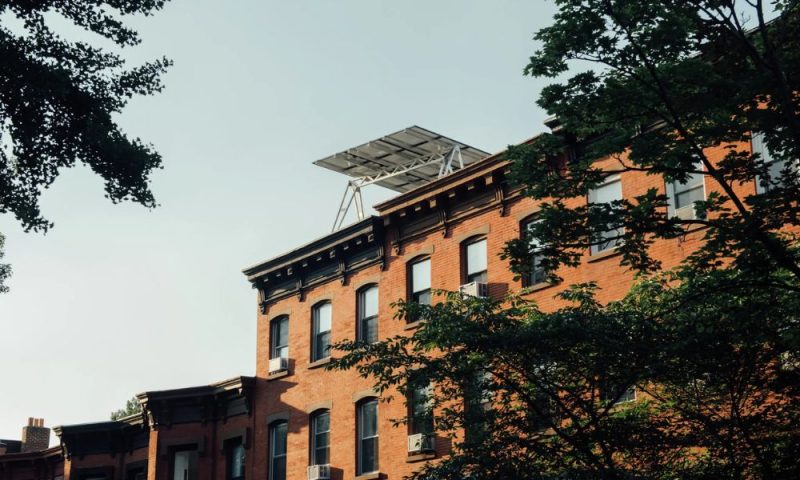
Our patented, award-winning Solar Canopy elevates solar panels nine feet above the roof. This design adheres to fire path requirements while creating shaded, usable roof space underneath the panels. Plus, it’s sleek, with fewer legs and cleaner lines than bulky alternatives.
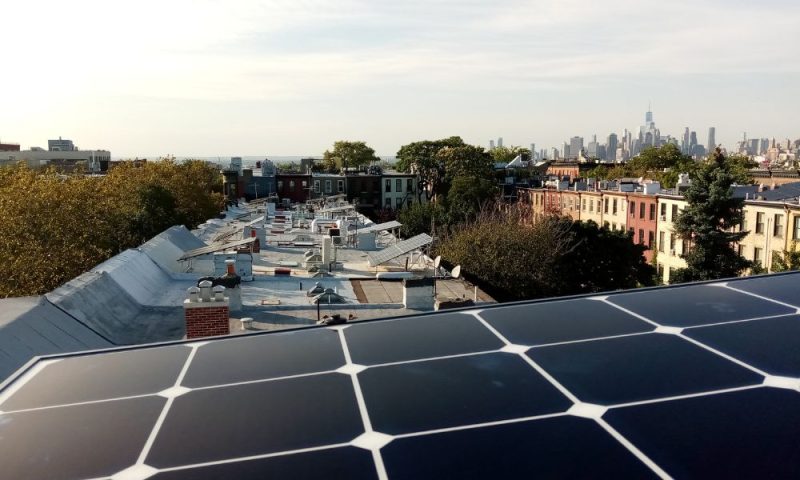
Tilt Racks
Tilt racks are ideal for projects that require a low-profile design that’s invisible from street level. If you’re building or renovating in a landmarked or historic area, tilt racks are a great option.
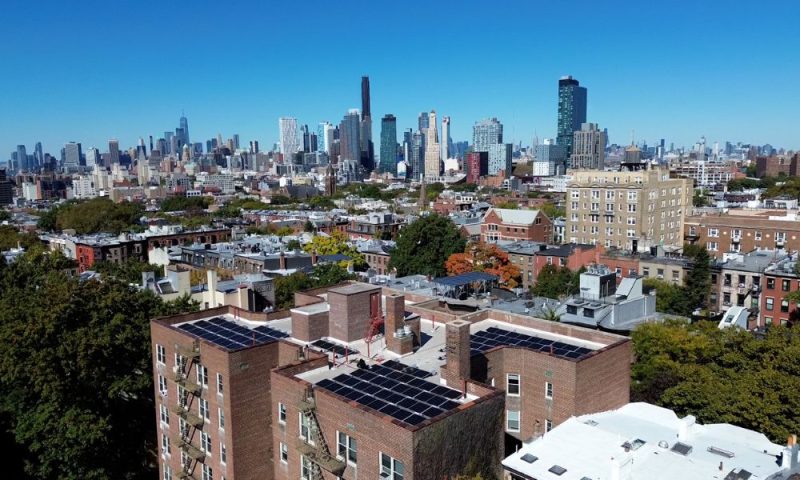
Ballast Mounts
Ballast mounts are a non-penetrating option that uses weight instead of roof anchors. They’re typically best for large roofs with a lot of open space.
Ready to Get Started?
Brooklyn SolarWorks is more than a solar installer. We’re a partner you can trust to manage solar requirements, so you and your clients can focus on the bigger picture. Let’s talk early so we can set your project up for success.
Call 929-977-0058 to learn more or schedule a free solar consultation today!
In New York City, rooftops work hard. They double as gardens, store HVAC equipment, and provide emergency access for firefighters. Can they really do all that and support solar panels?
Absolutely—with the right design.
At Brooklyn SolarWorks, we design custom home solar solutions specifically for NYC roofs. We work around (and above) challenges to make solar not just possible, but practical for city homes.
If you’re thinking about installing rooftop solar in NYC, we wrote this guide for you. It covers everything you need to know about your design options, permitting requirements, and the installation process.
Rooftop Solar Design Options for NYC Homes
Rooftop solar installation in NYC is complicated for a few reasons:
- Your roof may be flat with limited space or obstructions like skylights
- You have to meet strict code and fire safety requirements
- Your home may be in a historic neighborhood with strict aesthetic standards
At Brooklyn SolarWorks, we embrace these challenges and design custom solutions to overcome them. Our team will survey your roof and recommend the best fit, which could be:
Solar Canopies

Solar canopies make solar viable for most flat roofs. We install our own, patented canopy that we designed specifically for NYC rooftops. It raises your solar panels nine feet above your roof, meeting fire code requirements while creating shaded, usable space underneath.
Solar canopies are ideal for homes with flat roofs, including:
- Brownstones
- Townhouses
- Rowhouses
See a solar canopy in action! This Brooklyn brownstone is offsetting 93% of its electricity usage with a custom solar canopy installed by Brooklyn SolarWorks.
Tilt Racks
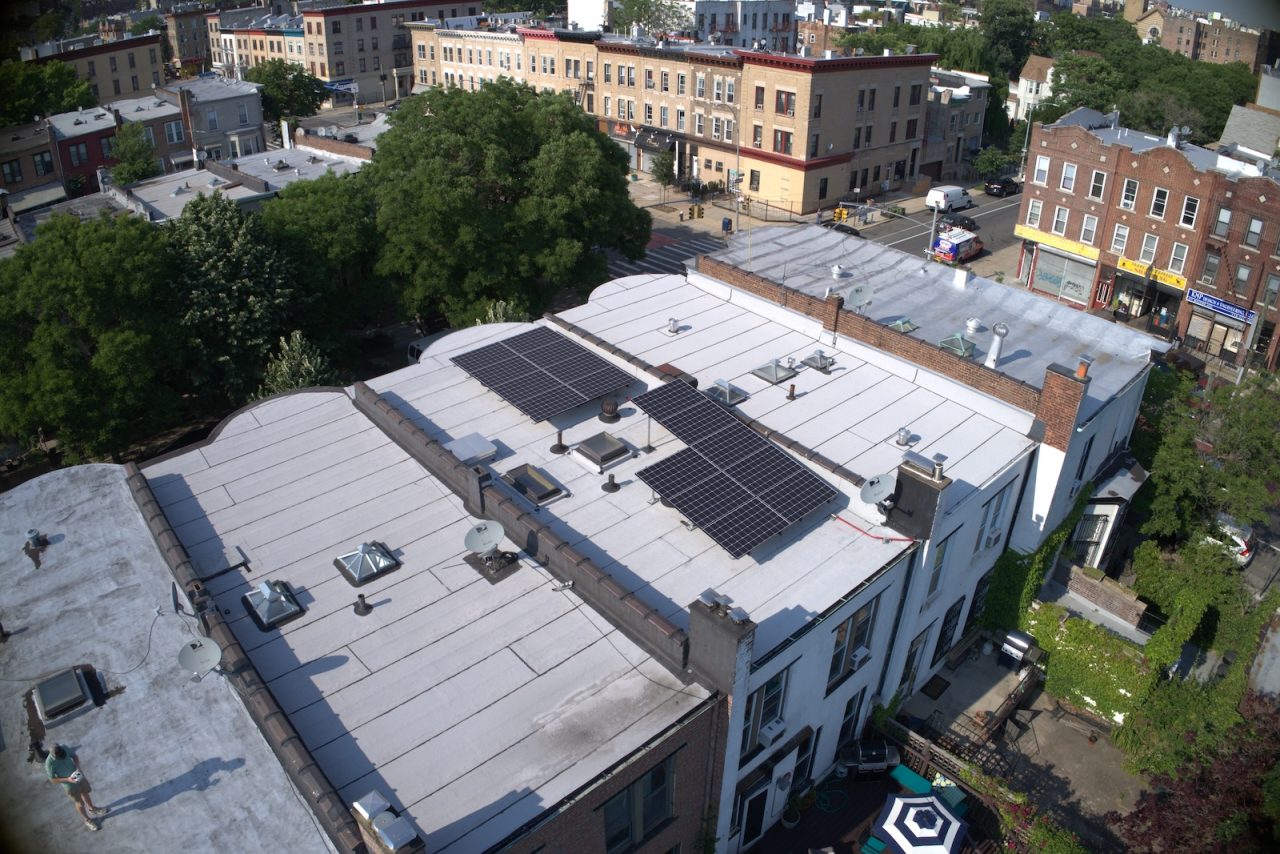
Tilt racks allow us to mount solar panels at a specific angle, creating better sunlight access on a flat roof. The tilt racks we install are discreet and low-profile, making them almost invisible from street level. To keep fire paths clear, we split the arrays into sections.
Tilt racks can be a great option for:
- Flat roofs
- Historic and landmarked homes
- Co-ops and condos
Ballasted Solar Panels
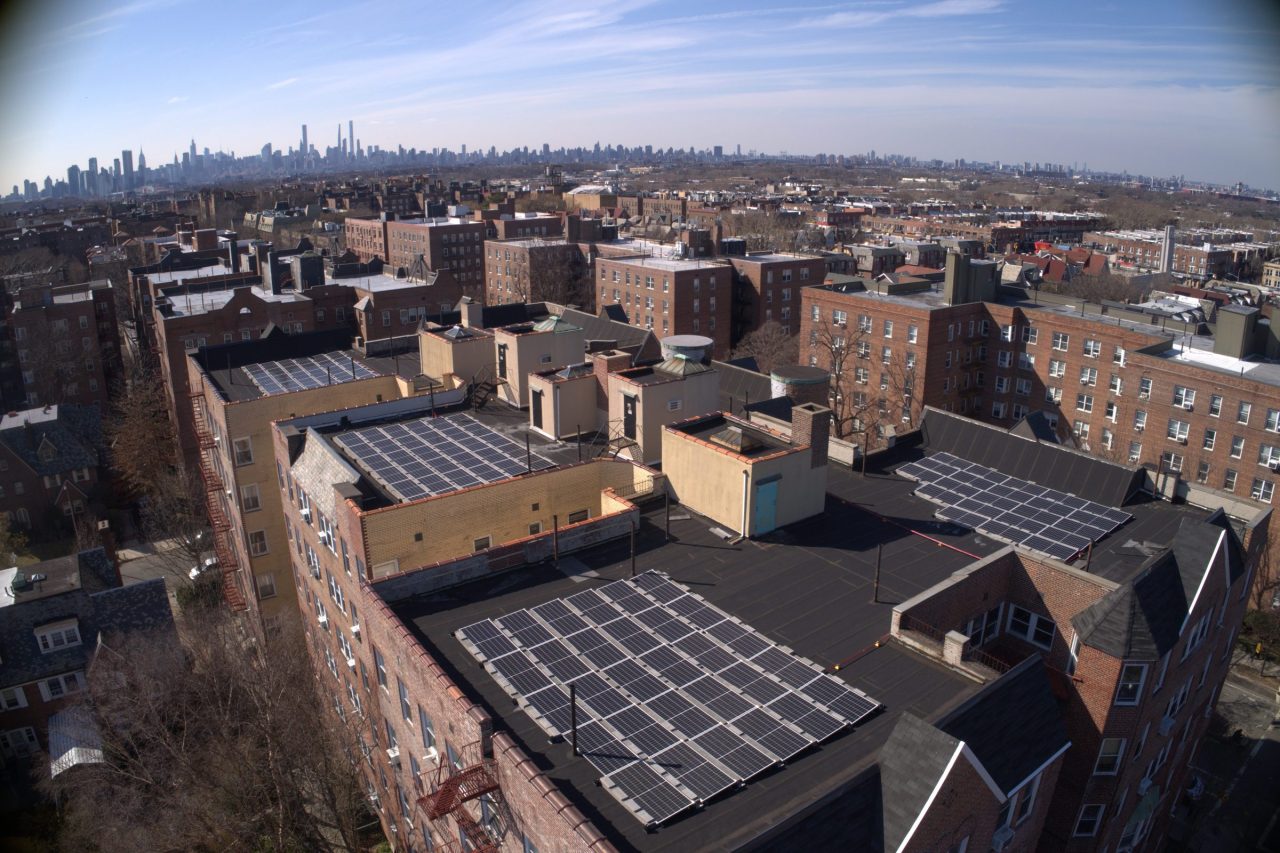
Ballasted systems use weighted bases to secure solar panels to the roof, instead of bolting them in. This method is non-invasive with minimal roof penetrations needed.
Ballasted solar systems are ideal for:
- Large flat roofs
- Multi-family buildings
- Co-ops and condos
Traditional Solar Mounts
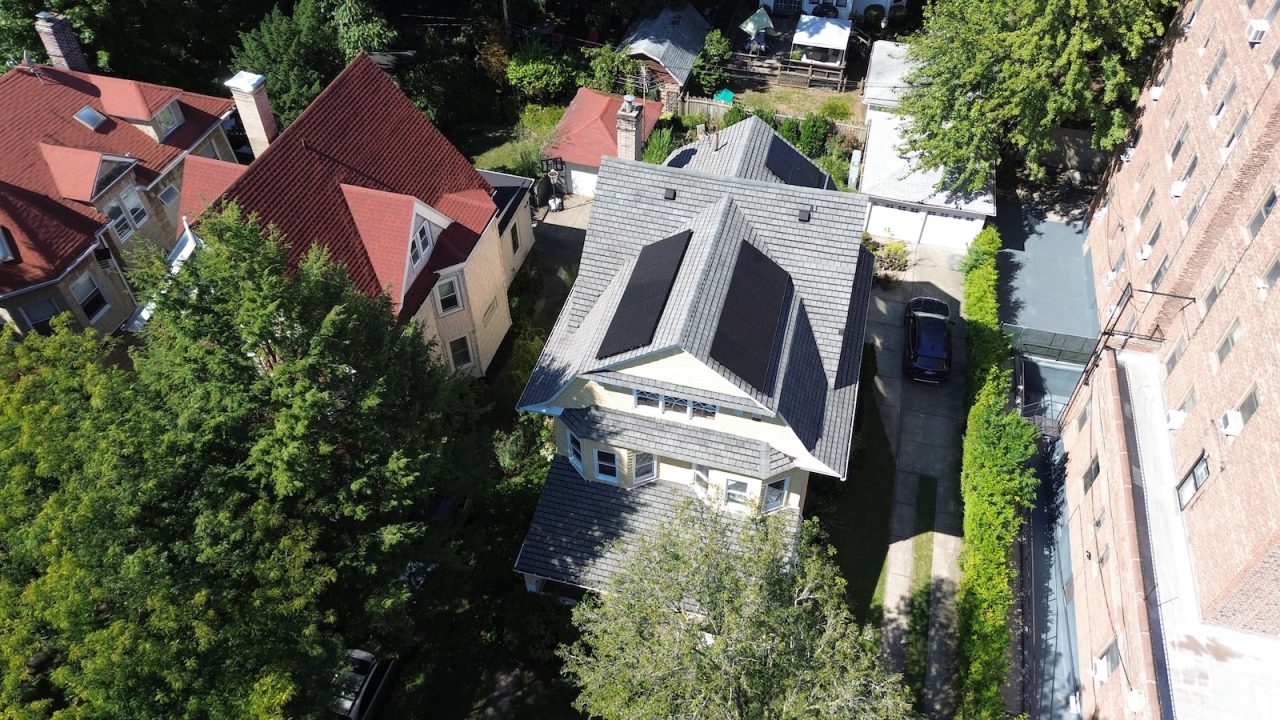
If you have a pitched roof, a standard solar mounting system is likely the best fit. Standard mounts allow us to install solar panels flush with your roof’s surface for a sleek, unobtrusive look.
Traditional solar mounts are best for:
- Pitched or sloped roofs
What to Expect During the Installation Process
Going solar with Brooklyn SolarWorks is a streamlined process completed by our in-house, Brooklyn-based team.
Here’s what you can expect during the solar installation process:
- Free Consultation – Start with a free consultation and to learn more about rooftop solar and whether it’s a good fit for your home.
- Assessment – We assess your roof and gather the information needed to design your system using satellite imagery and digital tools.
- Proposal – You’ll receive a custom solar design and project proposal to review.
- Contract & Permitting – Once you sign, we handle all city permits and keep you updated throughout the process.
- Installation – Most installations are completed in just 1 day by our in-house installation team.
- Inspections – We’ll handle final inspections with the Department of Buildings and Con Edison. Then, we’ll turn your system on!
- 24/7 Monitoring – We monitor your system 24/7 to ensure performance. You can also track performance through your personal monitoring portal.
- Guaranteed Production – We back your system with an industry-leading, 30-year warranty. And, we guarantee production for 10 years. If your system fails to perform as expected, we’ll pay you the full Con Ed rate to make up the difference.
Solar Permitting Requirements in New York City
Installing rooftop solar in NYC means working with some of the most complex building codes in the country.
We’ve spent years mastering the city’s codes, zoning laws, and permitting requirements. Our team handles the entire process, and you can easily track progress through your customer portal.
Here’s a basic overview of what’s required.
Department of Building Permits
Every solar project in NYC must be approved by the Department of Buildings (DOB). As a local New York City solar installer, we know city code inside and out. We’ll make sure your installation is compliant and obtain all the necessary permits for your project.
Landmarks Preservation Commission Permit
If your home is in a historic district or landmarked, you’ll need an extra layer of approval from the Landmarks Preservation Commission (LPC). Our team has worked on over 600 landmarked homes, and we know how to design systems that meet LPC guidelines.
Utility Interconnection Approval
Before we can turn your system on, it must be approved by Con Edison and connected to the electric grid. This process, called interconnection, ensures your system is safely connected to the grid and set up for net metering. We’ll manage interconnection from start to finish, including submitting all necessary documentation and coordinating inspections with Con Ed.
Solar Net Metering with Con Edison
Net metering is one of the best incentives for rooftop solar in NYC. Here’s how it works:
- As a residential solar customer of Con Edison, your house will remain connected to the electric grid.
- When your solar panels produce extra electricity that your house doesn’t need, the excess is sent to the grid.
- Con Edison credits you for the electricity you send to the grid.
- You can use your credit to offset the cost of electricity you buy from the grid at night, when your solar panels can’t produce electricity.
In New York, we’re lucky to have 1:1 net metering. That means Con Ed credits you at the full retail rate for the electricity you send to the grid.
See if Rooftop Solar Panels Make Sense for Your Home
New York City is a great place to go solar, and Brooklyn SolarWorks makes it easy. We offer free consultations and can help you decide whether rooftop solar is a good fit for your home.
Get started with a free consultation for rooftop solar installation in New York City. Call 929-977-0058 or schedule now!

New York City is notorious for being expensive, and electricity costs are no different. But if your utility bills from Con Edison have been higher than usual, you’re not alone. Over the past couple years, Con Ed has been charging New Yorkers more and more for electricity, regardless of their usage.
Here’s the deal about why your Con Edison bill is so high, and what you can do about it.
Brief History of Con Ed Energy Costs in NYC
Across the country, utility rates have been rising. In 2022, consumers across the U.S. paid an average of 14.3% more for electricity compared to 2021. Meanwhile, Con Edison customers saw a 22% increase on their electric bills from the winter of 2021 to the winter of 2022.
New York City has some of the highest energy prices in the country, with New Yorkers paying an average of 35-40% more for electricity despite being relatively energy efficient.

If you pay an electric bill in NYC, we don’t have to tell you that Con Ed’s rates have been increasing for years. In 2021, the average bill for a residential customer was $73.11, and in 2022, it was $84.10.
The rate hikes over the last few years have been a result of not only volatile market conditions, but also Con Ed’s operating costs being passed on to customers. The costs associated with maintaining electrical infrastructure and with delivering energy to a densely populated area are high, and they continue to grow as the electric grid requires further upgrades.
Are you a homeowner in NYC looking to reduce your energy costs?
How does Con Edison’s billing system work?
To understand why your bill might be higher than usual, it’s important to first understand the two main charges on your bill: supply and delivery.

Your Supply Charges
The supply charge is the cost Con Ed pays for the energy it transports to you. Neither Con Ed nor the PSC sets these rates, as they’re subject to the energy market as a whole. Con Ed sells energy to you at cost – it’s not legally allowed to profit from the sale of electricity.
In January and February of 2022, many New Yorkers saw a huge increase in their monthly bills. This particular spike was due to a sudden increase in supply charges, not delivery. Around 70% of the electricity used in NYC is powered by natural gas, which has been more expensive for the past couple years due to the pandemic and the war in Ukraine.
Although it wasn’t all Con Ed’s fault, Governor Kathy Hochul called on the utility to reform its communication and billing practices after the burden of this surge fell on customers who were already financially strained due to the pandemic.
Your Delivery Charges
The delivery charge is the cost of transporting energy into your home and is regulated by the Public Service Commission (PSC).
Although Con Ed’s not allowed to profit from the supply of electricity, it can raise its delivery rate. Con Ed has been raising its rates for years, and will continue to do so in the future:
- In 2020, the PSC approved a three-year incremental increase in electric rates totaling 13.5%.
- In February of 2022, Con Ed requested another increase of 11.2% starting in 2023.
- In July of 2023, the PSC approved three more increases, beginning with a 9.1% increase in August and followed by two more increases in 2024 and 2025.
- In January of 2025, Con Ed has proposed a new price increase of 11.4% that will start on Jan. 1, 2026 if passed.
The reasoning behind these increases is to cover Con Ed’s capital investments and infrastructure upgrades and invest in clean energy initiatives.
Interested in clean energy for your home? We can help!
Why are energy bills so high right now?
In July 2023, the PSC approved another round of rate increases for Con Ed. Beginning in August, residential customers can expect their electric bills to be 9.1% higher. In January 2024, bills will increase 4.2%, then 1.4% in January 2025.
This bill increase comes at the tail end of the hottest summer on record, while the next one is scheduled for the dead of winter (when energy bills already tend to be high).
Are these soaring electric costs here to stay?
One thing is clear: the cost of electricity is on the rise across the board, and major rate hikes are bound to happen again. The price of natural gas will always rise and fall with supply and demand, and it’s evident that Con Ed has no plans to end its rate hikes. Unfortunately, this won’t be the last time that you’ll be left wondering why your Con Edison bill is so high.
If you’re tired of surprise bills, solar could be the solution for you!
How can New Yorkers combat high electric bills?
If you feel like electricity costs are out of your control, you’re not alone. The solutions can vary greatly depending on your home and income level. But no matter your situation, there are some things you can consider doing to help offset your energy usage and monthly bills.

1. Invest in Solar Energy
As a solar installation company, we would be remiss not to mention solar energy as a solution to combating electric bills.
If you’re a homeowner in NYC, installing solar on your roof is the single best way to cut down on your electric bill. Many of our customers’ systems produce enough energy to eliminate their electricity charges altogether, paying Con Ed nothing other than a basic service charge (see below). After your solar panel installation, your energy costs will become more predictable and you’ll be able to avoid sudden rate hikes.

See how much you could save with home solar!
But we recognize that not everyone has the ability to invest in rooftop solar. There are other ways to incorporate solar into your life. For example, our friends at Grouphug Solar created a solar panel window charger that’s perfect for that south-facing window in your apartment.
2. Use Energy Efficient Appliances
When it comes to the energy consumption of household appliances, the solution is not always clean cut. Appliances responsible for heating, cooling, refrigeration, hot water heating, and laundry are huge energy users, but they’re also necessities. So what’s the solution?
Investing in energy efficient appliances can make a big difference in your home’s energy usage and therefore, your electricity bill — especially when paired with solar. If you own a home, installing all-electric, efficient appliances like these could make a big impact:
- Air source heat pump
- Heat pump water heater
- Energy Star washing machines and refrigerators
- Energy efficient lighting, window AC units, fans, and more

3. Consider Your Everyday Usage
Regardless of home situation or budget, there’s a lot of little things we can all do to be more conscious of our energy consumption. Here’s a few small ways you can make a difference in your usage everyday:
- Turn off lights and appliances when they’re not in use and when you’re not at home.
- Be mindful of the temperature you keep your home. According to NYSERDA, each degree above 75°F that you set your air conditioner’s thermostat saves you 3 percent of the energy used to cool your home.
- Take advantage of insulation and shades to keep your home warm and cold naturally.
- Run your dishwasher in the morning or evening to avoid adding to electricity demand in the middle of the day.
- Wash your laundry in cold water, and opt to air dry your garments.
4. Consider a Payment Plan or Financial Assistance
Con Edison offers financial assistance for customers who are unable to pay their bills. Contact Con Ed to learn about the following programs:
- Level Payment Plans: allow you to spread your payments evenly over the year.
- Payment Agreement: helps you to pay down your outstanding balance.
- Energy Affordability Program: you may qualify for a discount on your bills if you receive certain government benefits.
- Payment Extensions: allows you to extend your payment due date.
Does Con Edison have sustainability initiatives?
Con Edison has been developing sustainability initiatives for several years. In 2021, it committed to 100% clean electricity by 2040. To that end, it has made progress towards the electrification of buildings and transportation, and building out numerous solar and wind projects across the country.
We’re glad that one of NYC’s main utility companies is committing to sustainability goals, as any progress towards clean energy is positive in the long run. But, these initiatives will translate to higher and higher bills from Con Ed for years to come.
You can avoid the continued volatility of Con Ed bills by installing solar on your home. By investing in your own solar energy system, you’ll be able to take advantage of clean energy right away – no waiting on Con Ed to make its system upgrades, and no unexpected rate hikes in the meantime.
Rooftop solar gives you energy independence. Why pay Con Ed for clean energy in the future, when you could produce it in your own home right now?
If You’ve Been Considering Solar, The Time is Now
The cost of energy in NYC has been on the rise for years, and will continue to grow in the future. If you own a home in NYC, installing solar on your roof will allow you to avoid increasing electric rates for decades to come – just one of the many advantages of solar energy!
Start saving with solar!
In 2015, Brooklyn SolarWorks landed in Gowanus with a mission to bring innovative and affordable solar to the rooftops of NYC. We’ve overcome barriers to develop industry-leading approaches to permitting, design, and installation that are specifically adapted to New York City.
Now, solar power is transforming how New York City’s co-ops manage energy costs and sustainability goals. With rising utility rates and strict carbon emission laws like Local Law 97, co-op owners are increasingly exploring solar as a way to reduce expenses, boost property values, and ensure compliance with local regulations.
This guide provides everything you need to know about solar energy for NYC co-ops, from roof compatibility and installation options to navigating NYC building codes and financial incentives.
Background of Solar in NYC
For many years, solar contractors in the area embraced installation methods and system designs that were not developed for the typical New York City building. Unlike the NYC suburbs, buildings here in the city have many unique features, such as:
- Surrounding buildings
- Skylights
- Hatches
- HVAC equipment
- Required FDNY fire paths
Despite NYC’s dense urban landscape, innovative solar solutions such as canopies, tilt racks, and ballasted systems have made it possible to maximize solar potential on flat and limited rooftop spaces. As more co-ops recognize the long-term benefits of solar, the closer the city grows towards its climate goals of reaching net-zero carbon emissions by 2050.
How to Know if Your Roof is Compatible with Solar
Not all roofs are ideal for solar installations. For co-op owners, determining roof compatibility is a crucial first step. Key factors include:
- Workable Roof Size and Space: Larger roofs provide economies of scale and better ROI.
- Structural Integrity: The roof must support the additional weight of solar panels.
- Roof Condition: Older or damaged roofs may need repairs or replacement before installation.
- Shading: South-facing roofs with minimal shading yield the best results.
In order to know for sure if your roof is fit for solar, it is important to get the roof surveyed by a certified solar professional.
Want to know if your building is compatible with solar? Schedule a free consultation today!
Solar Design Options
Installing solar in New York City– especially those with obstructions like hatches, skylights, and required FDNY fire paths – requires a bit more creativity than other solar designs. Luckily we have created multiple design options for co-op solar installations, depending on their roof structure and needs:
Canopy

The Brooklyn Solar Canopy is a revolutionary design tailored for NYC’s flat roofs. This award-winning innovative structure elevates solar panels above roof obstructions and fire safety paths while creating usable rooftop spaces for amenities like green roofs or decks. Its functional and aesthetic appeal has made it a favorite for co-ops, offering a way to maximize energy generation without sacrificing usability. It’s so popular that we now distribute our solar canopy to other installers all over the country through a separate company, Brooklyn Solar Canopy Co.
Tilt Rack

Tilt rack systems are ideal for flat roofs where a canopy may not fit the building’s aesthetic or functional goals. These systems elevate panels at an optimal angle to capture sunlight while maintaining proximity to the roof. By allowing flexibility in panel placement, tilt racks work around obstructions like vents or skylights, ensuring maximum energy production.
Ballasted

For buildings seeking a non-invasive approach, ballasted systems offer an excellent solution. These designs use weighted mounts to secure the panels without penetrating the roof, preserving its integrity while ensuring stability.
Traditional Solar Panel Installation

Traditional solar designs for pitched and sloped roofs integrate solar panels seamlessly with the roof. Panels are installed flush with the roof surface, providing a streamlined appearance. This option works best for co-ops with traditionally sloped roofs and ample sunlight exposure.
Financial Benefits of Solar for NYC Co-ops
Solar energy provides co-ops with substantial long-term financial advantages that go beyond just energy savings. By investing in solar, co-op owners can take control of their energy costs, protect against rate hikes, and increase property value while benefiting from low maintenance costs and incentives.
How Solar Protects Against Utility Rate Hikes in NYC
Utility rates in NYC have consistently risen over the years, with no signs of slowing down. By switching to solar, co-ops can shield themselves from unpredictable Con Edison rate hikes. Solar systems generate clean, renewable energy on-site, allowing buildings to offset their reliance on grid power. This not only stabilizes energy costs but also locks in predictable savings for the next 25–30 years, ensuring financial security for co-op owners.
Low Maintenance Costs of Solar Systems
One of the most appealing aspects of solar energy is its low maintenance requirements. Modern solar systems are designed for durability and longevity, requiring minimal upkeep throughout their lifespan.
To ensure your solar system is at peak performance, Brooklyn SolarWorks provides a 24/7 monitoring system as part of our warranty package. Our team actively monitors our entire fleet of solar systems on a regular basis, and are alerted in case of any irregularities in system functionality. System owners also have access to monitor their panels as well.
Additionally, Brooklyn SolarWorks includes an industry leading 30-year total system warranty AND a power production guarantee, minimizing out-of-pocket expenses for co-ops. This low-maintenance advantage ensures co-op owners enjoy consistent energy savings without added hassle.
Boosting Property Value with Solar Energy
According to an April 2019 study by Zillow.com solar homes sell on average at 4.1% higher than comparable homes without solar. The study also found that the solar boost was higher in the NYC metro area than the national average, topping out at 5.4%. That’s an extra $23,989 in value for solar property owners in the five boroughs. The study corroborated similar findings of an early report funded by the U.S. Department of Energy.
Co-op buildings with solar energy systems are more marketable and competitive in NYC’s real estate landscape, offering long-term benefits that far outweigh the initial investment. For co-op owners, solar provides a unique opportunity to enhance their property’s financial and environmental appeal.
Want to learn more about the benefits of solar? Schedule a free consultation today and start saving for decades to come!
Solar Panel Installation Cost
Determining the cost of a solar panel installation for NYC co-ops depends on multiple factors, making it more complex than in other regions. Factors such as roof type, system size, incentives, and energy consumption patterns all play a role in shaping the final price. Unlike other areas, where pricing may be more standardized, NYC’s unique urban environment and stringent regulations require specialized solar design solutions.
NYC’s solar market stands out as one of the most incentivized in the country. Programs like NYSERDA rebates and a property tax abatement collectively cover around 50% of a system’s cost. On top of these incentives, some NYC buildings (including HDFC co-ops) qualify for additional rebates. These robust financial incentives make solar a feasible investment for many co-ops, allowing them to transition to renewable energy without bearing a significant upfront financial burden.
Although the initial cost may seem high, it’s crucial to view solar as a long-term investment. Solar installations not only reduce utility bills but also increase property value over time. For co-ops in NYC, the payback period typically ranges from 4 to 6 years, and the cumulative energy savings can exceed $150,000 over the system’s lifespan. These benefits, combined with the ability to avoid penalties under Local Law 97, make solar an increasingly popular choice among NYC co-ops.
For a personalized estimate and to explore incentives specific to your co-op, schedule a free consultation today.
Navigating NYC Building Codes and Solar Installation Regulations
New York City’s building codes and regulations can feel overwhelming, but understanding these requirements is essential for a smooth and successful solar installation process. From carbon emission laws to permitting procedures, NYC co-op owners must address several key factors before proceeding with solar.
Complying with Local Law 97
Local Law 97 is a critical regulation that sets strict carbon emission limits for NYC buildings larger than 25,000 square feet. Under this law, co-ops that fail to reduce emissions below the defined limits may face significant financial penalties.
Solar energy provides a practical solution by reducing reliance on fossil fuels and lowering emissions. By installing solar panels, co-ops can offset their energy usage, achieve compliance with Local Law 97, and avoid steep fines while improving their building’s overall sustainability.
How Roof Warranties and Building Codes Affect Solar Installations
Roof warranties are a common concern for co-ops considering solar. Solar panel installations must be designed and implemented carefully to ensure the roof warranty remains intact. That’s why we offer non-invasive solutions, such as ballasted systems, that avoid roof penetrations while maintaining structural stability.
Additionally, NYC building codes require solar installations to meet strict safety, fire, and structural standards. Working with experienced local installers ensures compliance with these codes and minimizes the risk of costly delays or issues all while getting the best solar system possible.
Addressing Permitting Challenges
The permitting process can be complex and time-consuming. Luckily, we’ve created a turn-key business model, meaning it’s on us, the installer, to manage all permits and permissions on behalf of the customer with the city, Con Edison, and all other entities. Because of the time it takes to permit a project, the installation process takes about 4-6 months to complete from contract signing. During that time, the customer is required to do almost nothing until the day of the installation.

How to Bring Solar Power to Your Co-op Board
Installing solar on your co-op building will require approval from all of the decision-makers in your building. Bringing solar power to your co-op board will involve careful preparation and clear communication about how solar will benefit residents.
Educate Your Co-op Board on Solar Benefits
Start by educating the board about the benefits of solar energy, both financial and environmental. Emphasize how solar can reduce operating costs, protect against rising utility rates, and help the building comply with Local Law 97 to avoid penalties.
Present Financial Data to Stakeholders
To build support, present detailed ROI and payback period data that demonstrate the financial feasibility of solar installations. Highlight that the average payback period in NYC is just 4–6 years (compared to the national average of 7-10 years) and that co-ops can save $5,000–$10,000 annually on energy costs.
Understand Incentives that Make Solar More Accessible for Co-ops
Financing is often a key concern for co-op boards. Luckily, NY solar incentives can help cover around 50% of the total system cost come tax season.
By presenting a comprehensive case and addressing potential concerns, you can successfully bring solar power to your co-op board and move toward a more sustainable and cost-effective energy solution.
If you need help gathering this data, schedule a free consultation with us today. We are always excited and ready to present to a Co-op board! Start the conversation.
Solar Story: David, Park Slope
Meet David, Treasurer of his 8-unit co-op in Park Slope, Brooklyn. He shares how going solar with Brooklyn SolarWorks not only helps the environment but also provides significant savings to residents of his building. With the help of state incentives and expert analysis, David’s co-op saved 81% of the initial installation costs, and the financial benefits have exceeded expectations. Watch his full story to learn how solar power is transforming his building and helping them save on energy costs. 💡
How to Choose the Right Solar Installer
Selecting the right solar installer is a critical step in ensuring a successful transition to renewable energy for your co-op. Unlike typical home improvement projects, solar installations in NYC require expertise not only in solar technology but also in navigating the city’s complex building codes, permitting processes, and unique structural challenges.
A reliable solar installer should offer more than just high-quality products; they should act as a partner throughout the entire process. From the initial consultation and feasibility studies to securing permits and completing the installation, your chosen provider must demonstrate a thorough understanding of NYC’s specific requirements. Look for companies with a proven track record in urban solar installations and an in-depth knowledge of local laws, such as Local Law 97.
We’ve built our business from top to bottom to do all of these things for each and every customer of ours – contact us today!
Solar Warranty and Maintenance
When you invest in a solar system, you want assurance that it will perform reliably for years to come. That’s why reputable solar installers offer robust warranties and straightforward maintenance processes. At Brooklyn SolarWorks, all our systems come with a comprehensive 30-year warranty, covering panels, inverters, and overall system performance. We even include a production guarantee, ensuring that if your system underperforms, you’ll receive compensation for the lost savings.

Surprisingly, solar panels require minimal maintenance thanks to their durable, low-maintenance design. With no moving parts, the risk of mechanical failure is virtually eliminated. Panels are typically angled to allow rainwater to naturally wash away dirt and debris, so you don’t need to worry about regular cleaning. If you choose to clean them, avoid abrasive tools or detergents that could scratch the glass.
Snow removal is also unnecessary, as most systems are designed to handle winter weather conditions. Snow naturally melts or slides off, and the minimal power loss during snowy periods is not worth the risk of climbing onto an icy rooftop.
There’s not much you’ll need to do for solar panel maintenance. Solar systems are equipped with remote monitoring, allowing you and your installer to track performance effortlessly. This hands-off maintenance approach ensures that you can enjoy decades of clean, cost-effective energy without the hassle.
FAQs About Solar Energy for NYC Co-op Owners
Co-op owners often have many questions about the logistics, costs, and benefits of solar energy. Here are answers to the most common inquiries to help guide your decision-making process.
What does solar installation cost for co-ops?
The cost of installing solar panels for co-ops varies based on factors like system size, roof type, and energy consumption. However, NYC co-ops benefit from a variety of incentives, including NYSERDA rebates and property tax abatements, which can significantly reduce upfront costs around 50%. On average, co-ops in New York City can expect a payback period of 4–6 years, making solar a highly cost-effective investment.
What incentives are available to NYC co-op owners?
NYC co-ops have access to generous incentives that make solar installations more affordable. The NYSERDA rebate is one of the most significant, with commercial buildings receiving rebates up to four times higher than residential properties. Additionally, co-ops can take advantage of the NYC’s property tax abatement, further lowering the overall investment.
How does solar installation impact the roof?
Co-op owners often worry about how solar panels will affect their roofs. Fortunately, modern installation techniques, such as ballasted systems, are designed to preserve roof integrity by avoiding penetrations. Most solar providers also offer roof warranties to ensure the roof remains protected throughout the system’s lifespan. In fact, solar panels can extend a roof’s lifespan by shielding it from weather and UV exposure.
Get Started with Solar for Your NYC Co-op
Taking the leap toward solar energy for your NYC co-op is not just an investment in cost savings; it’s a commitment to sustainability, resilience, and forward-thinking property management. From compliance with Local Law 97 to long-term financial stability and increased property value, solar power offers so many benefits that make it a smart, impactful choice for co-op owners across the city.
If you’re looking to install solar on your New York City co-op, trust an expert. Brooklyn SolarWorks has been designing and building innovative solar systems for NYC since 2015, with over 3,000 complete projects.
Ready to get started? Schedule your free consultation.
In New York City, the drive toward carbon neutrality has reshaped building regulations to prioritize energy efficiency and renewable energy. A key part of this initiative is the requirement for new construction to incorporate solar panels or green roofs, as mandated by Local Laws 92 and 94.
While existing buildings are not universally required to install solar panels, those undergoing major roof alterations may be subject to these requirements. Read on to see what this could mean for your NYC property.
Understanding NYC Building Codes and Solar Panel Mandates for New Construction
New York City has taken bold steps toward reducing greenhouse gas emissions and achieving carbon neutrality by 2050. To support these goals, the city has implemented a series of forward-thinking building codes designed to promote sustainability and energy efficiency. Among these measures, solar panel and green roof mandates stand out as pivotal requirements for new construction and major roof renovations.

By requiring the installation of solar photovoltaic systems, green roofs, or a combination of the two, these codes not only enhance energy efficiency but also help mitigate the urban heat island effect, improve stormwater management, and reduce overall building emissions. These initiatives reflect the city’s commitment to creating a more sustainable urban environment while encouraging property owners and developers to adopt greener building practices.
Understanding how these mandates apply to various building types and roof conditions is critical for compliance. With solar panels playing a key role in these regulations, developers and property owners must navigate complex requirements to align their projects with NYC’s sustainability objectives.
Key NYC Building Codes Mandating Solar Panels
While other building codes focus on broader energy efficiency measures, Local Laws 92 and 94 are the cornerstone regulations in New York City requiring solar panel and/or green roof installation. These laws aim to reduce the city’s carbon footprint, improve energy efficiency, and combat the urban heat island effect. Let’s look at the requirements, applications, and exceptions under these important local laws.
Local Laws 92 and 94
Enacted in 2019, Local Laws 92 and 94 require that the roofs of certain buildings be partially covered with green roofs or solar photovoltaic electricity-generating systems. These laws apply to new buildings and to existing buildings undergoing major roof renovations, aiming to enhance energy efficiency and reduce urban heat island effects.
Compliance is critical, as projects cannot obtain a Certificate of Occupancy without a related and code-compliant solar application.
When do Solar Panel Requirements Apply?
LL 92 and 94 mandated that beginning November 15, 2019, all new buildings and roof replacements in NYC must install a solar photovoltaic system or green roof (or a combination of the two). There are some exceptions and different requirements based on the size, classification, and slope of the roof.

- For continuous roof area greater than 200 square feet (100 square feet or more in Group R buildings up to five stories), and a slope below 2:12
- A solar system, green roof, or a combination of both, must be installed.
- If the solar power capacity cannot reach 4 kW due to conditions like shading, a green roof is the only option.
- A minimum solar panel efficiency of 15% must be used for all calculations.
- For continuous roof area of less than 200 square feet (less than 100 square feet in Group R buildings up to five stories), and a slope below 2:12
- A solar system reaching 4 kW must cover the entire area
- If solar capacity cannot be reached, the entire area must be covered by a green roof
- A combination of a solar PV system and green roof is not allowed
- Continuous roof area with a slope higher than 2:12
- A solar PV system is the only option because the slope is too great for a green roof
- However, if a solar capacity of 4 kW cannot be reached, that roof section is exempt from LL92/94
Exceptions to LL 92 and 94
The requirements of this law apply to all new roof installations in the city and are based on the square footage of “continuous” or available space on the roof. In some cases, a roof or sections of a roof may be exempt from the requirements of these laws. Here are some exceptions:
- If the slope of the roof is greater than 2:12 and a solar system would not reach a capacity of 4 kW
- Too much of the roof area is occupied by other structures such as water towers, mechanical equipment, or stormwater management systems
- The roof is already occupied by recreational spaces
- If you’re making simple repairs to your roof, rather than replacing it altogether
Other Local Energy Efficiency Mandates
While Local Laws 92 and 94 explicitly require solar panels for certain buildings, there are other building codes in New York City where the use of solar can help property managers comply and avoid fines.
Local Law 97
Local Law 97 limits greenhouse gas emissions for buildings over 25,000 square feet. In accordance with city goals, these buildings must reduce their emissions by 40% by 2030, and by 80% by 2050.To comply with Local Law 97, you’ll likely need to make some energy efficient improvements to your building. This could include:
- Electrifying your HVAC systems and hot water heating with heat pumps
- Installing solar to power your building
- Retrofitting your common area lighting
- Improving your wall and roof insulation
- Installing an energy management system

Local Law 154
Local Law 154, also known as the “All-Electric Building Act,” mandates that new buildings in New York City utilize electric heating and appliances, effectively prohibiting the use of fossil fuels in most new construction.
As of 2024, new buildings under seven stories must not use fossil fuels for heating, hot water, cooking, or other energy needs. By 2027, these requirements will extend to larger buildings over seven stories.
While clean energy isn’t required to comply with this law, it can help. By pairing building electrification with solar energy, you can significantly cut down on operating costs and increase your building’s energy efficiency. Planning for solar during the design phase not only ensures compliance but also allows you to capitalize on renewable energy incentives and long-term savings.
Key Rules and Regulations for NYC Solar Installations
Navigating the rules for solar installations in New York City requires careful attention to building codes and regulations to ensure compliance while maximizing energy efficiency. Proper planning and early collaboration with solar consultants can streamline the process and prevent costly design changes or delays. As a solar installation firm in NYC, here are some of the factors that we need to consider.
Fire Safety Codes and Solar Panel Placement
The New York City Fire Code specifies requirements for rooftop access and ventilation pathways to ensure firefighter safety.

Collaboration between architects and solar specialists early into the planning process ensures maximum solar output while meeting fire code requirements.
Looking to design a code-compliant building in NYC? Submit your design today and see what solar can do for you!
Meeting Minimum Efficiency Standards
Solar installations must meet specific efficiency standards as outlined in the New York City Energy Conservation Code. This includes considerations for system performance, energy output, and overall contribution to the building’s energy efficiency.
Managing Shading and Lot Line Considerations
Proper placement of solar panels is crucial to maximize energy production. Installations must account for potential shading from adjacent structures and comply with zoning regulations related to lot lines and building heights.
Historic District and Specialty Building Restrictions
Buildings located within historic districts or those with landmark status may face additional restrictions on solar installations. Approvals from the Landmarks Preservation Commission are often required to ensure that solar panels do not compromise the building’s historic character.
Ensuring Compliance with Mandates and Smooth Solar Installations
Meeting NYC’s solar mandates requires strategic planning and expert guidance. Proper integration of solar systems not only ensures compliance with building codes but also enhances project efficiency and sustainability. Here are some critical steps and considerations for achieving seamless and code-compliant solar installations in New York City.
Planning Rooftop Layouts for Solar Compliance
Effective designs accommodate fire codes, structural integrity, and solar optimization. Early planning minimizes costly revisions later in the design stages.
Key Milestones for Including Solar Consultants
Bringing solar consultants on early in the design process ensures that solar integration aligns with architectural plans, structural considerations, and regulatory requirements.
Navigating the NYC Department of Buildings Approval Process
The Department of Buildings requires permits for solar installations, including electrical and construction permits. Compliance with building codes, zoning laws, and safety regulations is essential for approval. Missteps can delay projects significantly.
That’s why we recommend working with a solar installer – like us – who not only specializes in permitting solar projects in NYC, but handles it all on your behalf. Submit a solar design request today!
Solutions for Solar Installations in Dense Urban Environments
In urban settings, innovative solutions such as solar canopies, tilt racks, and ballasted systems can overcome space constraints and maximize energy generation.
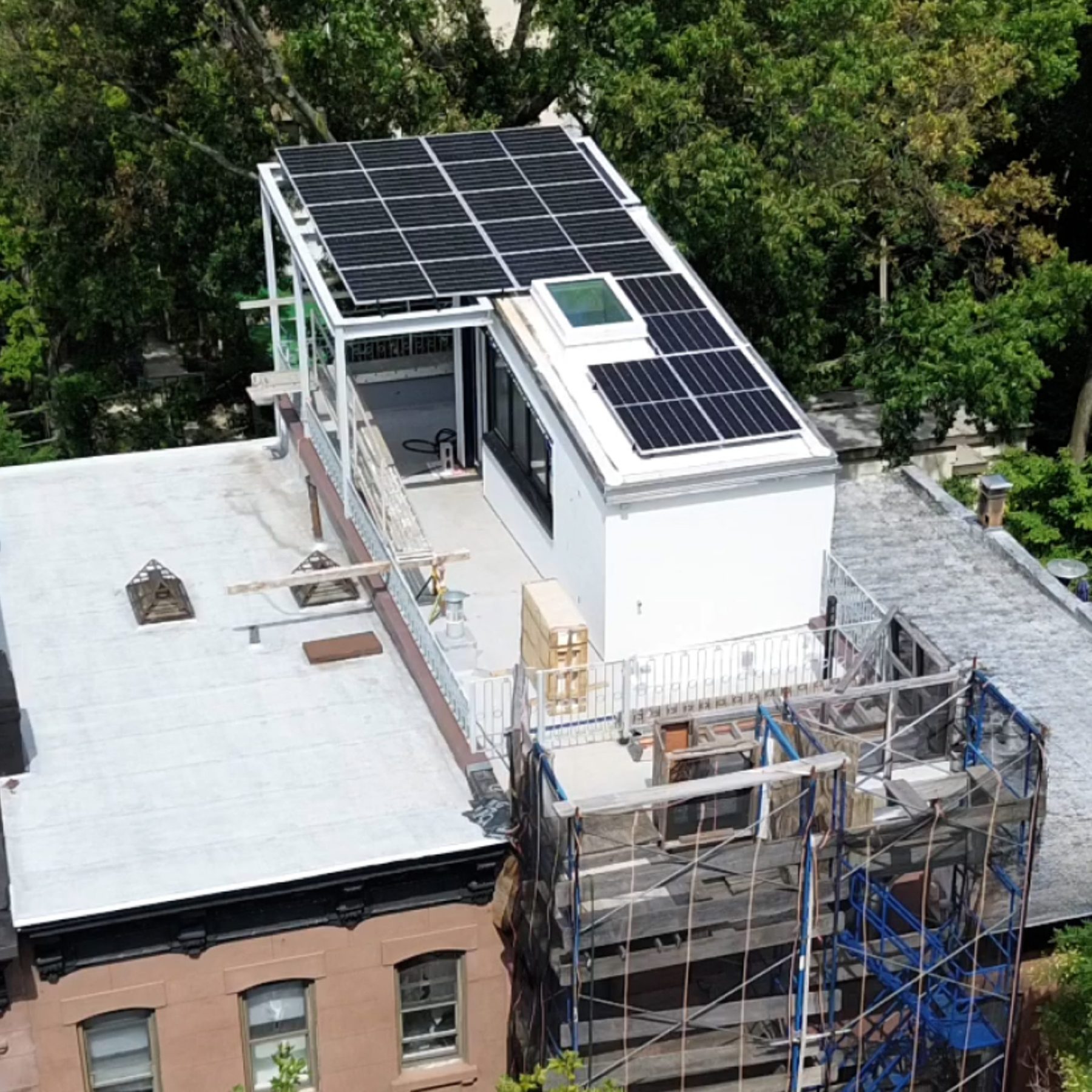
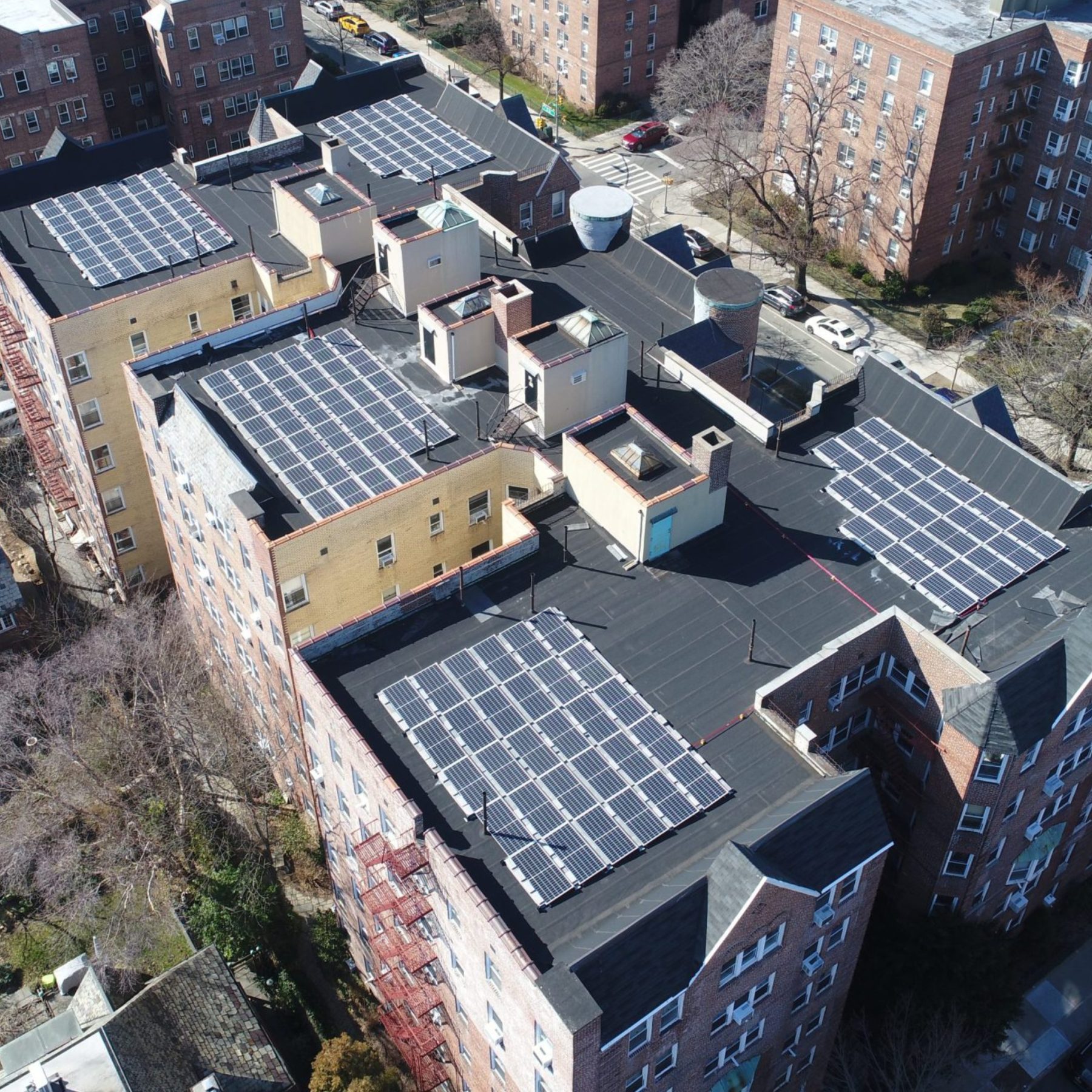
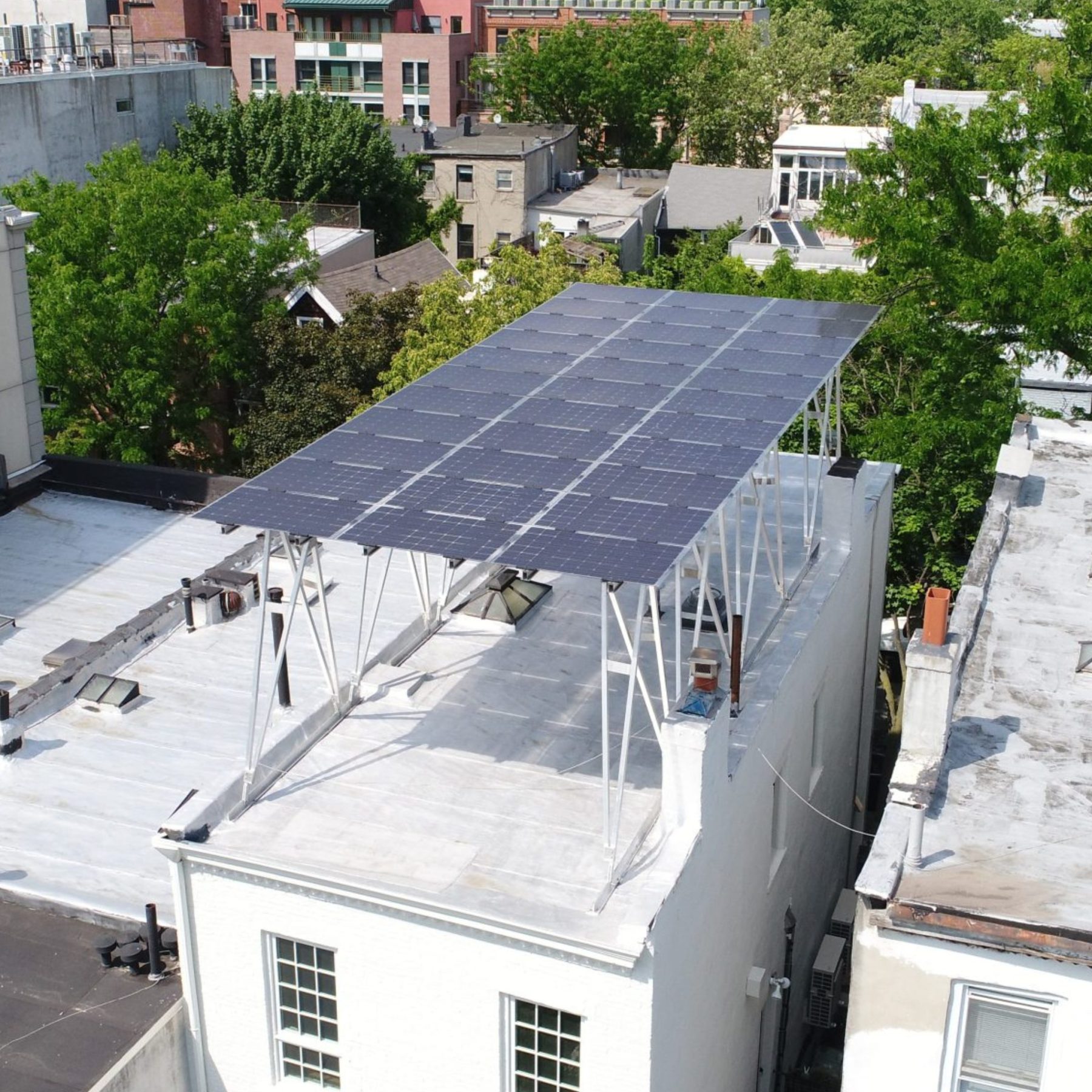
Frequently Asked Questions About Solar Regulations
What is Zoning Compliance and How does NYC’s City of Yes Initiative Impact Solar Projects?
Zoning compliance involves adhering to regulations that dictate land use, building size, and placement. The City of Yes initiative aims to modernize zoning laws to facilitate sustainable development, potentially easing restrictions on solar installations and promoting renewable energy adoption. The City of Yes initiative allows for a 15-foot rise clearance for solar on flat roofs, creating easier integration while addressing zoning limitations.
How do Solar Panels Impact Structural and Electrical Design?
Installing solar panels adds weight to a building’s roof and requires integration with its electrical system. Structural assessments are necessary to ensure the roof can support the additional load, and electrical designs must accommodate the new energy inputs safely.
For new building designs, we highly recommend getting in touch with a local solar specialist as soon as possible. This will allow for code-compliant building designs with the best integration plan. Submit your building design for free today!
Do Solar Systems Require a lot of Cleaning and Maintenance?
A common misconception is that solar panels require extensive maintenance. In reality, they are designed to be low-maintenance. You don’t need to clean your panels. Your solar array is angled so that rainwater can run off naturally, taking with it any build up and debris. If you do choose to clean your panels, however, avoid harsh detergents and metal or hard plastic brushes that could scratch the glass.
You also don’t need to clean snow off of your panels and we don’t recommend it. The power you may miss out on during a snowstorm is minimal. It’s not worth risking a trip up to an icy rooftop.
Integrate Solar into Your New Building Plans with Local Experts
Collaborating with local solar experts who understand New York City’s specific regulations and incentives can streamline the process of integrating solar energy systems into new building projects, ensuring compliance and optimizing both financial and environmental benefits.
Do you need solar options for your next project? Submit a design request to our team today.
Switching to solar power in New York City offers homeowners a unique opportunity to save on energy costs while contributing to a greener city. With substantial incentives, evolving technologies, and a growing focus on sustainability, New Yorkers are discovering that solar power can be both a smart investment and a positive environmental choice.
Read on to explore the rise of solar power in NYC, the landscape of urban solar installations, and a real-life case study of a Brooklyn household that has experienced the benefits of solar energy over six years, achieving significant savings and energy independence.
The Rise of Solar Power in New York
The appeal of solar power in New York is rising, especially in light of recent Con Edison rate hikes. In 2023, Con Edison implemented multiple rate increases, with residential electricity costs rising by 9.1%, and further hikes anticipated over the coming years. As utility prices increase, more New Yorkers are looking for alternative energy solutions to manage their expenses, with solar power emerging as an attractive option.
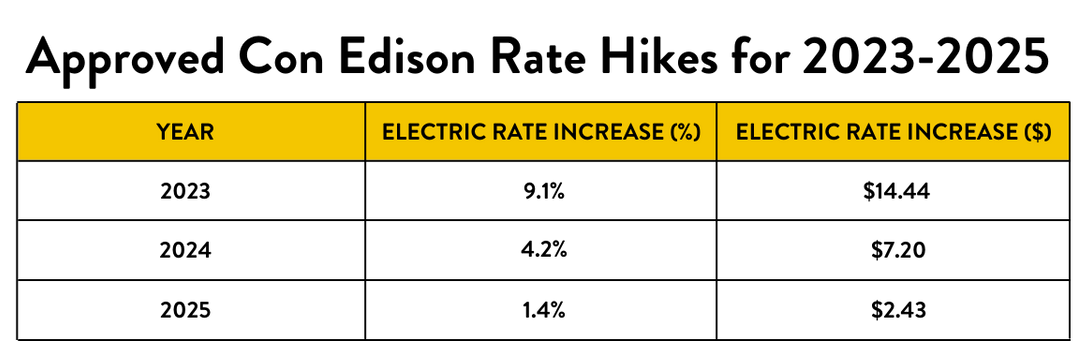
Solar power in New York City not only provides a way to offset these steep utility costs but also offers a level of stability that traditional energy sources cannot match. With a solar panel system, homeowners can generate their own electricity, reduce reliance on the utility grid and protect themselves from further rate increases. Programs like net metering even allow excess energy to be fed back into the grid, creating credits that lower utility bills—a significant benefit for many in the face of climbing energy costs.
Understanding the Urban Solar Landscape
While the rise of rooftop solar in New York is promising, installing solar in an urban environment like NYC poses unique challenges. New York City’s buildings vary widely in design, height, and age, creating space limitations and shading issues that can complicate solar installation. Tall buildings and nearby high-rises can cast shadows on panels, reducing their efficiency. Additionally, many NYC buildings are historic or landmarked, requiring special permits for exterior modifications.
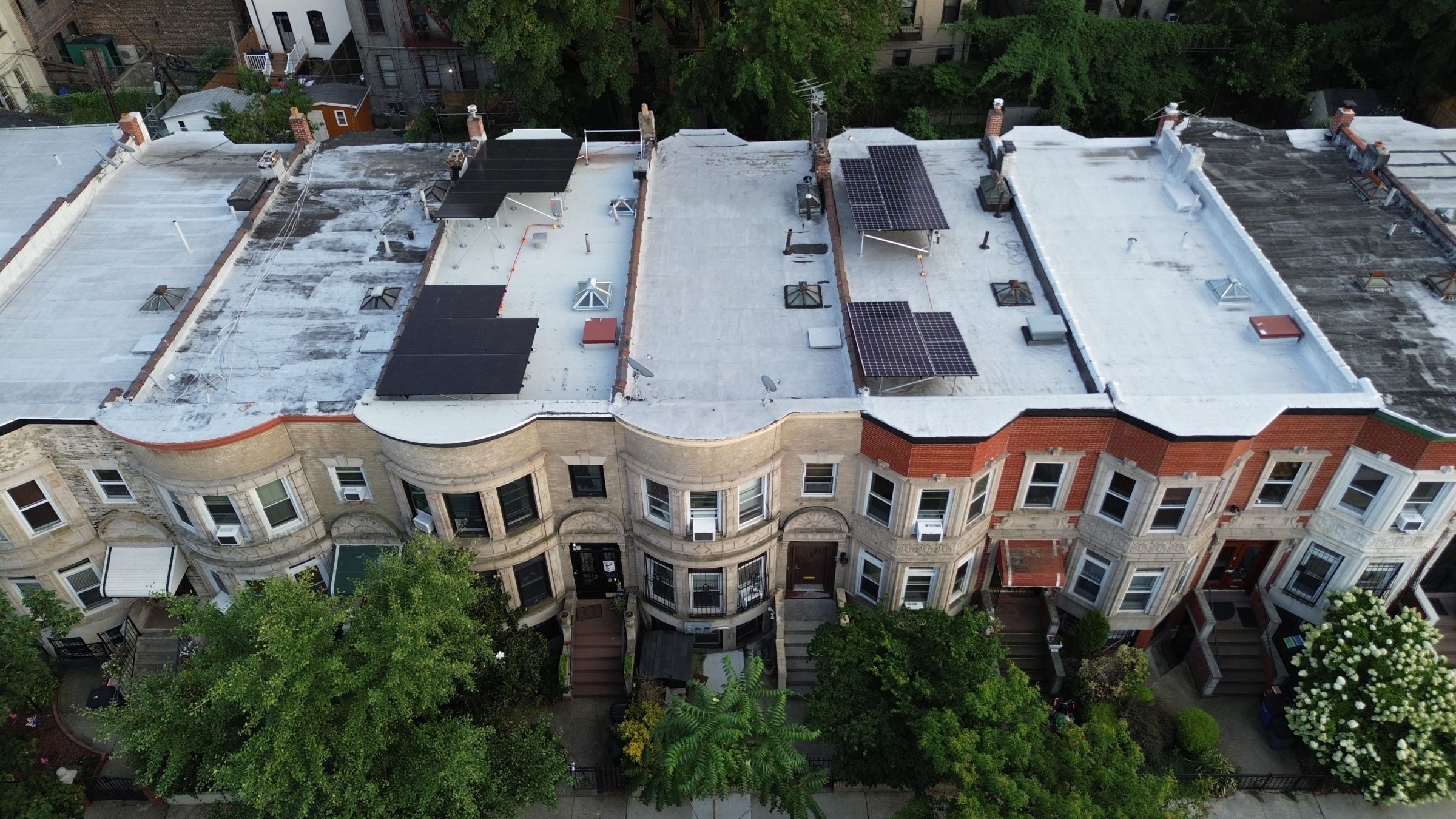
Despite these obstacles, many property owners in New York are finding innovative ways to incorporate solar power, helping reduce their environmental footprint while saving on energy costs.
Navigating City Codes and Zoning
City codes and zoning laws play a crucial role in the expansion of solar power in New York. New York City’s zoning regulations are designed to protect building safety and the visual landscape, meaning solar panels need to comply with placement, height, and setback requirements. For landmarked buildings, additional approvals from the Landmarks Preservation Commission may be necessary to ensure that solar installations are in line with historic preservation guidelines. By navigating these codes, property owners can harness solar power while remaining compliant with city regulations.
Permitting Processes
Permitting can be a significant step when installing solar power in New York City. The Department of Buildings (DOB) requires solar projects to go through a review process to ensure safety and code compliance. In addition, solar installers must submit plans for approval and may need to pass inspections before activating the system. For historic properties, special permits are often required to maintain the building’s original aesthetic. Working with experienced local solar installers, like Brooklyn SolarWorks, can simplify this permitting process and prevent unnecessary delays.
Find out how much your NYC home could save with solar! Get a free consultation with the local solar experts.
Solar Canopy in Prospect Lefferts Gardens: A Case Study
One inspiring example of the successful adoption of solar power in New York City is the custom solar canopy installed by homeowners Trevor and Gary on their beautiful brownstone in Prospect Lefferts Gardens, Brooklyn.
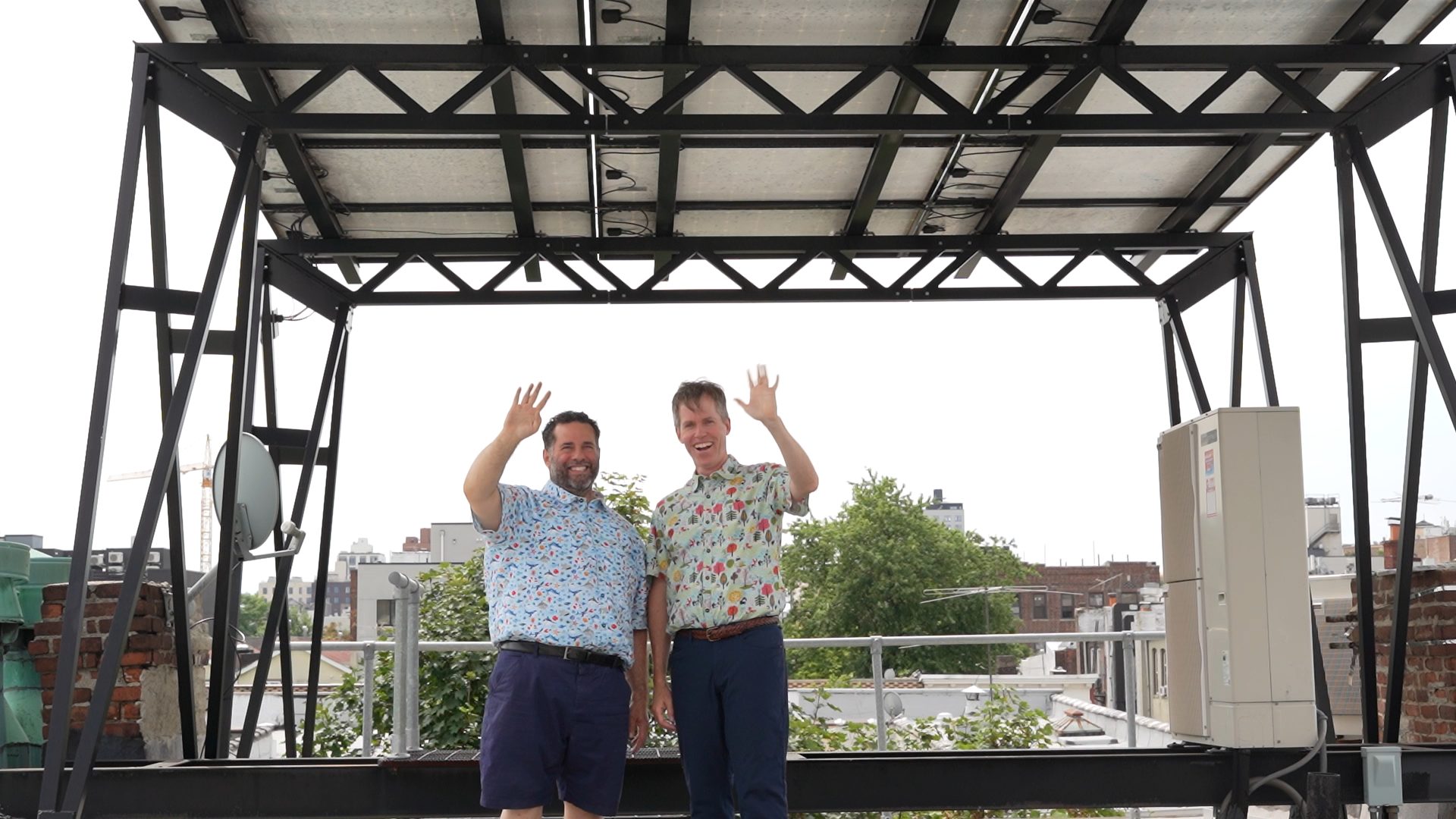
In 2018, they decided to work with Brooklyn SolarWorks to create a custom solar canopy that could maximize energy generation and savings without compromising the character of their home.
Why were the homeowners interested in solar?
Trevor and Gary were drawn to solar power for both environmental and financial reasons. They were motivated by the financial advantages, such as lower electricity bills and the ability to lock in energy costs through net metering.
How much have they saved with solar power?
After six years, Trevor and Gary’s solar system has generated around 28 megawatt-hours worth of net metering credits, which equals about three years’ worth of electricity. Through the process of net metering, their excess energy is fed back into the grid and counted as credits. These energy credits offset their electricity bill all year long.
With a payback period of eight years, Trevor and Gary see their solar system as a mortgage stating, “You’re going to be paying for [electricity] anyway, so why not pay it like a mortgage and be done with it?”
After only two more years, their system will have paid for itself in electricity savings., Then, they’ll be saving hundreds of dollars each month and with their new found energy independence, worrying about Con Ed’s rising rates will be a thing of the past.
Switch to Solar Power in New York City with Local Experts
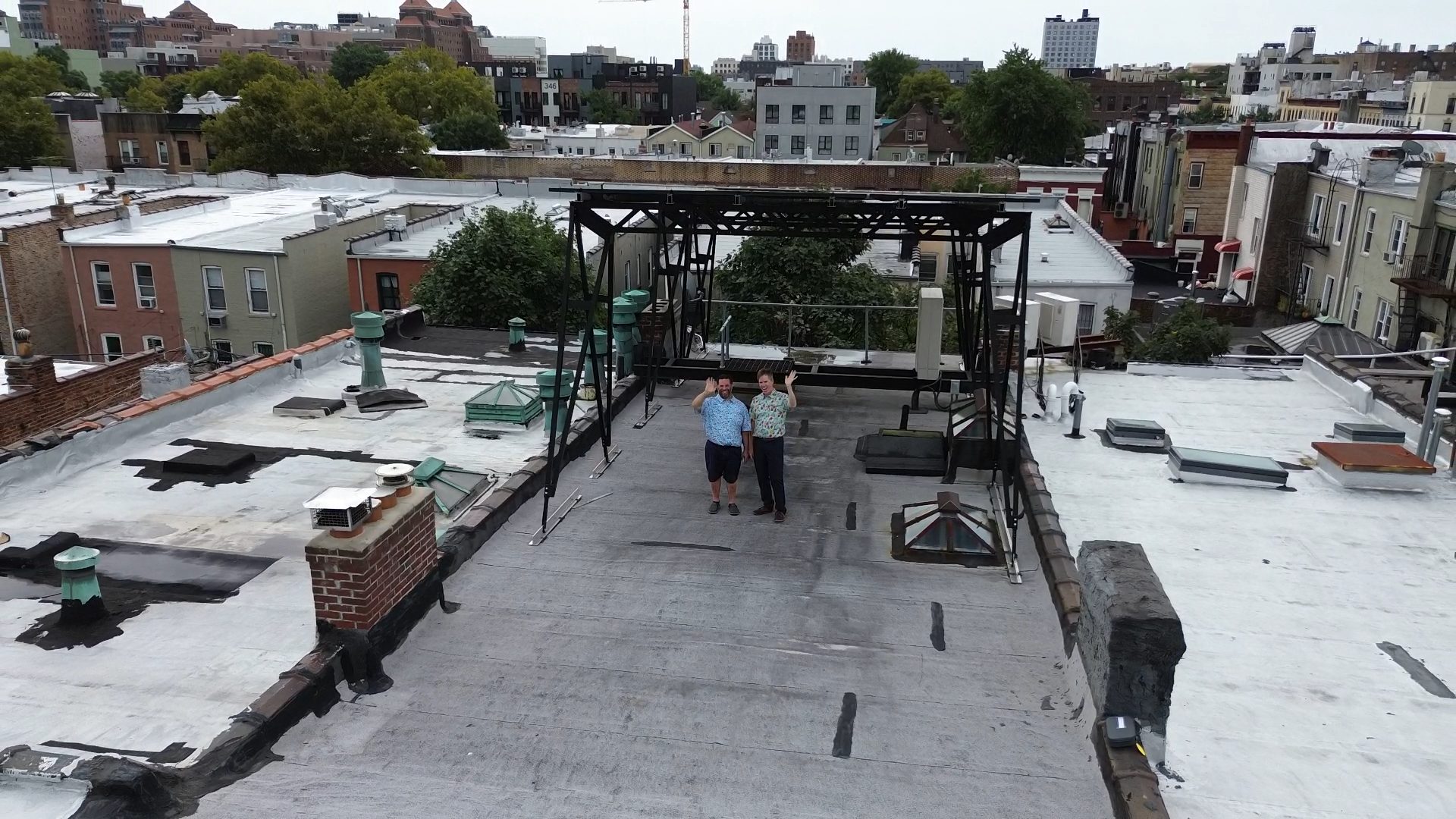
For Trevor and Gary, working with knowledgeable local professionals made a significant difference. “They helped us navigate every part of the process, from design to permits,” Trevor noted, highlighting the benefits of relying on a team familiar with NYC’s unique solar landscape.
If you’re considering solar power in New York City, reach out to our expert team. Our solar specialists can guide you through the process, helping you save on energy costs and join the growing community of New Yorkers benefiting from clean, renewable solar energy.
Take your first step towards solar savings! Schedule your free solar consultation today.
If you’re developing a new property or starting a major renovation in New York City, you are more than likely subjected to Local Law 154.This law mandates the electrification of most new buildings in the city and has significant implications for building owners and developers.
Read on to explore what Local Law 154 entails, why it was created, its requirements, compliance timelines, and how integrating solar energy can help you manage the transition.
What is Local Law 154?
Local Law 154, also known as the “All-Electric Building Act,” mandates that new buildings in New York City utilize electric heating and appliances, effectively prohibiting the use of fossil fuels in most new construction.

Enacted in December 2021, the law aims to reduce greenhouse gas emissions by transitioning away from gas-powered appliances and heating systems to electric alternatives in newly constructed buildings.
Why was Local Law 154 created?
New York City has been trending towards mandating sustainable building design and construction for years now. In 2019, the NYC Climate Mobilization Act (CMA), otherwise known as NYC’s Green New Deal, was passed by the New York City Council. It put NYC on the path to fighting climate change by reducing building carbon emissions by 40% by 2030 and by 80% by 2050.
The largest climate legislation of any city in the world, the CMA consists of several laws aimed at reducing GHG emissions across the city, with special attention paid to improving the energy efficiency of both residential and commercial buildings.

One of these laws was NYC Local Laws 92 and 94 – also known as the Green Roof Law – which mandated that all new roof construction must add either a green roof, a solar PV system, or a combination of both.
Local Law 97 is also a cornerstone of the CMA. This law sets carbon emissions limits for buildings greater than 25,000 square feet. In accordance with city goals, these buildings must reduce their emissions by 40% by 2030, and by 80% by 2050. Buildings must submit yearly emissions reports starting in May 2025, and face penalties for exceeding emissions limits.
Local Law 154 was created a few years later to continue New York City’s growth towards decarbonizing buildings. LL154 mandates the use of electric heating and appliances.
Reduce Greenhouse Gas Emissions
Buildings are one of the largest contributors to carbon emissions in the city, accounting for about 70% of NYC’s greenhouse gas output. By requiring electrification in new buildings, Local Law 154 seeks to significantly decrease these emissions over time, helping the city meet its long-term carbon reduction goals.
Improve Air Quality
Eliminating the use of fossil fuels in new construction can improve air quality by reducing the amount of pollutants released into the atmosphere. This change is particularly important in densely populated urban areas like New York City, where air quality issues have direct health impacts on residents.
Promote Energy-Efficiency
Transitioning to electric heating and appliances encourages the adoption of energy-efficient technologies. With modern electric systems, buildings can achieve higher energy efficiency levels, resulting in lower energy consumption and operating costs in the long run.
What are the requirements for buildings in LL 154?
Local Law 154 imposes specific requirements for new construction projects in the city. Understanding these requirements is essential for building owners, developers, and construction professionals.
Emission Limits
The law sets stringent emissions limits for new buildings. As of 2024, new buildings under seven stories must not use fossil fuels for heating, hot water, cooking, or other energy needs. By 2027, these requirements will extend to larger buildings over seven stories.
Covered Buildings
The law primarily applies to newly constructed buildings, including those undergoing significant renovations. It affects both residential and commercial projects, with specific requirements depending on the type and size of the building.
Want to make sure your building is compliant with all of NYC’s climate regulations? Get a free solar consultation with a solar specialist today!
Exceptions
Certain buildings are exempt from the law, including hospitals, industrial facilities, and certain types of affordable housing. These exceptions are in place to ensure that essential services can continue to operate without disruption while still encouraging electrification where feasible.
What is the timeline for compliance?

The timeline for compliance with Local Law 154 is phased to give building owners and developers time to prepare:
- June 1, 2023: Studies on heat pumps and grid readiness due.
- January 1, 2024: 1-2 family homes for all energy use AND all other buildings < 7 stories, except hot water systems.
- January 1, 2025: Public schools.
- January 1, 2026: Buildings < 7 stories with at least 50% affordable housing units.
- July 2, 2027: Buildings ≥ 7 stories for all energy use AND hot water systems in all buildings < 7 stories.
- January 1, 2028: Buildings ≥ 7 stories with at least 50% affordable housing units.
Compliance will be monitored, and building permits will be contingent upon meeting the stipulated electrification standards.
What are the penalties for non-compliance?
Failure to comply with Local Law 154 can result in significant penalties. Non-compliant building owners may face fines and delays in obtaining building permits. Additionally, there may be ongoing fines for buildings that do not meet the emissions limits or other requirements. These penalties are designed to incentivize adherence to the law and ensure the city meets its carbon reduction targets.
Building Electrification and Solar Energy
Electrification naturally leads to higher operating costs due to the increased demand for electricity. However, integrating solar energy into building projects can help offset these costs significantly. Solar panels can generate renewable energy on-site, providing a sustainable power source for electric heating, cooling, and appliances. By pairing electrification with solar energy, building owners can not only comply with Local Law 154 but also achieve long-term savings on energy costs.
Solar installations can reduce a building’s reliance on the grid, stabilize energy costs, and even generate additional revenue through net metering. As the technology for solar energy improves, these benefits will only continue to grow.
Integrate Solar into Your Construction Project with Ease
Planning for solar during the design phase not only ensures compliance but also allows you to capitalize on renewable energy incentives and long-term savings. By pairing building electrification with solar energy, you can significantly cut down on operating costs and increase your building’s energy efficiency.
Ready to make your project greener and more cost-effective? Get started today by booking a free solar consultation to explore the best solar solutions for your new construction and take the first step towards a sustainable future.
Sustainable building design is rapidly gaining momentum, especially in urban hubs like New York City. With the rise of environmental awareness and new building regulations, NYC has made strides toward more eco-friendly construction. This shift towards sustainable building design isn’t just a trend—it’s becoming mandatory.
One effective way to embrace sustainable building practices is through solar energy. Learn how solar power can play a pivotal role in creating more energy-efficient, eco-conscious buildings.
What is Sustainable Building Design?
Sustainable building design focuses on minimizing the environmental impact of buildings throughout their life cycle. This includes the planning, construction, operation, and eventual demolition of a structure. It is based on saving resources, lowering carbon emissions, and making life better for the people who use the residential and commercial buildings.
The concept of sustainable design gained traction during the 20th century in response to growing concerns about resource depletion, pollution, and climate change. What started as an environmentally-conscious niche has now evolved into a mainstream design approach, especially in cities like New York, where energy use and emissions are under heavy scrutiny.
Key Principles of Sustainable Building Design
Several guiding principles shape sustainable building design, helping developers and architects create structures that are energy-efficient, environmentally friendly, and health-conscious. Here are the key principles.
Energy Efficiency
Energy-efficient buildings use less power to heat, cool, and illuminate. Property owners often achieve this through improved insulation, efficient HVAC systems, smart windows, and clean energy sources like solar panels. Energy-efficient design reduces both operational costs and the building’s carbon footprint.


Water Conservation
Water conservation is another critical principle of sustainable building design. You can accomplish this through low-flow fixtures, rainwater harvesting systems, and greywater recycling. Efficient water management is essential, especially in urban areas where demand on water resources is high.
Material Selection
Selecting eco-friendly materials that are sustainable, recycled, or sourced locally is vital in reducing the environmental impact of construction. Materials that are non-toxic and have lower embodied energy contribute to the building’s sustainability profile.
Indoor Environmental Quality
The health and well-being of occupants are crucial to sustainable design. This principle focuses on factors like air quality and natural lighting to create a comfortable and healthy indoor environment. Using non-toxic materials and ensuring proper ventilation are central to this idea.
Site Selection and Planning
Choosing an appropriate site and planning for minimal environmental disruption is another pillar of sustainable building design. Urban locations that reduce the need for transportation, minimize land use, and integrate green spaces help lower the environmental impact of new building developments.
Why is Sustainable Building Design Important to New York City?
New York City’s buildings are its largest source of carbon emissions, accounting for nearly 70% of the city’s total greenhouse gasses. As part of NYC’s ambitious climate goals, sustainable building design is critical to achieving a greener future.
By prioritizing energy efficiency and reducing emissions, sustainable buildings also help ease the strain on the electrical grid, improve air quality, and support better public health outcomes. With initiatives like the NYC Climate Mobilization Act, sustainable design isn’t just a preference—it’s becoming a necessity.
Is Sustainable Building Design Mandatory in NYC?
Yes, sustainable building design is becoming effectively mandatory in New York City. Over the last few years, the city has passed a series of laws that require buildings to meet strict environmental standards. These regulations shape how developers execute new projects and renovations, focusing on sustainability.
Local Law 92/94
Local Law 92/94 mandates that all new buildings, or buildings undergoing significant roof renovations, must install solar panels or a green roof, making renewable energy a requirement rather than an option.
Local Law 154
Local Law 154, also known as the “All-Electric Buildings Law,” is a significant step in New York City’s plan to reduce carbon emissions by transitioning buildings away from fossil fuel reliance. The law mandates that new buildings, as well as major renovations, must use electricity as the primary power source, effectively phasing out gas- and oil-powered systems like stoves, boilers, and heating units. For smaller buildings (up to seven stories), compliance started January 1, 2024 and larger buildings are required to follow suit by 2027.
Local Law 97
One of the most stringent climate laws, Local Law 97 caps the emissions of buildings larger than 25,000 square feet. Starting in 2024, buildings must comply with emissions limits, with steep penalties for non-compliance. This law is a major driver for energy-efficient retrofits and renewable energy installations.
Make your building code compliant with ease. Submit your solar design request to our team today!
Benefits of Solar Energy for New Construction & Renovations in NYC
Solar energy is one of the most effective ways to reduce a building’s energy consumption. It aligns perfectly with the key principles of sustainable building design and offers a host of additional benefits.
Reduced Energy Costs
One of the most significant advantages of solar energy is the reduction in electricity costs. By generating electricity from the sun, buildings can drastically reduce their reliance on the grid, which translates to lower monthly utility bills. Over time, this can lead to substantial savings, particularly as energy prices continue to rise in New York City. For new construction, integrating solar panels during the design phase ensures that the building benefits from energy savings from day one.
Compliance with Local Laws and City Codes
In NYC, compliance with environmental laws is critical for avoiding costly fines. Solar energy can help buildings meet the stringent requirements set forth by Local Laws 92/94, 97, and others. These laws mandate energy efficiency and emissions reductions, and incorporating solar energy into your building’s design is one of the most straightforward ways to comply. Solar energy helps buildings meet emissions caps and green building mandates, future-proofing your development against evolving regulations.

Environmental Impact
Solar energy significantly reduces a building’s carbon footprint by replacing fossil fuel-based electricity with renewable power. This transition helps combat climate change by reducing greenhouse gas emissions, which is especially important in a city like New York, where buildings contribute to the majority of emissions. By integrating solar energy, developers can create more sustainable buildings that contribute to the city’s broader environmental goals.
Energy Independence
Solar energy offers greater energy independence for buildings. By generating their own electricity, properties can become less reliant on the local power grid, which can be particularly advantageous during peak demand periods. This energy independence ensures that buildings have a more stable and predictable energy source, which can be especially important in large developments.
Increased Property Value
Installing solar panels can increase the overall value of a property. People view solar PV systems as valuable upgrades that make buildings more attractive to buyers and tenants alike. Lower energy costs, compliance with local laws, and environmental consciousness all contribute to the building’s marketability. For developers, solar panels provide a competitive edge in a market increasingly focused on sustainability and energy efficiency.
Increase your property value and start saving with solar today! Submit your design request to our team today.
How can Solar Panels be Integrated into New Construction & Renovations?
We specialize in helping architects, developers, and general contractors seamlessly integrate solar panels into their new construction and renovation projects. Our dedicated department offers expertise in maximizing the benefits of solar energy while ensuring compliance with city regulations and reducing costly changes during construction. Here’s what’s involved in the process.
Roof Layout and Structure
A well-thought-out roof layout is critical for building an efficient solar energy system. The structure and size of your roof directly influence the effectiveness of solar panel placement and energy generation. By getting involved early in the planning stages, we can work with your architects and contractors to design a layout that optimizes solar power while minimizing the need for later modifications.
This proactive approach not only saves time but also ensures that your project complies with building requirements while making the most of the available space.
City Codes and Zoning
Navigating New York City’s intricate building codes and zoning laws can be challenging when it comes to solar installations. Our team will manage the permitting and navigate the city’s regulatory framework for solar installations, ensuring projects are not only code-compliant but also optimized for energy production. This includes meeting height restrictions, fire safety rules, and setback requirements that may affect your solar panel layout.
Custom Solar System Designs

Every building has unique needs, and we tailor our solar designs to meet your specific project requirements. Our custom solar systems ensure perfect alignment of your panels with your building plans. For example, our solar canopy, designed for NYC’s urban landscape, adds a modern look to rooftops while creating usable recreational space. It’s the perfect solution for developers looking to maximize energy efficiency without sacrificing aesthetic appeal.

We also offer tilt racks for a more traditional, subtle appearance.
The Future of Sustainable Building Design in NYC
Sustainable building design is more than a passing trend—it’s the future of urban development in New York City. With strict environmental regulations and a clear focus on reducing emissions, sustainable practices are becoming standard. This shift is good news for the city, promising better air quality, lower energy costs, and a healthier environment for residents.

Experience Seamless Solar Integration with Your Local Partner
If you’re ready to integrate solar into your next construction or renovation project, our specialty projects team is here to help. We make solar integration easy, ensuring your building is energy-efficient and compliant with NYC’s latest codes.
Want to integrate solar with your new construction or renovation project? Get started by submitting a solar design request today!
When considering installing solar panels, one of the first factors to evaluate is your roof layout. While many roofs can accommodate solar power systems, certain designs—especially flat roofs—pose specific challenges.
Flat roofs, commonly found in New York City, typically have obstructions and restrictions that make solar installation more complex. The condition and layout of objects on your roof are significant in determining whether your home is a good candidate for solar.
Determining Solar System Size
The size of your solar energy system is crucial to maximizing efficiency and meeting your energy needs. To determine the optimal system size, we evaluate several factors:
- Electricity Usage: Your past energy bills help us estimate your energy consumption and how much electricity you’ll need your solar panels to generate.
- Available Roof Space: The amount of usable roof area influences how many solar panels can be installed.
- Building Code Restrictions: Local regulations, including fire safety codes, limit where panels can be installed and may require leaving certain areas clear.
We aim to design a solar system that meets your energy needs while adhering to these restrictions. If space is limited after accounting for these factors, it may impact whether solar is the right choice for your home.
See if your home qualifies for solar with a free, no-obligation consultation!
What Factors Affect My Roof’s Compatibility with Solar?
When assessing your roof for a solar project, we take several key factors into consideration:
Roof Orientation
The orientation of your roof plays an important role in its suitability for solar and the amount of energy it can produce. South-facing roofs are ideal because they receive the greatest amount of sunlight throughout the day. However, east and west-facing roofs can also be good options depending on their exposure.
Roof Pitch
Roofs with a pitch are often easier to deal with when installing solar panels. These roofs tend to have fewer obstructions and can capture more direct sunlight. On the other hand, flat roofs—while common in urban environments—often come with restrictions and objects like HVAC systems or skylights that need to be worked around.


Shading
If large parts of your roof are heavily shaded by trees or nearby buildings, it can significantly reduce the effectiveness of solar panel systems. A roof that is shaded for most of the day may not be a good candidate for solar.

Structural Integrity
The condition of your roof and roofing material is a crucial factor. A strong, well-maintained roof is necessary to support the weight of the panels and ensure a system that lasts for decades.
How Does the Layout of my Roof Affect Solar?
Flat roofs often hold various objects that complicate solar panel placement. HVAC systems, skylights, roof hatches, decking, and dunnage can take up significant space and limit available areas for solar installation. These objects also have implications for complying with local building and fire codes.
Understanding Setback Requirements
Certain setbacks are required by building regulations to ensure safety and access. These restrictions may limit how close solar panels can be installed to objects on the roof or the roof’s edge, reducing the available space for panels.
Required FDNY Fire Paths
In New York City, the FDNY mandates a clear fire path on flat roofs. This 6-foot-wide path, stretching from the front to the back of the roof, is designed to give firefighters safe access in case of an emergency. Ensuring compliance with this regulation often limits available space for solar panels.
Historic Preservation Regulations
For homes located in historic or landmarked districts, additional regulations may apply. Solar panels cannot be visible from the street in such areas, making certain options, like solar canopies, less accessible.
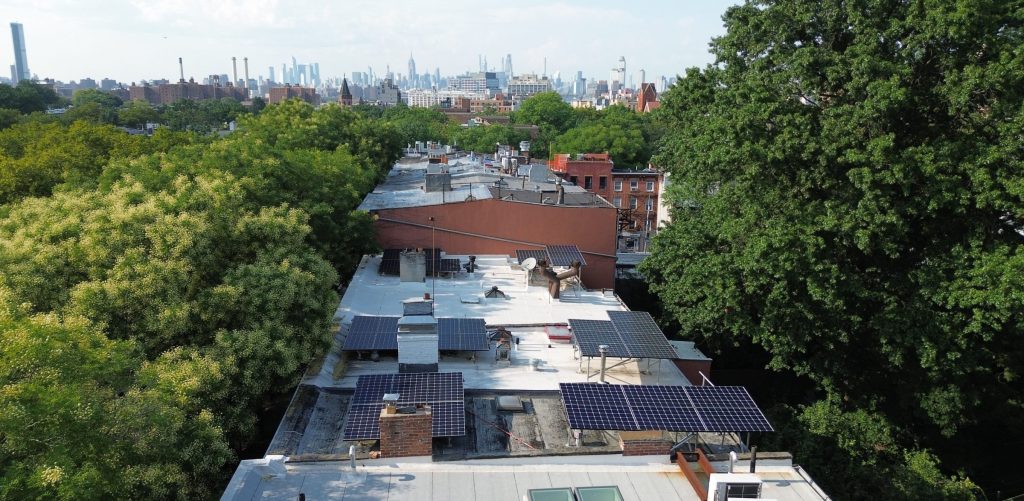
Solar Design and Installation Methods for NYC Buildings
Given the challenges of installing solar in urban environments, we offer several solutions tailored to the unique needs of New York City roofs.
Solar Canopy
With the help of our sister company, Brooklyn Solar Canopy, we created a solar canopy system that was designed with NYC’s flat roofs in mind. It elevates the solar panels above roof obstructions and designated fire paths, allowing for efficient use of limited roof space and opening up the opportunity of solar for more homeowners around the city.
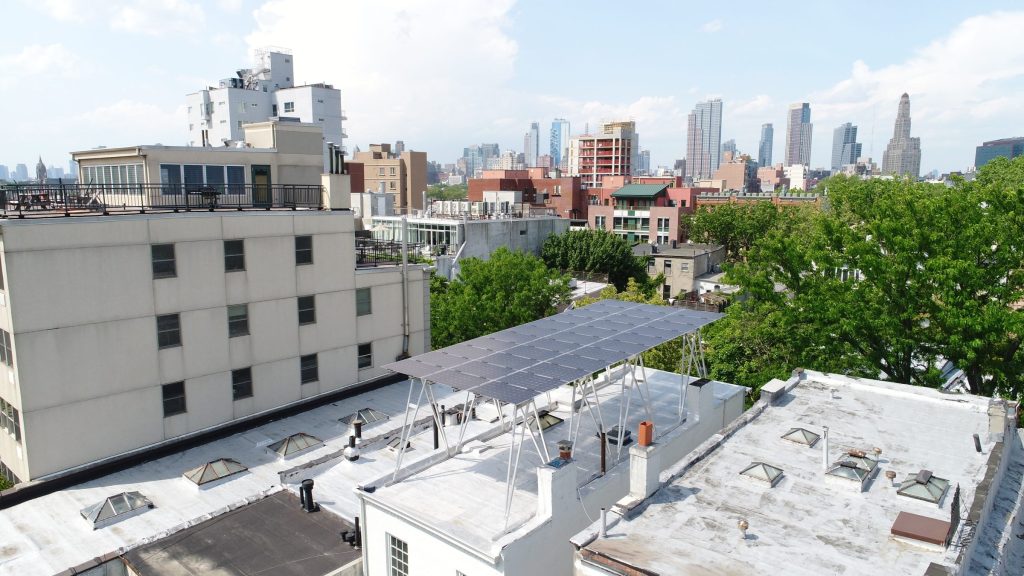
Tilt Rack
Tilt racks allow us to split the solar array into smaller sections, working around obstructions like HVAC units and maintaining required fire paths. This design can also be installed with minimal visibility from the street, making it a great option for buildings with aesthetic or historic concerns.

Ballasted System
For larger buildings (like co-op or commercial buildings) with wide-open roof space, ballasted systems are an excellent option. These systems use weights to hold down the solar panels without penetrating the roof membrane, preserving the roof’s structural integrity. However, they are heavy, so the roof must be strong enough to support the additional load.
Explore Solar Solutions Tailored for Your Roof
Whether you have a flat roof, pitched roof, or any unique configuration, Brooklyn SolarWorks offers a range of solutions tailored to meet your home’s needs for clean energy. Every roof is different, and that’s why we survey every roof before proceeding with an installation.
Get started with your free solar consultation today to see if your roof is a good fit for solar and to see how much you can save!
When it comes to installing solar panels on a New York City co-op building, there’s no one-size-fits-all answer. The solar potential of each building varies depending on factors like roof space, sunlight exposure, and building regulations.
However, with the right conditions, many NYC co-ops can successfully make the switch to solar energy, receiving significant benefits in the process. This blog will guide you through the key considerations and benefits of installing solar panels on your co-op building, helping you determine if solar is the right choice for your property.
Benefits of Solar for Co-Ops in NYC
Installing solar panels provides many benefits, making it a very attractive investment for co-op owners and residents alike. From complying with Local Law 97 and saving thousands on energy costs, solar energy is becoming essential for co-op buildings.
Reduced Electricity Costs
New York City has some of the highest electricity rates in the country. Going solar not only means significant savings on monthly bills, it also protects co-op owners and residents from annual rate hikes.
For co-ops, there are multiple ways to share the savings of solar. One plan allows residents to share energy by apartment unit through a community solar arrangement. The most common plan, however, is having the generated solar energy cover the building’s common area costs.
Want to find a solar plan that works for your co-op? Get a free quote now!
Local Law 97 Compliance
New York City’s Local Law 97 (LL97) requires buildings over 25,000 square feet, including co-ops, to significantly reduce their carbon emissions. There’s around 18,000 multifamily buildings in NYC that are also covered by LL97. Of these buildings, most are low-rise (7 stories or fewer) and either pre-war (built before 1940) or post-war (1940-1980). Overall, pre-war, low-rise buildings are the ones who have the most LL 97 work to do.
Solar energy is a powerful tool for meeting these requirements. By generating clean, renewable energy, co-ops can lower their carbon footprint, ensuring compliance with the law and avoiding the fines associated with non-compliance. Investing in solar now can help your co-op stay ahead of these regulations, contributing to a greener New York.
Climate Friendly
Solar energy is one of the most environmentally friendly power sources available. It produces no greenhouse gas emissions during operation, making it a key player in the fight against climate change. By adopting solar, co-ops can make a substantial impact on reducing the city’s overall carbon emissions. For residents who value sustainability, this can be a major selling point, reflecting the building’s commitment to environmental responsibility.
Increase Property Value
Installing solar panels can also enhance the property value of your co-op. As more buyers prioritize energy efficiency and sustainability, properties with solar installations become more desirable. Solar panels not only reduce ongoing operational costs but also signal a forward-thinking approach to property management. This added value can make your co-op more competitive in NYC’s real estate market, attracting potential buyers who are interested in long-term savings and environmental impact.
Does My Roof Qualify for Solar?
There are multiple factors that tie into what makes a roof qualified for solar. Generally, what we look for in a qualified co-op roof is open space with a good amount of sunlight. Too many obstructions on the roof, or too much shade from a nearby building, can prevent solar panels from producing sufficient power.
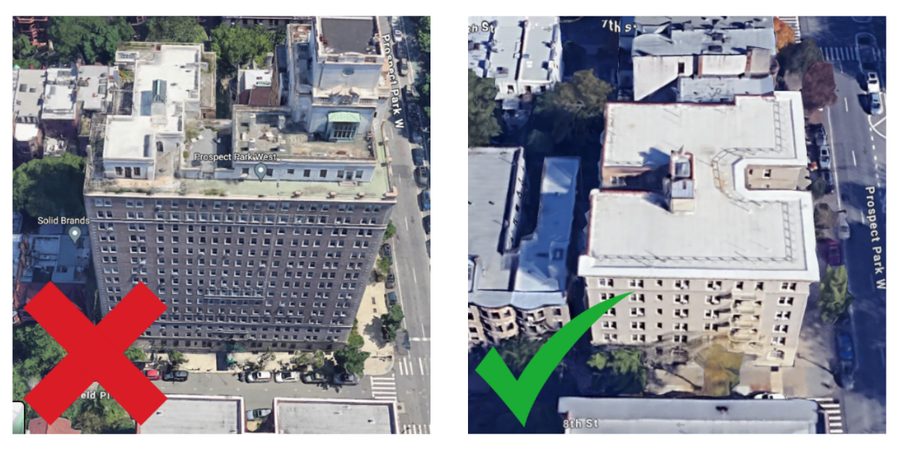
For any roof in NYC interested in going solar, including residential buildings and businesses, our local solar experts take a look at the roof and make sure that it fits the right conditions for you and your building to benefit from the solar system.
See if your building qualifies for solar today with a free quote.
NYC Solar Incentives for Co-Ops
New York City has some of the best solar incentives in the country for co-op buildings. Here’s a breakdown of the NYC solar incentives that your co-op could qualify for.
- NYSERDA Rebate: The NYSERDA Rebate is currently at $0.80 per watt for co-ops whereas residential homes get $0.20 a watt. Only a limited amount of funds are available for this incentive. This will be filed by Brooklyn SolarWorks.
- Property Tax Abatement (PTA): The PTA covers up to 30% of the solar system cost and will be paid through a reduction in your property taxes over a 4 year term. This will be filed by Brooklyn SolarWorks.
- Federal Tax Credit: The Federal Tax Credit covers 30% of solar system cost and can be claimed by individual shareholders or unit owners on a prorated basis. It also includes dollar for dollar credit.
- State Tax Credit: The New York State Tax Credit covers 25% of solar system cost and is also dollar for dollar credit. This credit is only available to owner-occupied units capped at $5000 per taxpayer.
Solar Design Options for Co-Ops
All co-op buildings are different. We have multiple solar design options available to fit your building’s design and energy needs.
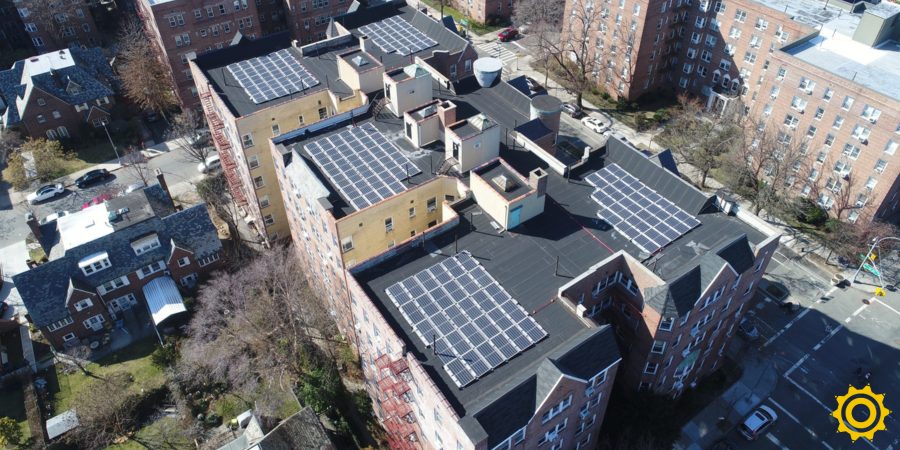
Ballasted systems are installed with minimal roof penetrations. They’re low cost and low profile.

Our tilt rack system is installed directly to the roof deck. The solar array is split into sections to work around roof obstructions. This option increases system size compared to ballasted systems.

Our patented, award-winning solar canopy elevates solar panels 9 feet above the roof’s surface to avoid obstructions and FDNY fire paths. Canopies can increase system size substantially compared to tilt rack and ballasted systems.
NYC Co-Ops That Have Gone Solar
As New York City continues to become more sustainable, co-ops across the boroughs have been making the switch to solar. Here are a few examples:
Griswold Hall
Installed in 2021, this 84 unit co-op installed a 140 panel solar system to fully offset their common area electricity costs. Located in a historic district of Jackson Heights, this building coordinated their solar project with a full roof replacement and opted for a low profile ballasted design. On top of energy savings and tax incentives, installing solar will also help reduce expected Local Law 97 penalties.
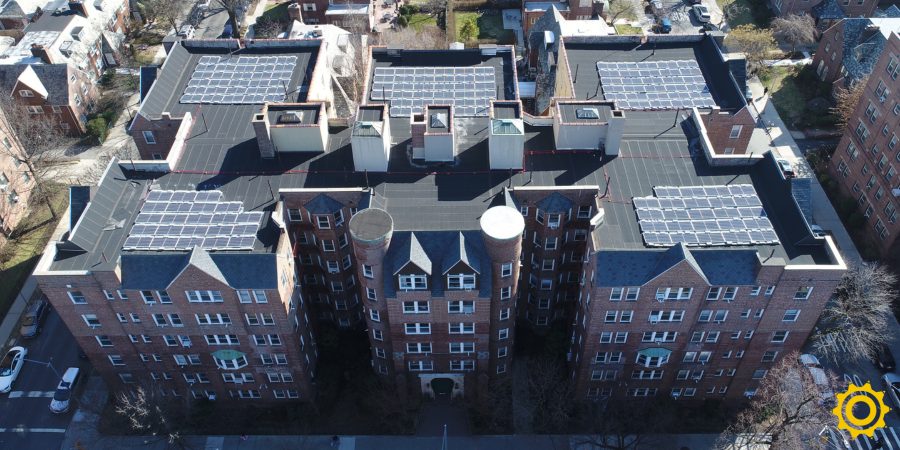
838 Park Place
Installed in 2017, this 8 unit co-op was the first affordable housing co-op in NYC to install an onsite community solar system! Using a hybrid design made up of 100 LG solar panels, this co-op was not only able to offset their common area electricity needs, but also provide bill savings to individual shareholders.

Frequently Asked Questions about Solar for NYC Co-Ops
What is the typical cost for a co-op to go solar?
Every system cost is different, as it depends on the size of your building and what your energy needs are. Larger, more complex projects incur higher costs when it comes to materials, labor and permitting resources.
However, the government incentives available for solar reduce your upfront costs by 75% or more. If you would like a breakdown of your co-op’s solar costs, start your solar journey today by speaking with our solar experts.
How does Landmarks approval work for solar?
If you live in a landmarked building, we need to abide by the Landmarks Preservation Commission’s historic preservation guidelines. Generally, this means the solar system cannot be visible from street level. We work with historic and landmarked buildings pretty often, and our permitting team are experts at navigating these regulations.
The first thing we do is a landmark study. This involves going on your roof to do a mock up of the system to see if it is visible from street view. If it’s good to go, we’ll apply for Landmarks approval, then begin applying for other permits.
What is the average solar installation timeline for a six story building?
The average timeline is 4 to 6 months once the contract is signed and a deposit is put down, assuming there are no other contractors we need to work with and your roof is ready for solar. Most of this time is allocated to getting the permits processed and approved. The installation of the system takes about 3-5 days.
If your building is landmarked, we’ll need an extra month to get approvals. If the building is larger, Con Ed requires additional studies to be done.
What if I’m not a board member? How can I get my building to go solar?
In multifamily buildings, there’s a lot of different decision makers. It can be hard to get projects like this approved when you are not on the board yourself. It’s important to note that we must work with your board in order to make a solar installation happen. We can only work with those who own, and make decisions for, the building.
We’re more than happy to present to your board, or we can share some resources that you can use to present the idea yourself. Our team has presented to co-op boards across the city and has plenty of experience guiding board members through the decision-making process.
Find Out if Your Co-Op Qualifies for Solar!
Taking the first step towards a more sustainable and cost-effective future is easier than you might think. Whether you’re motivated by reducing electricity costs, complying with Local Law 97, or increasing your property’s value, solar energy offers a range of benefits for co-op buildings in NYC. However, not every roof is suitable for solar, so it’s important to determine if your co-op is a good fit.
See if your co-op qualifies for solar today with a free personalized quote and see what you could be saving with solar.

Brooklyn SolarWorks Powers onto Inc. 5000
New York Solar Developer-Installer Named One of the Fastest-Growing Private Companies in America
Brooklyn, NY, August 13, 2024 – Brooklyn SolarWorks, a leading rooftop solar developer and installer, today announced it has appeared on the prestigious 2024 Inc. 5000 list of America’s fastest-growing private companies. This recognition validates the company’s rapid expansion and commitment to implementing sustainable energy solutions in urban environments.
Less than a decade after its founding, Brooklyn SolarWorks has experienced rapid growth, fueled by its deep understanding of the New York City energy market and a relentless focus on customer satisfaction. The company has helped over 3,000 homeowners benefit from solar power, reducing their carbon footprint while saving on energy costs.
“We are thrilled to be honored as one of the fastest-growing companies in America,” said T.R. Ludwig, CEO of Brooklyn SolarWorks. “This achievement is a testament to the dedication and expertise of our team. By providing hyper local solar solutions for urban homeowners, we are not only transforming households and businesses, but also contributing to a cleaner and healthier city.”
“Rooftop solar is one of the bright spots in New York’s clean energy transition, says Noah Ginsburg, executive director of the New York Solar Energy Industry Association. “As New Yorkers grapple with extreme heat and rising electric bills, it’s no surprise that innovative companies like Brooklyn SolarWorks are rapidly growing to keep up with demand for clean energy.”
Brooklyn SolarWorks has seen remarkable growth over the last few years with revenues more than doubling from $8M in 2020 to $19M in 2023, an increase of 137%. The company now employs a staff of 73 compared to its 45 employees in 2020. Key to the company’s growth is its expertise in navigating complex city regulations and designing innovative solar systems for limited rooftop spaces while delivering sustainable energy Brooklyn customers desire.
“Navigating New York’s complex solar market requires comprehensive understanding of the city’s compliance standards,” says Ludwig. “Our mastery of local permitting and regulation, coupled with our made-in-NY patented canopy design, has positioned us as a leader in the city’s transition to renewable energy.”
To qualify for the Inc. 5000, companies must meet stringent growth criteria – companies are required to have been founded and generating revenue by March 31, 2020, and have generated at least $1 million in revenue in 2022. Brooklyn SolarWorks’ inclusion in this list is a testament to its achievement and positions the company as a leader in the solar industry.
About Brooklyn SolarWorks
Founded in 2015, Brooklyn SolarWorks is a solar design and installation company servicing New York City, with more than 3,000 residential and commercial installations completed within the five boroughs. The company specializes in custom installation and design methods, including its patented Brooklyn Solar Canopy, which elevates panels above obstructions commonly found on NYC rooftops to maximize solar potential. Brooklyn SolarWorks’ hyperlocal focus has allowed them to expertly navigate complex permitting requirements and remain on the forefront of solar policy in the city and state.
For more information, visit www.brooklynsolarworks.com.
Brooklyn SolarWorks Company Contact:
Christy Noble
christy@brooklynsolarworks.com
Brooklyn SolarWorks Media Contacts:
Lydia Miner, Sustainable PR
518-380-4968
Yes, installing solar panels on historic homes in NYC is entirely possible! New York City has some of the most stringent historic preservation rules in the country, and as a result many solar companies shy away from touching historic homes.
As the NYC local solar experts, we’ve figured out the permitting and design methods needed to make the solar process a breeze, even for historic and landmarked homes. Read on to learn more about the process of going solar for historic homes.
Benefits of Solar for Historic and Landmarked Homes
Installing solar panels on historic and landmarked homes in NYC offers numerous advantages that align with both environmental and financial goals.
Reduce and Stabilize Energy Costs
Solar panels generate electricity from sunlight, which decreases reliance on the grid. This leads to much lower energy bills and provides a more predictable energy cost structure, protecting homeowners from rising electricity rates.
Net metering can further offset costs by crediting homeowners for excess energy sent back to the grid, resulting in electricity savings throughout the year.
Boost Property Value
Research done by Zillow indicates that installing solar energy systems does increase the value of your home. Prospective buyers are increasingly attracted to properties with solar panels and other environmentally friendly features due to the promise of reduced energy bills, environmental benefits, and the potential for long-term savings.
National Renewable Energy Laboratory (NREL) estimates that home value increases by $20 for every $1 saved on electricity bills. With NYC’s high energy costs, solar panels can lead to significant energy cost reductions, further boosting value.
Installing solar panels on your historic property boosts its value without sacrificing its architectural integrity.
Enhance Sustainability
With its ambitious sustainable development goals, New York City is making major strides towards becoming a sustainable city. By installing solar panels on your historical home, you not only contribute to environmental preservation but also align with broader sustainability goals while reducing your own carbon footprint.
Claim Tax Incentives
New York City has some of the best financial incentives for residential solar in the country, covering between 75-95% of your costs. When it comes to solar tax credits in NYC, there’s the NYC Solar Property Tax Abatement (PTA), NYS Solar Income Tax Credit and the NYS Historic Homeownership Rehabilitation Tax Credit (HTC).
The NYC PTA allows NYC homeowners to claim 30% of solar energy system costs as a property tax abatement with the NYC Department of Finance. The NYS solar income tax credit gives a $5000 state tax credit for New York residents that install a solar PV system on their primary residence. The HTC gives homes that qualify an additional 20% income tax credit from NYS.
Want to see what solar tax credits and incentives your home is eligible for? Sign up for a free solar consultation today and see what you can save!
Challenges of Installing Solar Panels on Historic Homes
Navigating the installation of solar panels in NYC is challenging. We’ve mastered the process, but historic and landmarked homes have an additional layer of regulations that we have to navigate.
City and State Regulations
Historic homes in NYC face strict regulations imposed by both city and state authorities. Solar installations must adhere to guidelines ensuring that panels are not visible from street level, maintaining the historic character of neighborhoods. Compliance with these rules requires careful planning and design to integrate solar technology without altering the home’s appearance.
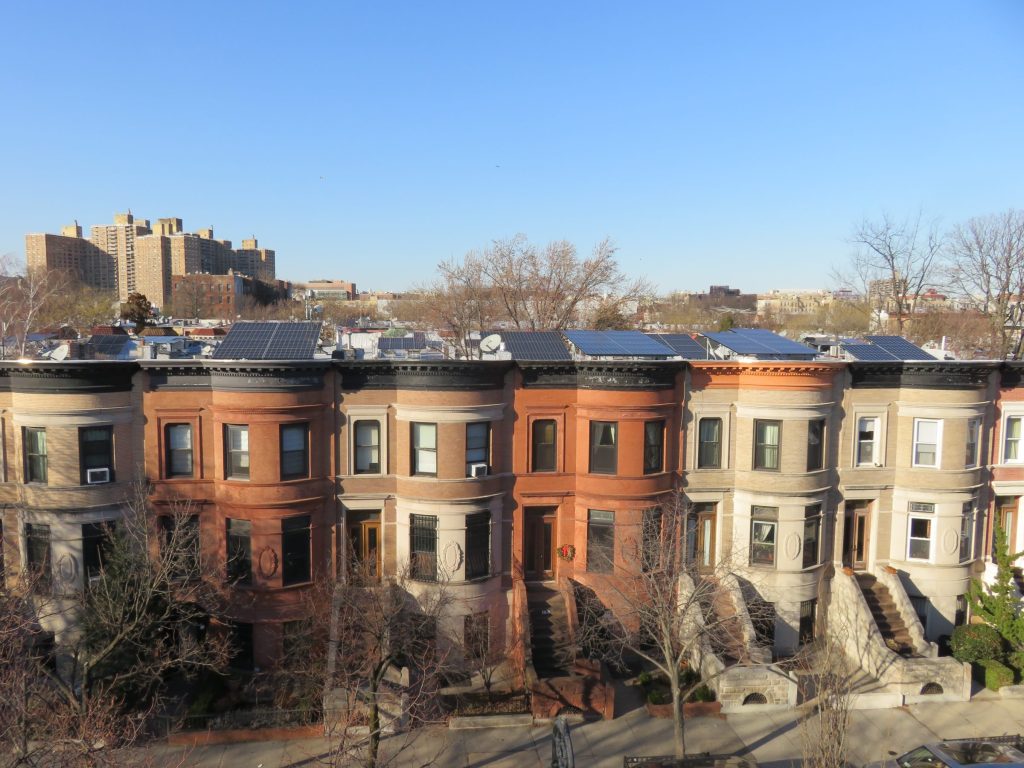
Preserving Architectural Integrity
Preserving the architectural integrity of historic homes is crucial. Solar installations must respect the original design elements and materials, avoiding any impact on the building’s historical significance.
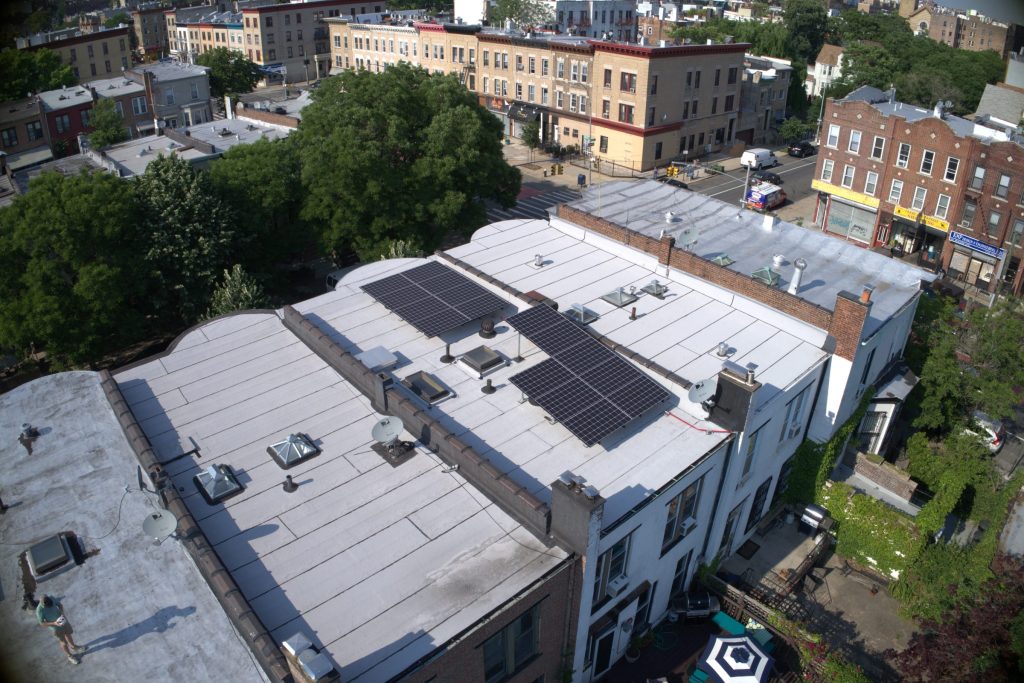
This often necessitates customized solutions, such as using low-profile panels and innovative mounting systems, to ensure that the home’s unique aesthetic is maintained while still benefiting from renewable energy. We’ve created the perfect solar mounting system called the tilt rack that brings solar power to the flat roofs of historic homes without being seen from the front.
Who Administers Approvals for Solar Installations on Historic and Landmarked Homes?
Approval for solar installations on historic properties involves coordination with specific government agencies to ensure compliance with preservation standards.
NYC Landmarks Preservation Commission
The NYC Landmarks Preservation Commission (LPC) oversees modifications to landmarked properties in the city. Their role is to ensure that solar installations do not compromise the historic character of buildings. This involves reviewing proposals to ensure that panels are discreetly placed and do not detract from architectural features. The LPC requires detailed plans and may suggest design adjustments to align with preservation guidelines.
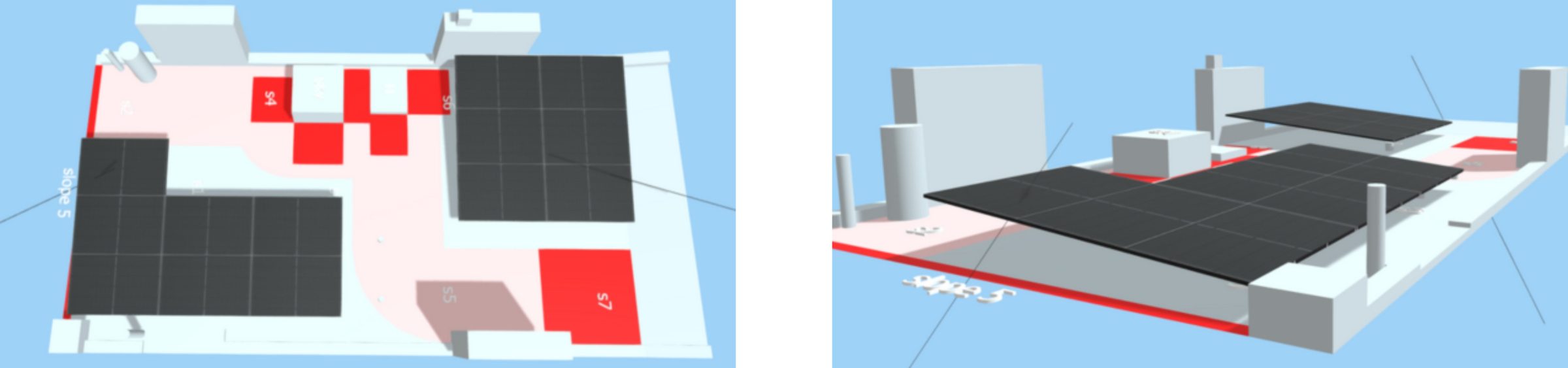
NYS Office of Parks, Recreation and Historic Preservation
The New York State Office of Parks, Recreation and Historic Preservation (NYS OPRHP) also plays a critical role in approving solar projects on historic properties. They ensure compliance with state-level preservation standards, focusing on maintaining the property’s historical integrity. The office reviews proposals for aesthetic impact and provides guidance on modifications to ensure that solar installations are sympathetic to the property’s heritage and appearance.
This agency is also responsible for administering the NYS Historic Homeownership Rehabilitation Tax Credit, which gives qualifying historic homeowners a 20% income tax credit for eligible home improvement expenses (including solar installation).
Solar Installation Solutions for Historic Homes
Innovative solutions make solar installations feasible for historic homes without compromising their character. We’ve developed a streamlined process for installing solar on historic and landmarked properties.
Zero Visibility Installations
To preserve the aesthetic appeal of historic properties, zero visibility installations are essential. Our tilt rack solar systems can be installed with zero visibility from street level by using low-profile mounting systems and strategic positioning. This ensures that the solar panels blend seamlessly with the home’s design, maintaining its historic charm.
Conduit Run
In order to connect your solar system to your home’s electrical panel, we have to run conduit from the roof to the basement of the home. When we design your system, we’ll include a conduit run that meets landmarked and historic visibility requirements.
Want to see if your home is eligible for solar? Get a free consultation today!
Streamlined Permitting Process
We’ve been the local solar installer for NYC since 2015. Over the years we’ve developed strong relationships with the NYC Landmarks Preservation Commission and the NYS Office of Parks, Recreation and Historic Preservation.
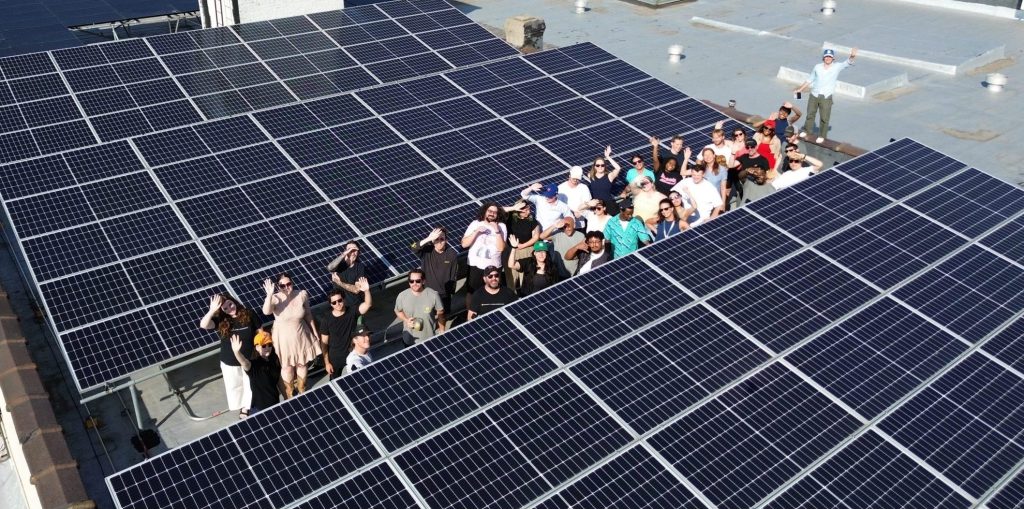
This expertise allows us to navigate the complex permitting process efficiently. Our familiarity with regulatory requirements ensures smoother approvals, making solar installations on historic homes more accessible and less time-consuming.
Taking Advantage of the NYS Historic Tax Credit
All New Yorkers qualify for 75% or more of their project costs to be covered by government incentives. But certain historic areas also qualify for an additional 20% income tax credit from New York State, bringing project savings up to 90-95% for qualified homes.
Do I Qualify for the Tax Credit?
The New York State Historic Tax Credit eligibility criteria depends on the home’s historic significance as well as the income level of its location. Understanding these distinctions is crucial for property owners seeking to leverage this incentive.
You can claim this credit if you:
- restore a qualified historic home in New York State
- purchase a restored qualified historic home in New York State.
A qualified historic home must be a residential structure that’s owner-occupied (including condos and co-ops) that appears on the State or National Register of Historic Places, or resides within a state or nationally registered historic district. Additionally, it should be certified as having historical significance within that district.
Your homes also must be located in:
- a federal qualified census tract or area of chronic economic distress, or
- a census tract that is at 100% or below the state family median income level, or
- a city with a population of less than one million with a poverty rate greater than 15%.
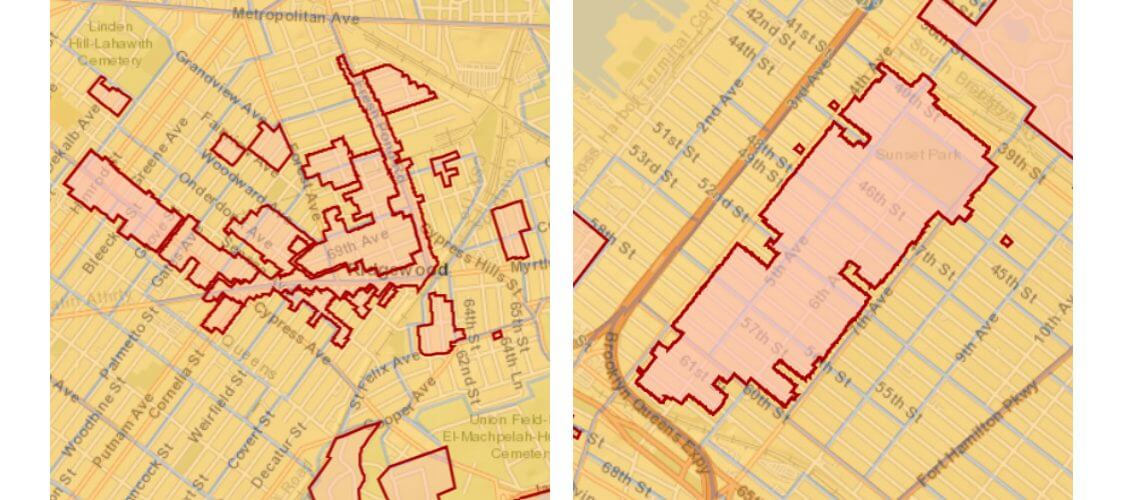
How do I File for the Tax Credit?
Filing for the NY State Historic Homeownership Rehabilitation Credit is a multi-step process:
- APPLICATION PROCESS: Property owners must complete the appropriate forms and submit them to the New York State Office of Parks, Recreation and Historic Preservation. The application process involves providing details of the rehabilitation project, expenses, and adherence to preservation standards. (If you work with us to go solar, we’ll help you through this step.)
- PROJECT APPROVAL: After the appropriate documents have been approved, project work can begin.
- PROJECT COMPLETION & CREDIT FILING: Once the project is completed and certified, you’ll need to file for the credit. This will be done with your New York State income tax filing.
If you’re looking to go solar with us, we will help you through the application process. And we’ll even send out reminders for tax season, too. Learn more about our process by scheduling a free consultation.
Enjoy the Benefits of Solar for Your Historic Home
Going solar is easier than you think, even if you live in a historic or landmarked home. When you work with us, we’ll make the entire process a breeze and you’ll be enjoying the benefits of clean energy in no time. Join over 3,000 of your neighbors and get started with us today.
Learn how your historic home could save 90% on project costs with a free consultation.
Brooklyn SolarWorks Named Top Contractor by Solar Power World
NYC Installer’s Innovation Earns Back-to-Back Recognition
Brooklyn, NY, July 23, 2024 – Brooklyn SolarWorks, Brooklyn’s leading rooftop solar developer and installer, known for their innovative Brooklyn Solar Canopy racking system, announced today it has been named one of Solar Power World’s Top Solar Contractors for the second consecutive year. This recognition solidifies the company’s position as a leader in the solar industry and underscores its commitment to providing specialized solar solutions for New York City rooftops.
Brooklyn SolarWorks has experienced rapid growth since its founding, fueled by its deep understanding of the energy market in New York City and their unique solar canopy designed for urban rooftops where codes and space restrictions make traditional racking systems unfeasible. The company has helped thousands of homeowners make the switch to solar, helping them save on energy expenses while reducing their carbon footprint.
“We are honored to once again be recognized as a top solar contractor by Solar Power World,” said T.R. Ludwig, CEO of Brooklyn SolarWorks. “This award is a testament to our team’s dedication to delivering innovative solutions like the Brooklyn Canopy that help homeowners overcome NYC’s rooftop challenges and maximize their solar potential.”
Solar Power World, the leading solar publication covering technology, development, and installation, publishes the Top Solar Contractors List annually. The list includes hundreds of solar contractors and developers in the United States, categorized by state/territory, service, and market.
“Solar projects in every market — residential to utility-scale — are getting bigger and oftentimes more complicated in scope, financing and permitting. That’s why it’s all the more impressive when so many top installation companies have banner years,” said Kelly Pickerel, editor in chief of Solar Power World. “The Top Solar Contractors List is a great gauge for how strong individual companies are in their local markets.”
Brooklyn SolarWorks has consistently delivered outstanding results by providing tailored solar solutions that maximize energy production and savings for its customers. The company’s deep understanding of the local market and its commitment to exceptional service have been instrumental in its continued success.
Interested in learning more about how Brooklyn SolarWorks can help you switch to solar? Visit their website at brooklynsolarworks.com for a free consultation.
About Brooklyn SolarWorks
Founded in 2015, Brooklyn SolarWorks is a solar design and installation company servicing New York City, with more than 3,000 residential and commercial installations completed within the five boroughs. The company specializes in custom installation and design methods, including its patented Brooklyn Solar Canopy, which elevates panels above obstructions commonly found on NYC rooftops to maximize solar potential. Brooklyn SolarWorks’ hyperlocal focus has allowed them to expertly navigate complex permitting requirements and remain on the forefront of solar policy in the city and state.
For more information, visit www.brooklynsolarworks.com.
Brooklyn SolarWorks Company Contact:
Christy Noble
christy@brooklynsolarworks.com
Brooklyn SolarWorks Media Contacts:
Lydia Miner, Sustainable PR
518-380-4968
Installing your own solar panels in New York City is not recommended. The process involves navigating complex building regulations, obtaining multiple permits, and ensuring the technical and structural integrity of the installation, which is better left to professionals.
Read on to learn more about the solar installation process in NYC and why using a local professional installer is the better choice.
Going Solar in NYC is a Complex Process
Solar panel installation in NYC is not as straightforward as it might seem. The city’s unique regulations and requirements make it a challenging endeavor for anyone attempting a DIY project.
Unless you or a friend is a professional engineer or registered architect, one will need to be hired to evaluate the building’s structural system to see if the solar system can maintain the weight of the equipment. This is just the tip of the iceberg for what is needed for a self-installed solar panel system.
Permits and Approvals Needed for Installing Solar
One of the biggest hurdles in installing solar panels in NYC is obtaining the necessary permits and approvals.
Building Permits
To ensure your building can handle the added weight and structure of solar panels, you must obtain building permits from the NYC Department of Buildings. This step is crucial to avoid potential structural issues.
Approval from FDNY
The Fire Department of New York (FDNY) must approve your solar installation plans to ensure they meet safety standards. For flat roofs, specific compliance with the fire code is necessary. You must include a fire path to allow safe access for emergency responders.
FDNY involvement is also why battery storage systems are not permitted in NYC right now, as they can pose additional fire risks. Compliance with FDNY regulations is mandatory and integral to the approval process. This involves assessing fire access and safety measures, which are critical for protecting both your property and emergency responders.
Engineering Sign-Off
A Professional Engineer or Registered Architect must assess and confirm that your building’s structural system can support the solar equipment. This is a mandatory requirement to ensure safety and compliance with local regulations.
Electrical Approvals
Electrical permits are also required for integrating your solar system with your home’s electrical grid. A licensed electrician must inspect and approve the installation to ensure it meets safety standards.
Solar Installation Requires Technical Expertise and Safety
Installing solar panels is not a simple DIY project; it requires a significant level of technical expertise and attention to safety. From ensuring the structural integrity of your roof to handling complex electrical components, the challenges are numerous.
Safety Hazards
Working at tall heights, handling electrical components, and ensuring the structural integrity of your roof are tasks filled with safety risks. Professional installers are trained to manage these hazards effectively.

Weatherproofing
All of our installed solar systems across NYC are engineered to withstand winds of at least 100 MPH. To do that we mechanically attach the system to the roof’s surface, making weatherproofing essential to the solar installation process. If done incorrectly, it can lead to significant and costly repairs over time.
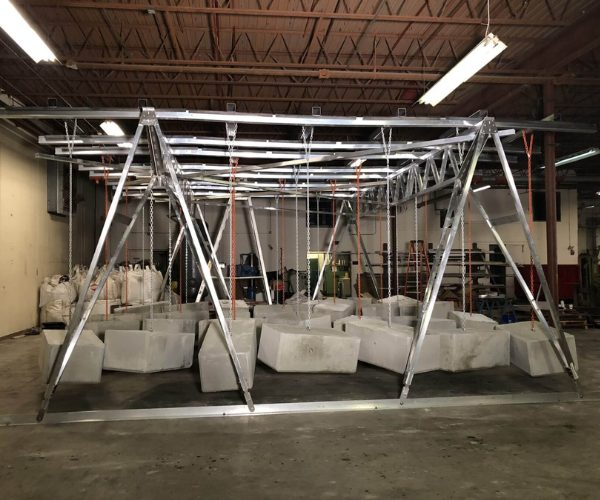
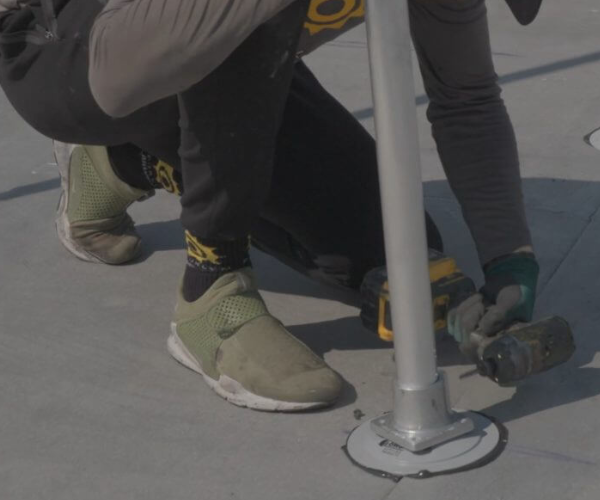
Our systems were engineered to withstand hurricane-force winds (left) and are always secures using watertight connections (right), ensuring stability in times of harsh NYC weather.
Knowledge and Skills
The technical knowledge required for solar installation is extensive. From understanding electrical systems to handling specialized tools, the skills needed are beyond the average DIY enthusiast.
Brooklyn SolarWorks has installed over 3,000 projects within the five boroughs since 2015, making us the local solar experts. Want to know how much your home could save with solar? Sign up for a free consultation today.
Solar System Components
Understanding the various components of a solar system and their functions is crucial. Proper installation methods ensure smooth and efficient energy generation for decades to come.
Logistical Installation Challenges in NYC
Installing solar panels in New York City comes with unique logistical challenges that can easily complicate a DIY approach, making the process more costly and time consuming than hiring a local professional solar installer.
Roof Suitability
Not every roof is ideal for solar panels. Roof pitch, orientation, and condition are critical factors that impact energy production and structural safety. Assessing these elements requires professional evaluation to ensure your roof can support solar panels effectively and efficiently.
Finding Equipment
Sourcing high-quality solar panels and equipment at competitive prices can be a daunting task. It involves extensive research to identify reliable suppliers and secure the best deals. Access to high-quality components is essential for a successful and long-lasting solar installation.
Tools and Resources
Proper installation requires specialized tools and resources, adding to the complexity and cost of a DIY approach. These tools are necessary for ensuring a safe and effective setup, making professional installation a more appealing and practical option for most homeowners.
For example, one such tool that is needed at the beginning of the solar evaluation process is the Suneye Shade Tool. The Suneye predicts how much solar power can be generated all year round, giving homeowners an estimate on how much energy they can generate on their roof. One Suneye tool costs over $3,000.
If you choose to go solar with a local professional company like Brooklyn SolarWorks, you will be able to start with a free solar consultation which includes: a custom solar design, an estimation on how much energy your system will create, your lifetime energy savings, and more!
Find out how much you can save with solar now with a free consultation.
Alternatives to DIY Residential Solar Installation
If you’re considering solar energy for your home, there are practical alternatives that offer ease and efficiency.
Hire a local, Licensed Solar Installer
Hiring a professional installer ensures your solar panels are set up safely and efficiently. Local experts are familiar with NYC regulations and can navigate permits and approvals seamlessly. Their experience guarantees optimal panel placement and system performance, saving you time and potential headaches.
For extra peace of mind on your switch to solar, Brooklyn SolarWorks also offers an industry-leading 30-year warranty and a 10-year Power Production Guarantee. We’re here for you from the first moment we talk on the phone to any post-installation maintenance that’s needed.
Subscribe to a Community Solar Program
Community solar programs provide access to solar energy without the need for personal installation. These programs allow you to subscribe to a shared solar farm, reducing your energy costs and environmental footprint. It’s a hassle-free way to enjoy the benefits of solar power, making it a great option for those with unsuitable roofs or rental properties.
DIY Solar Installation in NYC is Challenging and Risky
The solar installation process is filled with challenges and risks. From navigating permits and approvals to ensuring safety and technical precision, the complexities involved make DIY installation a daunting task.
For these reasons, opting for professional installation or exploring community solar options is highly recommended. Professional help not only ensures a smoother installation process but also maximizes the efficiency and longevity of your solar panel system.
Get the most out of solar power! Start your solar journey today with a free consultation!
Are you a solar owner with a quick question about solar panel maintenance? Are you considering installing solar panels on your home and wondering what kind of maintenance is involved? This guide is for you!
When you go solar with Brooklyn SolarWorks, our team will be there to answer any questions you may have and provide personalized guidance in taking care of your system. Continue reading to learn about the components of a solar system and why solar panel maintenance is a breeze.
Do solar panels need to be maintained in NYC?
If you’re considering solar, you may be wondering what kind of maintenance you’ll need to think about in the future. Good news! Maintaining a solar PV system requires very little effort.
Because there are no moving parts to a solar energy system, there’s not much that you actively need to keep an eye on. Cleaning your solar panels is not required either, because they’re angled in such a way that Mother Nature can typically take care of any build up of dirt or debris.
The most common issues we come across have to do with the system’s WiFi connection, which can happen if you change your network settings and is a simple fix.
All in all, solar is a very low maintenance renewable energy source for your home. But rest assured: if any issues or questions arise, we’ve got you covered. Get in touch with us to get started with solar.
How can I tell when my solar system needs maintenance?
Every solar panel system has an inverter, which we consider the “brains” of the operation. It has two important jobs: one, it converts the DC electricity generated by your solar panels into AC electricity used by your home and the utility grid. Two, it monitors the health of your solar array and stores performance data.
When it comes to solar panel maintenance, the inverter is key. It’ll be connected to your home’s WiFi, which enables the transmission of production data to our monitoring team and alerts us if anything is wrong.
The inverter is typically mounted in your basement near the main electrical service. It can also be placed on your roof attached to the solar array.

How do you maintain solar panels?
Solar panels are very low maintenance, but there’s a few things to keep in mind to operate and monitor your solar system.
Cleaning
Solar panel cleaning is not required. In NYC, we’re lucky to get rain relatively often. Your solar array is angled to allow rain water to run off naturally, taking with it any dust, pollen, or other debris.
If you do choose to clean your panels, however, avoid harsh detergents and metal or hard plastic brushes that could scratch the glass.
Snow Removal
We don’t recommend removing snow on your solar panels, as the power lost during snowstorms is extremely small. Snow will drift or melt off your panels naturally. Not to mention, it can be dangerous climbing up to a snowy, icy rooftop.
Repairs and Replacement
If your panels were installed properly, it’s unlikely that you’ll have to worry about repair or replacement. But things can happen – this is why it’s important to choose a trusted local installer that provides warranties for their equipment and service. Brooklyn SolarWorks provides a 30-Year Total System Warranty to give their customers peace of mind.
In the rare case that your solar panels need to be replaced or repaired, it’s best to get in touch with the company that installed them because they’ll be able to determine the best course of action for your system and your roof. If your system was installed by us, we’ll get a crew out to assess the issue and make repairs as soon as we can.
Rebooting Your System
Over the lifetime of your system, you may come across times when you’ll need to turn off or reboot your system, like if you have an electrician working in your home for example.
How do I turn my system off?
In the rare case that you need to turn your solar system off altogether, follow these steps:
- Turn off the DC disconnect. This is a black dial on the left side of your inverter.
- Turn off the AC disconnect. This will be either a circuit breaker in your main electrical panel, or a switch located outside your electric panel (it’ll be labeled as such). The system is now off.
- To reboot your solar panel system, turn both the DC and AC switches back on. Either order is fine, but turning on the AC connection first will allow the inverter to resume operation more quickly.
Monitoring Your System
After your inverter is connected to your WiFi network, we’ll register it in an online monitoring platform that allows you to track the performance of your solar array. Checking this data is a great way to monitor the health and performance of your solar system.
Performance data includes:
- Real-time output of your solar system
- Total energy output
- Approximate CO2 emissions avoided for the current day and lifetime of the system
- Basic information on system equipment
Additionally, our team actively monitors the performance of our entire fleet of solar systems against guaranteed output levels and receives automatic notifications should any errors occur.

How does NYC weather impact solar panels?
One of the most common solar myths out there is that solar panels won’t fare well in bad weather. In any given year in New York City, we can expect a range of weather conditions, from heatwaves, to hurricanes, to blizzards.
When it comes to solar, we prepare for this. The solar panel providers we use, typically Qcells, thoroughly test their panels against a broad range of extreme weather before going to market.
Brooklyn SolarWorks’s systems have also undergone extensive testing: our canopy system can hold around 48,000 pounds. This means it can withstand a blizzard’s worth of snow and over 120 mph winds — exceeding the city’s wind requirements. (For reference, when Hurricane Sandy made landfall in New Jersey, the highest recorded wind speed was 80 mph.)
Systems we installed back in 2016 are still up and running, despite being exposed to multiple hurricanes and snowstorms over the years. When you go solar, it’s important to choose an installer that uses high-quality solar panels and sound installation methods to ensure stability overtime.

Does my solar panel warranty cover maintenance?
Solar panel warranties can vary depending on the manufacturer, but most provide a standard warranty of 10 to 20 years. Typically, there are two components to a solar panel warranty: product and performance. The product warranty covers the equipment itself, while the performance warranty guarantees a certain power output over a set period of time. The specifics of each component vary depending on the provider.
Additionally, a good solar installer should provide their own warranties.
Brooklyn SolarWorks’ solar warranty package:
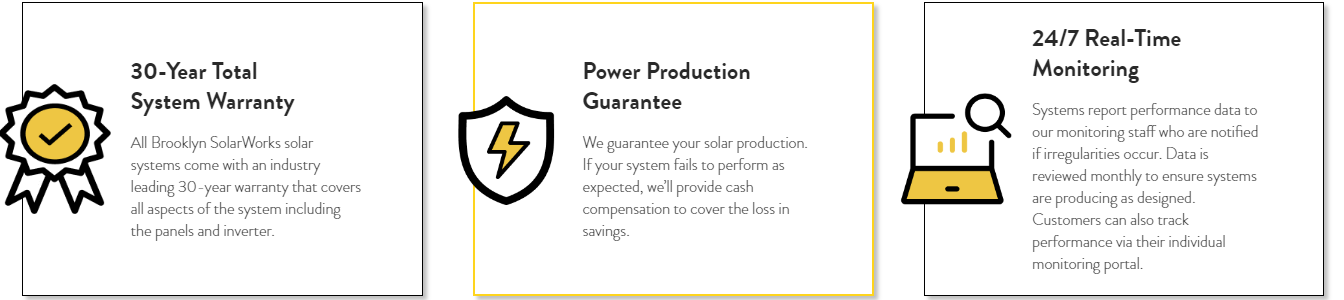
- 30 year total system warranty: Covers all aspects of the installation, including equipment and workmanship. We’re here for you before, during, and after your solar installation to provide any service or maintenance needed.
- 10 year power production guarantee: We build systems that are meant to last and produce power for your home. Your electric savings are guaranteed!
- 24/7 monitoring: We actively monitor all of our solar systems just in case any production issues arise.
It’s important to work with a solar company that provides a comprehensive warranty in the event your system ever needs maintenance.
Invest in a Power Source That’ll Last
When you invest in solar energy, you’re investing in a low maintenance, long-lasting energy source that’s actively reducing your carbon footprint. Overall, solar panel maintenance is a total breeze. But in the case that any issues arise, it’s important to know the basics of how your system operates and how to handle it.
If questions about solar panel maintenance are top of mind for you, it’s best to work with a trusted installer who uses high quality panels and installation methods. If you’re a homeowner in New York City, we’d love to help you switch to clean energy. Schedule a free consultation today!
Clean energy holds immense importance for nonprofits in New York City. By embracing renewable energy solutions such as solar power, nonprofits can not only reduce their environmental footprint but also strengthen their organizational resilience and deepen their impact on the communities they serve.
Read to learn more about the benefits of solar panels for nonprofits in NYC and find out if it makes sense for your organization!
Can Nonprofits get Solar Panels in NYC?
New York City nonprofits play a crucial role in serving communities and addressing societal needs. However, amidst the challenges they face, one question arises: Can nonprofits harness the power of solar energy to push their missions forward? The short answer is yes.
Now, not every roof in NYC is suitable for solar. Just like residential homes and businesses, nonprofit roofs need to be assessed. The ability to go solar depends on factors like energy usage, sun exposure, and roof space. What sets the stage for NYC-based nonprofits to make the switch to solar is the array of super-rich incentives that make solar panel adoption not only possible but highly affordable.

Want to see if your roof is fit for solar and what incentives you qualify for? Schedule a free consultation!
Benefits of Solar Panels for Nonprofits
Cost-Saving Benefits
Nonprofits often operate on tight budgets, with every dollar allocated to critical programs and services. Clean energy, such as solar power, offers a sustainable solution to reduce energy expenses. By generating electricity from renewable sources, nonprofits can lower and stabilize their utility bills, freeing up funds to invest in their core missions and better serve their communities.

Environmental Impact
In 2019, to combat the ever-looming climate crisis, New York City put in place the Climate Mobilization Act (CMA). The CMA will put NYC on the path to reducing building carbon emissions by 40% by 2030 and by 80% by 2050. For NYC-based nonprofits, running operations on clean energy can substantially reduce their carbon footprint, aligning not only with their practices with sustainability goals but the city’s as well.
Enhancement of Public Image
Public perception plays a crucial role in the success of nonprofits. Embracing clean energy initiatives, such as installing solar panels, enhances the public image of nonprofits as forward-thinking and socially responsible organizations. This can attract positive attention from donors, volunteers, and the broader community, bolstering support and amplifying the nonprofit’s impact.
Raise Awareness About Sustainability
Clean energy initiatives offer nonprofits valuable educational opportunities to engage with their communities and raise awareness about sustainability. Through programs, workshops, and outreach efforts centered around renewable energy, nonprofits can empower individuals to take action towards a greener future, fostering a sense of environmental stewardship and collective responsibility.

Long-Term Stability
Investing in clean energy provides nonprofits with greater stability and resilience in the face of fluctuating energy prices and regulatory changes. By generating their own renewable energy on-site, nonprofits can hedge against future Con Edison rate increases, ensuring more predictable operating expenses over the long term. This stability fosters organizational sustainability and strengthens the nonprofit’s ability to fulfill its mission in the years to come.
Solar Incentives for Nonprofits in New York
Federal Investment Tax Credit Direct Pay
Nonprofits in NYC can take advantage of the Federal Investment Tax Credit, which offers a tax credit equal to 30% of the post-rebate cost.
Unlike homeowners and for-profit businesses, tax-exempt entities like nonprofits are eligible for a direct pay option, meaning they can receive a cash payment for the value of the tax credit instead of using it to offset tax liability.
NYSERDA Solar Rebate
Nonprofits in NYC can also take advantage of the NYSERDA Solar Rebate, receiving $1.00 per watt for solar installations. This rebate further offsets the initial investment, making solar energy even more accessible for nonprofits.
Steps to Acquire Solar Panels for Nonprofits in NYC
Work with a Reputable Local Installer
Partnering with a reputable local installer, like Brooklyn SolarWorks, ensures quality workmanship, expertise in navigating local regulations, and ongoing support for your system.

Analyze Energy Needs and Potential Savings
Collaborate with your installer to analyze your organization’s energy needs and potential cost savings from solar panels. This helps in determining the optimal system size and design. You can get all of these answers and more by setting up a free consultation today!
Conduct Site Evaluation for Solar Panel Installation
Ensure your building is suitable for solar panels by conducting a thorough site evaluation with your installer. Factors such as roof orientation, shading, and structural integrity should be assessed.

Secure Funding and Determine Incentive Eligibility
Securing the necessary funding for your solar project is essential to its success. Explore various financing options, including grants, loans, and fundraising campaigns, to cover the upfront costs of solar installation.
Additionally, work closely with your accountant to determine your nonprofit’s eligibility for solar incentives, such as the Federal Investment Tax Credit and NYSERDA Solar Rebate. By leveraging these incentives, you can significantly reduce the financial barriers to solar adoption and accelerate your organization’s transition to clean energy.
Funding Solar Projects for Nonprofits
Funding solar projects can bring about many challenges for local nonprofits. The upfront costs for solar and assessing your financing options can be daunting.
Luckily, NYC is a place that is rich with solar incentives. By signing up for your free consultation with Brooklyn SolarWorks, we will be able to help you navigate what government incentives you qualify for as well as different payment options available for your project.
Besides incentives and financing, nonprofits can also fund their solar projects through the means of crowdfunding, fundraising, and community partnerships.
Getting the local community involved in fundraising for your solar project also brings many other benefits like:
1. Building Awareness
Engaging the community raises awareness about the benefits of solar energy and the importance of sustainability, garnering support for solar projects.
2. Mobilizing Support
Community engagement mobilizes financial contributions, volunteer efforts, and in-kind donations to support solar initiatives, helping nonprofits reach their fundraising goals.
3. Fostering Collaboration
Collaborating with local stakeholders fosters partnerships and collective action, enabling nonprofits to pool resources and leverage community support for solar projects.
4. Demonstrating Impact
Community involvement demonstrates grassroots support and showcases the positive impact of solar projects, enhancing the credibility and effectiveness of nonprofit initiatives.
Find Out if Solar is Right for Your Nonprofit
The benefits of solar panels for nonprofits in NYC are ever-growing, ranging from cost savings to environmental stewardship and enhanced public image. With a wealth of incentives available and a clear roadmap for implementation, nonprofits can harness the benefits of solar energy to advance their missions and create a brighter, cleaner future for all.
Take the first step today by securing your free consultation and join the clean energy revolution!
A $23 billion market opportunity incites increased NOI driving cap rates and real estate values in NYC
Mayor Adams’ City of Yes zoning initiatives are modernizing New York City’s zoning regulations to move the city towards more equitable and sustainable living. The landmark legislation, which features a Carbon Neutrality zoning amendment (COYCN), was passed into law this week relaxing restrictions on solar developments, furthering both the city and state’s efforts toward carbon neutrality.
The new zoning regulations abolish the coverage and setback restrictions for rooftop solar installations which have historically hampered the expansion of clean energy developments. With the setback regulations pardoned for solar installations, huge swaths of real estate which were not previously viable for solar development will be made available – in some cases as much as doubling the square footage available on one rooftop. This will result in millions of additional kilowatt hours of clean electricity over the lifetime of systems. In addition, the law will allow for solar canopies to be installed over the city’s 8,500 acres of parking lots, adequate space hundreds of additional megawatts of clean energy production – enough to power tens of thousands of homes and apartment units in New York City.
Provisions to the zoning laws also offer a boon to property owners in the city. Lower utility costs associated with the installation of solar which will increase profits and drive real estate values.
Commenting on passage of City of Yes Brooklyn SolarWorks’ founder and CEO, T.R. Ludwig said, “This is a landmark moment in New York’s effort to boost green technologies and support carbon neutrality. Solar energy’s potential will now be fully realized as a renewable energy resource for all New Yorkers. By removing zoning restrictions that held back installation of solar panels on many homes, thousands more New Yorkers will be able to enjoy the benefits of solar energy. We applaud Mayor Adams and City Council for taking this historic step forward towards a greener and more energy efficient future.”
T.R. Ludwig is a clean energy leader with over a decade of experience in various management and executive roles within the solar industry. He is the CEO and co-founder of both Brooklyn SolarWorks and Brooklyn Solar Canopy Co. and serves as Treasurer for New York Solar Energy Industry Association (NYSEIA), a trade group representing the solar industry. He has led solar companies both large and small, with a focus on sales, marketing, and finance, and helped pioneer solar lending in the Northeast market. T.R. received his MBA from the Maastricht School of Management in the Netherlands and was among the first solar professionals in the United States to become NABCEP Technical Sales certified.
To learn more about Brooklyn SolarWorks, contact us at info@brooklynsolarworks.com.
If you’re a property owner wondering how these zoning updates affect your solar potential, schedule a consultation with us!
NYC is rapidly becoming one of the most sustainable cities in the United States. Multiple plans for tackling climate change are in the works as New Yorkers are realizing that environmental issues are on the rise worldwide – and in our own backyards, too. We all can create a positive impact on our environment, making NYC sustainability a reality for our neighborhoods.
Is New York City a sustainable city?
Carbon emissions, landfill waste, air and water pollution and the use of fossil fuels has always been an issue for the concrete jungle known as the Big Apple. With its ambitious sustainable development goals, New York City is making major strides towards becoming a sustainable city through initiatives in transportation, waste management, retail, and energy.
The City has shown great progress by implementing legislation that’s facilitating a sustainable future. For example, the Climate Mobilization Act, enacted in 2019, set the city on a path towards carbon neutrality. The Zero Waste Act has also started taking action by making composting accessible to ALL New York residents and will put the city on track to mandatory composting by Spring of 2025.
Bike sharing programs such as Citi Bike and Revel have been developed and expanded upon to encourage the use of alternative forms of transportation and reduce gasoline-powered vehicle use. Citi Bike has around 40,000 bicycles in NY, granting New Yorkers greater accessibility to bike riding. Plus, the Department of Transportation is on track to install a record number of protected bike lanes, harden more than 10 miles of existing bike lanes, and to use sturdier materials in new bike lanes. With safer bike lanes being created, the DOT is seeing an all time high of bike ridership!

Unlike conventional bus transportation, hybrid MTA buses use a diesel hybrid electric propulsion system which relies on both fuel and electricity, resulting in a reduction of gas emissions in public transportation. The MTA revealed it has over 1,300 low-emissions hybrid buses and 399 2nd generation hybrid buses up and ready to transport New Yorkers to their destinations.
Lastly, with NYC incentivizing residential solar installations, the solar movement is alive and well. Because of the tax incentives and electricity bill savings it provides, solar has become a great option for homeowners. As a local solar installer, we’ve completed over 3,000 installations in NYC and continue to see growth in interest from New Yorkers of all boroughs!
Interested in solar for your NYC home? Get in touch with us.
Environmental Sustainability Issues in NYC
Although it’s fair to say that NYC is making much-needed strides to become a more environmentally-friendly city, we still have a long way to go to protect our future as the climate crisis looms.
Air Pollution and Quality
In general, due to the City’s hard work towards lowering local emissions, NYC has been seeing consecutive decent air quality since 2017 with an average AQI of below 50! Even though air quality in NYC is progressing, it still remains a leading environmental health threat to all New Yorkers. Emissions from transportation, commercial and residential heating, industrial activities, and more contribute to the city’s air pollution challenges. On June 7, 2023, New York City had the worst air quality in the world reaching an AQI of 405 out of 500 due to wildfires in Canada. This year’s wildfire season in Canada is on track to be the most destructive in history, made more severe by climate change-induced droughts and extreme temperatures. For us New Yorkers, it’s safe to say it could become a recurring issue.

Greenhouse Gas Emissions
New York City emits a substantial amount of greenhouse gases. NYC buildings make up a majority of the city’s greenhouse gas emissions, accounting for over 70% of total emissions. These emissions contribute to global climate change, prompting the city to take proactive steps to reduce its carbon footprint.
Waste Management
NYC is a city full of waste – simply taking a walk around your neighborhood on garbage day is proof of that! Our city sends millions of tons of waste to landfills and incinerators every year, which in turn releases tons of emissions. In 2015, Former Mayor De Blasio set a goal of sending zero waste to landfills by 2030, a goal which necessitates the development of stronger recycling and composting programs in order to divert waste. In 2024, curbside composting will be expanding to ALL NYC residents!

Water Management
As a coastal city, NYC must protect its water resources from pollution, aging infrastructure, and rising sea levels. Sustainable water management practices are essential for safeguarding the city’s future.
Urban Heat Island Effect
The concrete and asphalt of NYC can create an urban heat island effect, leading to higher temperatures in the city compared to surrounding areas. This effect can have adverse consequences on public health and air pollution levels as well as increased energy costs (higher AC usage).
Biodiversity Conservation
Preserving biodiversity is crucial for a healthy environment. NYC strives to protect its natural areas and diverse ecosystems. The NYS Pollinator Protection Plan is one effort the NYS Dept. of Environmental Conservation takes to conserve biodiversity in the area.
Coastal Resilience
With its vulnerability to sea-level rise and extreme weather events, NYC is investing in coastal resilience efforts to protect its communities and infrastructure. The Lower Manhattan Coastal Resiliency (LMCR) is the City’s plan to adapt Lower Manhattan to climate impacts, for this generation and the next. This plan will protect Manhattan from flooding via sea level rise and coastal storms. The plan will ensure the area’s continuity in serving the many businesses, residents, workers, visitors, and commuters in the area who rely heavily on its transit network and want to remain in their dynamic neighborhoods.

Transportation
Even with NYC’s extensive public transit system, there’s still a great reliance on cars. In New York City, transportation accounts for 30% of its greenhouse gas emissions. Looking to transition to an electric vehicle? In 2022’s federal climate bill, all Americans are now eligible for a $7,500 tax credit for purchasing a new EV and $4,000 for a used vehicle. To go even greener, you can pair your EV with rooftop solar for maximum environmental impact!
Energy
NYC’s energy consumption is enormous and Con Edison’s recent price hikes for electricity is a bit alarming. Transitioning to cleaner energy sources, like solar, is essential for reducing the city’s carbon footprint and saving you some cash. See if your home qualifies for solar today!
What is NYC doing about Climate Change?
Former Mayor Bloomberg kicked off his initiative for a greener city by implementing the PlaNYC in 2007. PlaNYC was implemented to support efforts to reduce waste with recycling, to create parks within every neighborhood, to adopt renewable energy sources, and to improve air quality.
This plan was absorbed into OneNYC in 2015. OneNYC takes PlaNYC’s goals further by promising to cut greenhouse gas emissions by 80% by 2050. With the former Mayor De Blasio issuing an executive order to adopt the goals of the Paris Climate Agreement in 2017, New York City established itself as a city that takes climate action.
Another plan in action is the NYC Climate Mobilization Act (CMA), passed by the City Council in 2019. This legislative package is a set of sustainability laws that put NYC’s buildings on a path toward lower greenhouse gas emissions. Local Law 92 and 94 are a pair of laws mandating the installation of “sustainable roofing zones” – a green roof, solar panels, or a combination of the two – on all rooftops undergoing major construction. Local Law 95 requires buildings to display their energy efficiency grades on for the public to see. Local Law 96 established Property-Assessed Clean Energy (PACE) financing to help building owners fund energy efficiency upgrades.
Considered the cornerstone of the CMA, NYC Local Law 97 set emissions limits for buildings greater than 25,000 square feet. These buildings are required to reduce their emissions by 40% by 2024 and then by 80% by 2050. Owners of these buildings must submit their yearly emissions reports starting in May 2025 or they will face heavy penalties.
How New Yorkers Can Positively Impact NYC’s Environment
Although our city officials are implementing plans to help the environment, there’s ways New Yorkers can positively contribute to the fight against climate change and reduce their carbon footprints too.
1. Invest in Solar Energy & Switch to Electric Appliances
If you’re a homeowner in NYC, one of the best ways to make an impact is by investing in a rooftop solar system. Solar panels allow you to harness the sun’s energy to power your home, reducing, or eliminating, your reliance on fossil fuels coming from the grid. Once you install solar, you have access to clean, reliable, and free energy for decades.
Many of our customers choose to take their impact even further by electrifying their homes. Making all-electric upgrades to your home, such as air source heating and electric water heating, after going solar allows you to run your home completely clean. Upgrading to electric appliances not only helps you save on energy costs, but it also supports a cleaner and healthier environment for you and your loved ones.
Want to learn more about installing solar on your NYC home? Get in touch with us.
2. Support Local Agriculture
Urban farming is crucial to NYC’s sustainability efforts. Buying produce locally helps to cut down on waste and on emissions from transportation, and supports local biodiversity. Local farming also improves air quality and gives communities access to affordable, fresh food.
Farmer’s markets are an excellent way to support local agriculture – GrowNYC hosts Greenmarkets every week at locations throughout the five boroughs, including Union Square in Manhattan and Grand Army Plaza in Brooklyn. Some Greenmarket events also offer textile recycling and composting opportunities.
Depending on where you live or work, rooftop gardening is something you can take up on your own. In fact, Brooklyn SolarWorks’s HQ now has its very own rooftop garden! Our garden has a variety of fruits and vegetables, like strawberries, peppers, eggplants, edamame, carrots, watermelons, bok choy, and more.


3. Shop Local & Second Hand Products
Shopping locally benefits the local economy and the environment. It reduces waste and cuts down on transportation emissions. Purchasing clothing or home goods second hand from thrift stores, consignment shops, or stoop sales can help to reduce waste (and help you find something unique!).
Check out Big Reuse or Beacon’s Closet for local second hand clothing, furniture, and other home goods.
4. Compost and Reduce Plastic Use
Composting is the practice of recycling organic waste, like leftover food, into fertilizer for soil or energy. Composting does wonders for the environment – it cuts down on methane emissions from food waste, reduces the need for chemical fertilizer, and aids in water retention in soil.
The Zero Waste Act passed in New York City, making composting mandatory for all NYC residents by April of 2025. As of now, Curbside Composting is available for all Queens residents and will roll out for Brooklynites October 2, 2023. To continue making composting accessible for New Yorkers, there are also a number of food scrap drop-off sites throughout the city.

5. Use Alternative and Sustainable Forms of Transportation
Fortunately, we live in a city that provides plenty of transportation alternatives. With the subways, buses, and bike shares available, there are now many ways to get around without using a car. When you choose to utilize these means of transportation as opposed to cars, you can significantly reduce your personal carbon footprint.
6. Educate Others on Sustainability and Get Involved
Sustainability efforts spread by word of mouth. Choosing to make sustainable lifestyle changes can have a ripple effect. By encouraging your friends, family, and neighbors to take public transportation, recycle more often, or install solar on their homes, you can make an impact within your very own community.
7. Conserve Energy and Water
Conserving energy and water is more than turning off the lights when not in use and fixing leaks. Many New Yorkers are making energy efficient home improvements to save money on their bills, add value to their homes, and reduce their personal carbon footprint! Some of these home improvements include: additional home insulation, switching to an electric heat pump water heater, and professionally sealing their homes.
8. Support Green Spaces and Biodiversity
Participate in community gardens, tree planting, and wildlife conservation programs to enhance urban biodiversity! A few of our favorite green spaces throughout the city is the Brooklyn Grange Farm, Brooklyn Botanic Garden, and Brooklyn Bridge Park! There’s a lot of sustainable areas and activities in NYC, if you know where to look.
Reducing Your Carbon Footprint One Day at a Time
NYC sustainability efforts are moving a positive direction, with New Yorkers pitching in on both legislative and individual levels. New York City deserves to become a city that is cleaner, safer and more sustainable for you, your loved ones and the next generation thereafter.
If you’re a homeowner in NYC, switching to clean energy is one of the best ways to make a difference. After installing solar, you’ll be able to say that you are making a difference on our planet and our city.
Ready to make the switch? Contact us to get started.
If you’re the owner of a commercial property or co-op building in New York City, you may be subject to NYC Local Law 97. Passed in 2019, this law sets stringent standards for reducing the greenhouse gas emissions of large buildings throughout the city.
With the initial compliance period for LL 97 beginning in 2024, now’s the time to determine whether your building is impacted by this law and how you can achieve compliance. Read on for everything you need to know about NYC’s Local Law 97.
What is Local Law 97?
Considered the cornerstone of the NYC Climate Mobilization Act, NYC Local Law 97 set carbon emissions limits for buildings greater than 25,000 square feet. In accordance with city goals, these buildings must reduce their emissions by 40% by 2030, and by 80% by 2050.
LL 97 set two initial phases of emissions limits for these buildings. The first phase begins in 2024 and continues until 2029, while the second, more stringent phase will take place in 2030-2034. The limits were set based on several different building use classifications and sizes. Buildings must submit yearly emissions reports starting in May 2025, and face penalties for exceeding emissions limits.

Why was NYC Local Law 97 created?
The NYC Climate Mobilization Act (CMA), otherwise known as NYC’s Green New Deal, was passed by the New York City Council in 2019. It put NYC on the path to fighting climate change by reducing building carbon emissions by 40% by 2030 and by 80% by 2050.
The largest climate legislation of any city in the world, the CMA consists of several laws aimed at reducing GHG emissions across the city, with special attention paid to improving the energy efficiency of both residential and commercial buildings.
One of these laws was NYC Local Laws 92 and 94 – also known as the Green Roof Law – which mandated that all new roof construction must add either a green roof, a solar PV system, or a combination of both. Another of these laws was LL 97, which set specific emissions reduction limits for NYC’s large buildings.
Reduce Greenhouse Gas Emissions
The main goal of NYC Local Law 97 is to significantly reduce the greenhouse gas emissions of NYC’s large buildings. NYC buildings make up the majority of the city’s greenhouse gas emissions. In fact, buildings account for over 70% of total emissions – surpassing even transportation emissions. The source of these emissions is energy consumption from electricity use, heating, and cooling, which can add up particularly in larger buildings.
Promote Energy Efficiency
In order to reduce their emissions in the coming decade, building owners will have to invest in energy efficiency measures. This could look like upgrading to electric heating and cooling systems, improving the building’s insulation, or powering it with solar energy. Creating more energy efficient buildings has the added benefit of decreased energy costs for building owners and reducing stress on the city’s power grid.
Improve Air Quality
Reducing emissions from buildings will result in better air quality for all New Yorkers. One of the biggest contributors to NYC’s poor air quality is the burning of fossil fuels for heating, electricity, and transportation. Moving towards a power system that is more energy efficient and less reliant on fossil fuels will create a healthier city.
Enhance Climate Resilience
One of the biggest challenges facing our city is preparing for the effects of climate change, like severe storms and heatwaves. Improving the energy efficiency of our buildings will help strengthen the power grid and make our city more resilient in the face of future severe weather events.

What are the requirements for buildings in LL97?
Under Local Law 97, most buildings in NYC over 25,000 square feet are required to meet new greenhouse gas emissions caps by 2024, and stricter caps by 2030. The emissions limits vary depending on the building type, but generally lead towards the goal of reducing emissions by 40% by 2030 and 80% by 2050.
Starting in May 2025, buildings are required to submit an annual Greenhouse Gas Emission report to the Department of Buildings demonstrating compliance. If the building is non-compliant, the report must show by how much the building exceeded its limit.
How are emissions limits determined?
Initially, emissions limits were set based on building classifications in NYC Building Code occupancy groups, but have since been revised to create more equitable emissions limits.
The new building classifications were established based on property types in the US Environmental Protection Agency’s Energy Star Portfolio Manager, which reflect real patterns of energy consumption in NYC buildings.
Because of this change, buildings whose emissions limits were made more stringent have the option to follow the original limit if they choose. However, this is only for the calendar years 2024 and 2025 – in 2026, they’ll be required to follow the Energy Star limits.

What are the timelines for compliance?
This law sets emissions limits for two separate compliance periods.
First Compliance Period (2024 – 2029)
The first compliance period begins in 2024 and ends in 2029. Building owners must begin submitting their emissions reports by May 1, 2025, which will reflect the calendar year 2024.
Second Compliance Period (2030 – 2034)
The second compliance period will take place from 2030 to 2034. At this time, stricter emissions limits will go into effect.
What are the penalties for non-compliance?
The penalty for not complying with LL 97 is a fine, calculated by taking the difference between a building’s annual emissions limit and its actual emissions (in metric tons), then multiplying the difference by $268. The Department of Buildings may also issue violations to buildings that are non-compliant.
Annual fines for buildings that are non-compliant will begin to be issued in 2025.
Which department will be enforcing LL 97?
The primary city authority enforcing LL 97 will be the Department of Buildings. Building owners will need to submit their emissions reports to the DOB, and the DOB will also issue penalties and violations for non-compliance.
How do I know if LL97 applies to my building?
NYC Local Law 97 covers the following buildings:
- Buildings greater than 25,000 square feet
- Two or more buildings on the same tax lot that, combined, exceed 50,000 gross square feet
- Two or more buildings owned by a condo association that are governed by the same board of managers and that, combined, exceed 50,000 gross square feet
This covers around 27,000 of NYC’s buildings, the majority of these being residential. Rent regulated residential buildings and affordable housing may be able to delay compliance until 2026 or follow a Prescriptive Pathway as an alternative.
We recommend using NYC Accelerator’s Building Energy Snapshot tool to get specific information about your building’s energy use and its compliance status.

Covered Multifamily Buildings
When you think of large buildings in NYC, you may only think about the skyscrapers and luxury high rises in Manhattan.
However, there are around 18,000 multifamily buildings in NYC that are covered by LL 97, which accounts for 60% of the covered square footage. And of these buildings, most are low-rise (7 stories or fewer) and either pre-war (built before 1940) or post-war (1940-1980). Overall, pre-war, low-rise buildings are the ones who have the most LL 97 work to do.
Certain neighborhoods in NYC have greater proportions of these types of buildings than others. Neighborhoods with the most census tracts made up of more than 50% of these buildings include:
- Central Brooklyn: Park Slope, Cobble Hill, Carroll Gardens, Bed Stuy, Clinton Hill, Brooklyn Heights
- North Brooklyn: Greenpoint, Williamsburg, Bushwick, Ridgewood
- South Brooklyn: Sunset Park, Bath Beach
- Queens: Astoria
- Manhattan: Soho, Harlem, Lower East Side
- Bronx: Port Morris, Van Nest, Soundview
If you own an apartment in an older, low-rise multifamily building in one of these neighborhoods, there’s a good chance it’s covered by NYC Local Law 97 and will benefit from solar energy.
What are the implications of LL97 for NYC building owners?
If you’re the owner of a covered building, there are some important implications and considerations to think about as the first compliance period approaches.
Determine Your Building’s Emissions Limit
The first step should be to determine your building’s emissions limit. If you’re the owner of a co-op, there is a specific limit set for Multifamily Housing. If you own a commercial-use building, there are a variety of classifications you may fall under.
To determine your emissions limit, refer to the DOB’s ESPM Property Types.
Consider Compliance and Penalties
It’s important to consider that the city will be penalizing buildings that do not comply with LL 97, and the penalties could be costly.
You can estimate your building’s carbon penalty using Building Energy Exchange’s free calculator and following these steps:
- Click “Find Your Building” to input your address
- Click “Next” on the upper right side
- Insert values for solar PV to see the added benefit of solar power.

Invest in Energy Efficient Upgrades & Sustainable Technology
To comply with Local Law 97, you’ll likely need to make some energy efficient improvements to your building. This could include:
- Electrifying your HVAC systems and hot water heating with heat pumps
- Installing solar to power your building
- Retrofitting your common area lighting
- Improving your wall and roof insulation
- Installing an energy management system
Investing in efficient, sustainable technologies will not only help you comply with LL 97, but can save you tons of money on energy costs in the long run. To get free, personalized guidance on how to upgrade your building, contact NYC Accelerator.
To learn about how solar can help you comply with LL 97, schedule a free consultation with us.
Financial Considerations & Affordability
Once you determine which energy upgrades you’ll need to make, you’ll need to consider your finances. Depending on the size of your building and the scope of the upgrades, it could be a pretty hefty investment.
However, there may be financing options available through the city that have little to no upfront costs and can make your upgrades much more affordable. NYC Accelerator’s Financing Specialists can help you find the right financing option for you. There are also tax incentives available for solar and for electric upgrades, made possible by the 2022 Inflation Reduction Act.
Impact on Building Valuation
Investing in energy efficiency measures and sustainable construction has the added benefit of boosting your property’s value. Under Local Law 95, buildings get an energy efficiency grade based on their Energy Star scores and are required to display them. Though there are no legal consequences for having a low score under LL 95, low energy efficiency grades imply higher utility bills for tenants and buyers.
In today’s market, sustainability is a valuable selling point. In fact, home solar has been proven to increase property resale value in NYC by up to 5%. Your LL 97 retrofits will not only help you comply with the law, but provide a lot of value for your building too.
Make a Positive Environmental Impact
All in all, you’ll be making a pretty significant impact on your building’s carbon footprint by complying with NYC LL 97. Reducing your emissions not only helps NYC do its part in the fight against climate change, but it also contributes to a healthier city overall.
Future-Proof Your Building
Making energy efficient, sustainable upgrades will help your building become more resilient in the face of climate change-related weather events, including heat waves and severe storms. It’ll also lower your energy costs and make them more predictable, in a city where energy rates are on the rise year after year.

Solar Energy Can Help NYC Buildings Comply with LL 97
Installing solar panels on your multifamily building or commercial property is an excellent way to work towards complying with Local Law 97. Powering your building with clean energy reduces your emissions substantially, and it’s a great financial investment too.
Solar can not only help you avoid Con Edison’s ongoing rate hikes, but also help you avoid potential carbon penalties. According to the law, adding solar will reduce LL97 penalties by ~7.7 cents per kWh from 2024-2029, and ~3.9 cents per kWh from 2030 on. Installing solar now will help you save lots of money in the long term, both in energy costs and potential fines.
Go Solar Today to Avoid Future NYC Local Law 97 Penalties
The first compliance period for NYC Local Law 97 is coming up fast. One of the best ways you can prepare right now is to talk to us about installing solar on your property. Due to the permitting process in NYC, it can take anywhere from 4 to 6 months to install your project once you sign on.
Now’s the time to get started on the road to LL 97 compliance. Schedule a free consultation now!
If you’re looking for a solar installer in New York City, you may be wondering whether it’s best to choose a large, national solar company or a smaller local installer. Like any home improvement project, choosing the right contractor will determine the outcome and your overall customer satisfaction.
Here in New York City, solar energy installation is much different than the rest of the country, and requires certain expertise – and that’s where local installers come in! There are a number of benefits to using a local solar installer in NYC. Read to learn why.
Local Solar Installer vs. National Companies
The U.S. solar industry is a mix of large solar companies that install nationwide, and many smaller companies that install in different regions or metropolitan areas. Some of the big names you may come across when searching for solar installers are Sunrun, SunPower Solar, and Tesla Solar. Depending on your area, you’ll most likely also find a number of local and regional companies of varying sizes.
The type of solar installer you choose to work with is a big factor in determining your experience as a customer, as well as the solar energy system you end up with and how much it’ll cost. This is especially true in a place like New York City, where there are inherent system design challenges and lots of regulatory hoops to jump through.
The truth is, the national company that installs solar power in the suburbs of Texas, California, and Florida, is not going to have the design and regulatory expertise that a solar installer local to NYC does.
How to Know if a Solar Company is in Your Local Area
To know if a solar company is local or not, you can simply take a look at their service area and where their office is based. There are a number of different companies in the NYC metropolitan area that claim to be local to the five boroughs, but are based in Long Island, New Jersey, or upstate New York. Brooklyn SolarWorks has been based in and servicing NYC since it was founded.
Another clue is what a company’s work looks like. If you’re a resident of Park Slope, Bed-Stuy, or Harlem, you’re very familiar with what houses in your area look like: brownstones and townhouses attached to neighboring homes with, by and large, flat roofs. This is our bread and butter, and by taking a quick look around our website or social media, this will become clear.
Many of the larger regional and national companies feature photos of solar panels on suburban, single-family homes with shingled, pitched roofs detached from their neighbors (not the most common sight in the five boroughs).


Benefits of Working with a Local NYC Solar Installer
New York City’s architecture is as unique and diverse as its people. And for that reason, there are unique considerations to be made when installing a solar panel system here. Here are a few of the many benefits to using a local solar installer in NYC.
Personalized Service for NYC Homeowners
Being a local solar installer means more to us than simply servicing the five boroughs. It means developing unique designs that fit the needs of each customer. It means having an unmatched knowledge of city architecture, building codes, and FDNY regulations, and knowing how to navigate them to get each project done.
All of this allows us to provide unrivaled knowledge and service to our customers and an extremely high quality product. When you receive a proposal from us, it’s personalized to your home, roof, and energy needs. Because our team is headquartered in NYC, we have the ability to assess every home prior to proceeding with the installation.
In many cases, larger national companies will propose solar designs that end in canceled projects, regulatory issues, or additional expenses because they didn’t assess the roof or don’t know quite how to navigate NYC regulations. In other cases, customers are left in the lurch when issues come up after the installation.
Because we pride ourselves on providing feasible solar proposals from the jump, we’re able to reduce change orders and get all of the necessary permits through the regulatory process seamlessly. And once your system is up and running, we have staff on-call to help with any issues or questions you may have.
Local Knowledge of NYC Regulations and Incentives
For us, solar is a turnkey process. That means it’s on us to obtain all of the necessary permits and approvals from various city entities prior to the installation.
You’d be surprised how many city agencies we’re required to get approvals from before installing a solar system – in fact, the entire process takes an average of three months from contract signing. From the FDNY, to the Department of Buildings, to the Landmarks Preservation Commission, to Con Edison, it’s a lot of paperwork. But we’ve developed an unparalleled mastery of all of it, and built strong working relationships with each agency. Over the years, we’ve managed to get the process down like clockwork.
Not only that, but we’re very knowledgeable when it comes to the unique financial incentives that are available to New York City homeowners who go solar. For example, there’s not only a federal solar tax credit, but also a NYS solar tax credit and a NYC property tax abatement too. Have questions about how net metering will change your energy costs and electric bills from Con Ed? Ask us!
“BSW is the best. Started the process in February and had my system installed in the end of May. Right in time for summer. Every step has been on time. If you are in the 5 boroughs, do not look any further. Reach out to BSW.
On install day the team showed up on time as promised. Everyone on the team was very polite and informative of what they were doing. Born and raised in Brooklyn how couldn’t I go with a local company. I will definitely be recommending BSW to all my neighbors, friends and family!“
German L. – Google Review
Timely Installation and Customer Service
If timely, reliable service is what you’re looking for, local is the way to go. We can complete most solar panel installations within one to two days, depending on the project and weather. Should any issues arise during or after the installation, we’re just a quick drive away and will resolve it as soon as we can. Our proximity to our customers allows us to provide high quality installation, monitoring, and aftercare services that are unlike any other company in the area.
Unfortunately, bigger companies don’t always provide the same kind of service. We’ve heard many stories of people struggling to get in touch with these national companies when they have post-installation issues.
When you go solar with us, we’ll be monitoring your system’s performance 24/7 and will be ready to take your call if you ever have any questions or concerns about your system. It’s important to us to maintain good relationships with our customers for the long-term – we’re your neighbors after all!

Support for NYC Economy
Supporting local businesses is critical for the local economy. When you buy solar from us, you’re supporting a team of over 70 fellow New Yorkers and helping to create more job opportunities for others. Buying solar locally means not only investing in our mission to spread renewable energy, but also in the city as a whole.
Positive Environmental Impact for NYC Residents
Choosing to power your home with solar will significantly reduce your carbon footprint. But buying solar from a local company will maximize that impact. Buying locally reduces emissions, largely from transportation – our crews are coming to you from Gowanus, not from out in Long Island or New Jersey. Plus, most of our employees take public transit or bike to the office – which is powered by clean energy!
Not only that, but our leadership team is on the frontlines of New York solar policy, working to advance solar adoption throughout the city and state. Improving sustainability and climate resiliency in New York City is personal for us, and that’s why we do what we do.
National Companies Installing Solar in NYC
If you’re looking into solar in the NYC area, you’ll likely come across a few national solar companies that service the five boroughs. These companies might be:
- Sunrun
- SunPower Solar (owner of regional dealers including Empower Solar, Kamtech Solar, and Sea Bright Solar)
- Tesla Solar
These big names are recognized as leaders in solar, but are also synonymous with “big box” solar and aggressive marketing tactics. We want to emphasize that solar in New York City is unique, and a big box approach is not the best fit. We’ve heard countless stories from customers that they were told by these companies, for example, that their flat roofs aren’t compatible with solar (they totally are) or that solar battery systems, like Tesla Powerwalls, are permitted (they are not yet allowed in NYC due to FDNY regulations).
If you’re a homeowner here, we urge you to speak with a local installer who understands your home and your city.
Start the Solar Process Today with a Local Installer!
Solar is an investment unlike any other home improvement project. It’s important to work with a contractor who will get your project done right, and make sure it provides the best return possible. In New York City, that means working with a local installer.
Brooklyn SolarWorks was founded in New York City, for New York City, and we’d love to help you go solar. Get started by scheduling a free consultation today!
Due to Con Edison’s price hikes in recent years, solar energy has become a popular and sustainable alternative to traditional sources of energy in New York City. Even with its growth in popularity, many people are still curious about whether solar panels work at night.
The short answer is: No. Solar panels do not generate energy at night.
But even though solar panels don’t work at night, there are still ways to keep your home powered by the sun all day (and night) long! Read on to explore the mechanics of solar energy, why solar panels don’t generate energy at night, and how net metering keeps solar-powered New Yorkers energized all year ‘round!
How Solar Energy Works
Sunlight is made up of tiny particles called photons. Solar panels work by using the photovoltaic effect to convert these photons into direct current (DC) electricity. This DC electricity is then sent to an inverter, which converts it into alternating current (AC) electricity.
AC electricity is used to power homes, co-ops, businesses, and the grid. Since solar panel systems are connected to a utility meter, any excess electricity is exported to the grid and credited to the property owner via net metering.

Why don’t solar panels work at night?
Solar panels don’t work at night because they require sunlight to generate electricity. Without sunlight, the photovoltaic (PV) cells, or solar cells, in the panels cannot create an electric field, and therefore cannot generate electricity. This is also why your solar energy system may produce slightly less on a cloudy day than it would on a clear, sunny day.
Can other sources of light power my solar panels at night?
Solar panels require direct sunlight to generate electricity, so other sources of light, such as moonlight or streetlights, cannot power them at night.
Interestingly, there are solar technologies being developed that use the change in temperature of solar panels to generate electricity (such as thermoelectric generators), but they are still in the experimental stage and not widely available.
Storing Solar Energy for Nighttime Use
A big solar myth is that solar doesn’t work when it isn’t sunny. While solar panels cannot generate electricity at night, the good news is that solar energy can still be stored for nighttime use. In fact, there are two main ways to store solar energy: net metering and battery storage.
Net Metering
Net metering is a billing mechanism that allows you to store your solar energy as a retail energy credit to be used at a later date.
As a NYC residential solar owner, you remain connected to the grid and any excess energy your system produces will be exported into the grid. Once your solar array is installed, the utility company will begin tracking how much energy flows in and out of your home, and credit you for your export on future electric bills.
Net metering in New York City credits you at the retail rate for energy your system produces (this is not the case in other regions or states, like California’s net metering program).
Solar Battery Storage
Battery storage systems store excess solar energy generated during the day, which can then be used to power homes at night when solar panels are not generating electricity or during a power outage when the power grid is offline.
Is solar energy a reliable source of power at night in NYC?
Solar energy is a very reliable and sustainable source of power at night in New York City when combined with the power of net metering.
There are many advantages to solar! Not only will your home be powered 24/7, you will also save a substantial amount of money from monthly electric bills, raise your home’s value, AND reduce your carbon footprint.

Advances in Solar Technology
Solar technology is always making advances, thanks to scientists and researchers continuing to improve the efficiency and cost-effectiveness of solar power. With government incentives at an all-time high and attractive solar panel financing available, now is the perfect time to go solar.
For homeowners who want to be solar powered in NYC, Brooklyn SolarWorks has developed unique solutions to bring reliable and sustainable flat roof solar to the city.
Powering Your Home All Day with Solar in NYC
The amount of energy generated by solar panels depends on the amount of sunlight they receive, which can be limited in a city with tall buildings and a lot of shade. Luckily, when you go solar with Brooklyn SolarWorks you can rest assured knowing your custom-designed solar system is generating the most energy possible.
With your solar energy and Con Edison’s net metering system, your home will be solar powered all hours of the day.
Ready to get started? Schedule your free consultation and home assessment today!
If you’re a resident of New York City, you’re likely a customer of Con Edison. And you most likely didn’t have a choice in the matter! We won’t sugarcoat it – if you’re looking for alternatives to Con Edison in NYC, there’s unfortunately not many. Read on to learn about why this is, and why solar is the key to energy independence for New Yorkers.
New York Energy Rates
Compared to the rest of the country, New Yorkers are very energy efficient. Yet, New York energy rates are some of the highest electricity rates anywhere in the US. Why is that?
New York City uses the majority of the state’s electricity in a small, densely populated area. Demand for energy is very high in an area that cannot supply it through local power plants, meaning power must come from further upstate. On top of that, NYC’s energy infrastructure is complex and largely outdated, meaning Con Ed is continually making upgrades – the costs of which are passed onto consumers.
Combine that with the fact that the majority of the state’s electricity is powered by fossil fuels, you’re going to get high Con Ed bills (that only continue to get higher).
Why Shop NYC Energy Suppliers?
When it comes to electricity rates, there’s two different factors to keep in mind: delivery and supply. Con Edison is responsible for delivering New York City’s electricity, meaning they transport it to your home and maintain the city’s energy infrastructure to keep power flowing. On the other hand, supply refers to where your power actually comes from.

Con Ed has control over delivery charges: the costs associated with transporting your electricity. However, it does not have control over supply costs, which was the main driver behind the most recent Con Ed bill increases – as the war in Ukraine threatened US energy supply, consumers saw the price of energy rise across the board.
Con Ed may not have control over supply costs, but you do. Rather than purchasing your energy supply from Con Edison, you can choose to use an energy service company (ESCO) or produce it yourself by installing solar panels on your home.
The benefits of looking into these Con Ed alternatives are clear:
- Cut down on monthly electricity bills
- Gain energy independence
- Power your home with clean energy
Con Ed Alternatives for NYC
PSEG LI
If you’re shopping around for alternative utility companies in NYC, you may come across the name PSEG. Be advised: this is the utility responsible for delivering electricity to Long Island and parts of the Rockaways. By and large, it is not available as an alternative option for New Yorkers.
National Grid
You might come across the name National Grid if you’re shopping around, or may even be a customer already. National Grid is a supplier of gas, not electricity. Depending on where you live in the city, your home or building’s heating system and appliances may be powered by gas from National Grid. But it is not an option as an electric utility.
Energy Service Company (ESCO)
One of your main alternatives to Con Edison is choosing to use an ESCO. ESCOs are companies that supply electricity and natural gas to residences in New York, often offering lower rates, fixed costs, or clean energy options. If you search for ESCOs in Brooklyn, you’ll see an extensive list of providers with various offers.

ESCOs often seem like an attractive option to Con Ed customers who want to cut costs and reduce their use of fossil fuels. But if you’re looking for an ESCO, it’s important to be discerning about the arrangement you’re getting into. Be aware that they can often be more expensive than retail rates, and may not guarantee fixed rates. They may entice you with the possibility of using clean energy, but may not be upfront about where their energy actually comes from.
If you choose to use an ESCO, you’ll still receive bills from Con Edison. ESCOs only change where you get your energy from, not how it’s delivered. ESCOs are an alternative if you’d like to change your power source, but don’t give you a ton of independence.
Solar Energy
If you’re a homeowner in NYC, the best alternative to Con Edison is home solar. When you install solar on your home, you become your own energy provider. No fees, no contracts – just clean energy from the sun, powering your home for decades.
Through a program called net metering, you can export excess electricity that your solar system produces back into the grid and Con Ed will compensate you through retail credits on your monthly energy bills. This way, the average residential customer in NYC can not only completely cover their energy needs, but also bank credits that are usable for 20 years (!).
We’ve helped over 3,000 homes in NYC switch to solar and unlock decades of energy savings. Want to know if your home is right for solar? Schedule your free consultation & home assessment today.

Benefits of Renewable Energy
At the end of the day, a major factor in rising energy costs is the volatility of fossil fuel prices. Around 70 percent of NYC’s energy supply comes from natural gas, and until that changes, utility costs will continue to get more expensive and fluctuate with energy market conditions.
As a homeowner, making investments in renewable energy isn’t just good for the environment – it’s a smart financial move too. Benefits include:
- Cutting down on monthly electricity bills
- Reducing your personal carbon footprint
- Gaining energy independence
- Collecting government tax credits
- Raising your home value
Learn More About Solar Energy
Unfortunately, there are not many alternatives to Con Edison in NYC. But if you’re a homeowner looking to cut costs and make your home more sustainable, look no further than solar energy.
Interested in learning about what solar power could do for your home? Schedule your free consultation & home assessment today.
Winter is coming…so what does that mean for your residential solar panels (and your wallet)?
Here in New York City, the winter months bring more than just cold weather – they also bring snow. Luckily, snow on solar panels doesn’t have as big of an impact on energy production as most people think! Read on to learn about the effects snow has on solar panels, how to take care of your panels this winter, and how winter compares to the other seasons.
Do Solar Panels Work When They Are Covered In Snow?
Do solar panels work with snow on them? Short answer: if your solar array is ever fully covered by anything (including a thick layer of snow), solar production will be limited.
When it comes to snow, if the layer is thick enough, it could cease energy generation for a short period of time. But even if this happens, the snow’s impact on your energy generation is pretty insignificant in the grand scheme of things. If you find that your solar panels are fully covered, you now have two choices: you can take the snow off yourself or let Mother Nature do the work!
Do I Need to Clear Snow From My Solar Panels?
Your solar panels are covered by a layer of snow, what should you do? Our recommended method of snow removal is to simply let the snow melt off naturally. Our solar systems are made to withstand extreme weather conditions, including heavy snowstorms. So you don’t have to worry about how long your solar panels will last or how much energy they’ll produce even when there’s heavy snow cover on top of them.
Remember: the power you may miss out on during a snowstorm is minimal. It’s not worth risking a trip up to an icy rooftop.
Solar cells are designed to attract and trap sun rays. With their dark and reflective surface, solar panels are about 36°F warmer than the outside temperature. With this generated heat, snow tends to melt at a faster pace than usual. Pair this with the angle of your solar panels and the snow should slide off relatively quickly without any help at all! Since the snow doesn’t stay as long, you should see very little impact to your overall electricity generation.
Another added benefit to letting the snow melt naturally is that your solar panels essentially get a free cleaning! Any dirt that is stuck on your panels will bond to the snow and wash away as the snow melts. Pretty cool, right?
Can The Same Amount of Solar Energy Be Generated in the Winter?
A solar myth that goes around every winter is: solar doesn’t work when it isn’t sunny.
Seasonal solar panel performance is a common question, and the short answer is that each season has its pros and cons for energy generation. Even though the days are shorter in the winter, solar panels tend to work more efficiently in the cold. This is due to the solar panels’ “peak temperatures.” What this means is that if a solar panel goes over its peak temp (about 77°F) their efficiency for producing electricity decreases. This is less likely to happen during the winter months. The lack of direct sunlight and rise in solar panel efficiency tend to balance each other out!
New York residents also have the advantage of net metering! Net metering takes all the unused energy you create and sends it to the grid for others to use. When this happens, you’re rewarded with energy “credits” from your utility provider. Net metering is a great way to keep your electric bill balanced all year-round.
Want to learn more on how you can be rewarded with energy credits this year? Schedule a free consultation today.
Are Snow Guards Necessary for Solar Panels?
Solar panels have a glass surface which is essentially frictionless. This can cause snow to release and slide off your roof. Having heavy snowfall can be a hazard to your gutters, landscaping, and people just passing by. In areas that have moderate snowfall, solar panels tend to melt the snow off before it collects enough to become dangerous.
To prevent this, many folks opt to use a snow guard on their roof. This is a device installed above the edge of a sloped roof to block snow from falling. One of the main considerations here is the slope of your roof: pitched roofs are the most common roofs for solar panels to be installed, and most likely to have this issue.
But in NYC, there are also a lot of flat roofed homes with solar as well. For flat roofs or low sloped roofs, snow guards are generally not necessary.
Solar Panels Are A Great Renewable Energy Solution Year Round
Even in a winter wonderland, the advantages of solar panels are endless. Energy is generated through sunlight, not the heat the sun produces. So as long as there’s sunlight hitting your panels, your home will be generating solar power!
Generating energy, improving your home, and reducing your carbon footprint are just a few of the excellent benefits of solar. Not only are solar panels a cost-effective solution anytime of the year but, solar panel maintenance in the winter weather is easier than anyone gives them credit for as well.
Don’t let a little snow get in the way of your savings! Schedule a free consultation today to start your journey towards energy independence.
For New York City homeowners, solar power is an excellent way to reduce your carbon footprint and avoid rising electricity rates. In most cases, solar panels can completely power your NYC house, meeting your family’s energy needs and then some. But the output of your solar system can vary greatly depending on a variety of factors.
In this article, we’ll break down what you need to know about solar production in NYC.
How does solar energy work on NYC’s Brownstones?
A solar energy system on a NYC brownstone works just the same as it does on any other home. The solar panels on your roof absorb sunlight, generating direct current (DC) electricity. The DC electricity is converted into alternating current (AC) electricity by your system’s inverter and distributed through your home’s main electrical panel. Any unused electricity will be exported into the grid, and Con Ed will compensate you for it on your next electric bill through a system called net metering.
Calculating How Many Solar Panels it Takes to Power a Home
The easiest way to determine the potential size of your home’s solar system is by talking to a trusted solar installer to get an accurate estimate (we provide custom proposals for free!). But if you’d like to do some quick math on your own, you’ll need three key pieces of information:
- Your annual electricity usage
- The wattage of your potential solar panels
- The production ratio of your solar system
With these numbers, you can use the formula below to estimate how many panels you’ll need:
Number of panels = system size / production ratio / panel wattage
Annual Energy Usage
Your annual energy usage is how much electricity your home uses in one year, measured in kilowatt-hours (kWh). You can get this information from Con Edison. This number varies from home to home based on how many lights, appliances, and electronics you’re running and how frequently – for example, if you’re using a home EV charger to power your car every night, your usage will reflect that.
Ideally, your solar system will offset 100% of your home’s energy consumption, so this number is key in determining how many panels you’ll need.
Solar Panel Wattage and Output
The wattage of a solar panel is its expected output under ideal conditions, measured in Watts (W). The higher the wattage, the more powerful the panel. Most panels on the market today are between 250 and 400 Watts, but vary in productivity due to solar panel efficiency. For the purposes of this calculation, it’s important to know overall how much energy your panels can produce.
Production Ratio
A solar panel system’s production ratio is its projected amount of kWh produced in one year divided by its total wattage. This ratio largely depends on how much sunlight your system is exposed to over the course of a year, which differs depending on geographic location. In the United States, typical production ratios are somewhere between 1.3 and 1.6.
Other Factors that Impact Your Solar Panel System
The formula above can help give you a rough estimate of your system size. But in a lot of situations, it’s not quite as clear cut. Achieving 100% offset through solar power can vary depending on a number of factors, especially here in New York City.
Roof Size and Orientation
The roofs of New York City are as unique as its people are. Roof space varies: any given home could have an assortment of skylights, hatches, HVAC equipment, garden beds, and more. Depending on how your roof is set up, this could affect how many panels can reasonably fit considering other factors like the fire path.
Needless to say, we have to get creative! For this reason, we only survey our customers’ roofs in-person – no virtual estimates here. Schedule a free consultation to get started.
How Many Square Feet Your Home Is
When it comes to energy usage, the size of your home may have an impact on how much solar power you’ll need. Larger homes typically have more lights and more appliances, and also require more power to heat and cool.
Hours of Sunlight Your Home Receives
The amount of sunlight your home receives depends on the time of year – naturally, we receive less sun in the winter versus the summer, meaning you’ll see less peak sunlight hours. Shade is also an important component of determining solar viability, especially in NYC. Because everything is built so close together here, it’s common to receive shade from taller buildings and trees. But every roof is unique, and in most cases, solar still makes sense.
Proper Installation of Solar Power
Because of the many external factors at play, like shading and fire code, it’s important to work with an installer who knows how to work around potential hindrances and maximize solar production. Unfortunately, many installers who work in the area do not specialize in NYC roofs. But for us, they’re our bread and butter – we’ve spent years honing our craft and our working hard to install solar wherever possible in NYC.
Usage of Quality Solar Panels
Like any manufactured product, not all solar panels are created equal. The material used in the manufacturing of a solar panel affects how it converts sunlight into electricity. The wiring, busing, and glass used in the construction of a panel can affect its performance as well.
The Average Number of Solar Panels on NYC’s Brownstones
To reiterate, every roof and home in NYC is different – thus, we do not provide quotes or proposed system designs with exact numbers without performing an in-person assessment first.
But to give you an idea of how many solar panels could power your house, we offer two mounting options: a canopy and a tilt rack. A solar canopy elevates the panels nine feet above the roof surface to avoid the fire path and any obstructions. Tilt racks are installed closer to the roof surface and split solar arrays into sections, working around obstructions.

A solar canopy is the larger system option – typically consisting of 21 or more solar panels. Tilt rack systems are smaller, with around 15 panels. The actual system size is subject to change depending on your roof and clean energy needs.
Now is the Time to Power Your NYC Home with a Solar System
Residential solar power is an incredibly valuable renewable energy source for New Yorkers. In most cases, solar panels can completely power the average home in NYC, allowing you to say goodbye to Con Ed bills and reduce your carbon footprint too.
Ready to start your solar journey? Schedule a free consultation to get started.
Electric vehicles are quickly becoming a mainstay in New York transportation. If you depend on cars to get you from point A to point B, swapping out your gasoline-powered vehicle for an electric car is a great way to save on fuel costs and cut your personal emissions. What’s more, charging an electric car with solar panels is the cleanest, most cost-effective way to fuel your ride.
Considering investing in an electric car and wondering how solar EV charging works? Here’s what you need to know.
How does solar EV charging work?
If you’ve installed an EV charger in your home, you’ve essentially brought the gas station to you – no more trips to the pump in order to fuel your car. Your EV charger is connected to your home’s power, so if your home is powered by solar panels: congrats! You’ve got a solar powered car.
Solar EV charging is relatively simple. All you need to charge your EV at home with solar is: an active solar system, an EV charger, and, of course, your electric vehicle. Your solar panel system will produce AC electricity to be distributed throughout your home by your main electrical panel. This power will feed into your EV charger, and therefore your EV.
How much energy do you need to charge your EV?
Though solar EV charging is a simple process, there are some variables to consider. One of these is how efficient your home solar system will be for EV charging. Charging your vehicle will consume a considerable amount of energy, so it’s important to take the size of your solar system into account.
If you’re looking into solar panels for your home and see EV charging as part of your future, be sure to note this with your solar installer. If you already have an EV charger and you’re adding solar into the equation, be sure to collect a few months of data on your energy usage – this will help your solar installer to calculate exactly how much extra power you’ll need.
Another factor to consider is how often you’ll be driving your EV. There are different charging options available, depending on your needs.
Level 1 Charging
A Level 1 EV charger is a standard charging cord that comes with most EV purchases, and plugs into a typical wall outlet. These chargers are the slowest of the options available, but can work just fine if you don’t drive very often. These are also good to bring with you in case you need a charge while you’re out.
Level 2 Charging
If you drive everyday, you’ll probably want to consider installing a Level 2 charger in your home. Level 2 chargers operate on 240-volt power, performing up to 8 times faster than Level 1 chargers. Level 2 chargers do require a more complex electrical setup than Level 1, so you may want to hire an electrician to complete the job. Needless to say, Level 2 chargers are more expensive than Level 1, but may be well worth it!
Level 3 or Direct Current (DC) Charging
The fastest EV charging option is Level 3, which uses DC electricity for maximum efficiency. However, Level 3 charging is only available in some public charging stations, like Tesla’s Superchargers, and not for home use due to its high voltage nature.
Combined Solar Inverter and EV Charger
Recent technological developments have led to the creation of combined solar inverter and EV charging units. In this case, your rooftop solar system would feed directly into your EV, bypassing the electric panel. Because this is a newer technology, there are limited options on the market, and they’re generally the most expensive of the home charging systems.
Can rooftop solar panels charge an electric car?
The short answer is: yes! Using your home’s solar panels to charge your EV is the cleanest and most environmentally friendly way of doing so.
One of the common arguments against EVs is that you can’t always control the power source – so if your neighborhood charging station is powered by fossil fuels, then your car is too. But a solar installation and EV charger in your home solves that problem completely.
If you plan to charge your EV with your solar panels, you should note this with your solar installer, as it will be an important factor in determining the size of your solar energy system. We’ve helped a number of customers switch to solar while factoring in EV charging, and even have a few charging stations of our own! Talk to one of our solar experts today.
How many solar panels does it take to charge an electric car?
The number of panels it takes to charge an electric vehicle can vary depending on a number of factors, like panel type, EV model, your vehicle use, and weather conditions. For that reason, it could take anywhere between 5 and 12 panels to fully charge an electric vehicle.
When considering a solar powered EV charging set up, it’s best to get the advice of your solar installer to determine the best course of action and maximize your production.
Solar Charging vs. Other Charging Options Costs
Regardless of your charging source, fueling your car with electricity is cheaper than buying gas. A study released in March 2022 estimated that electric vehicles are now 3 to 6 times cheaper in the United States than their gas-powered counterparts. Check out the chart below for the average cost per mile of some of the most popular gas-powered cars (left) and electric vehicles (right) on the market.

When you own an EV, you have two charging options at your disposal: public and home charging. Public charging gives you the ability to plug into commercial stations whenever you’re out and about or on a road trip. Some public stations may be free, but generally they charge per kWh of charge to your car’s battery or on a time basis. The cost of public charging is much more variable, and generally higher than charging at home.
By and large, home charging is the cheaper option. The cost will depend on your home’s electricity rates, which can, of course, increase overtime. This is why the value of charging your EV with solar power cannot be understated. The average cost of solar energy is much cheaper than grid electricity over time, and also stays consistent across the lifetime of the system.
Purchasing solar panels to pair with your EV charger simply means buying many years of fuel upfront – and puts you in control of the cost, rather than being at the whim of volatile fossil fuels prices.
Electric Vehicle Incentives in NYC
Thanks to President Biden’s 2022 federal climate bill, all Americans are now eligible for a $7,500 tax credit for purchasing a new EV and $4,000 for a used vehicle.
As a New York State resident, you’ll also be able to take advantage of NY’s Drive Clean Rebate. As part of the state’s Charge NY initiative, drivers can save $2,000 on the purchase or lease of a new eligible electric car.
Reduce Your Carbon Footprint with a Solar Powered Car
EVs and rooftop solar panels are the perfect pair. Each is great on its own – but when combined, you’ll truly maximize your environmental impact and your savings.
Ready to reduce your carbon footprint with solar energy? Schedule a free consultation with NYC’s local experts today.
When it comes to energy, efficiency is the word. The efficiency of your home’s power source makes an impact on both your electric bills and your carbon footprint.
If you’re investing in solar power for your home in NYC, it’s important to consider the efficiency of the solar panels that’ll be installed on your roof. Solar panel efficiency is an important factor in determining the ROI of your solar installation and how much of your home’s energy needs will be covered.
What is solar panel efficiency?
Solar panel efficiency is a measure of how much of the sun’s energy can be converted into electricity through photovoltaics. In other words: if a solar panel is rated at 18% efficiency, that means 18% of the sunlight that shines on the panel will be converted to usable electricity. Solar panel efficiency depends largely on material, size, and PV cell design and configuration.
The higher the efficiency rating, the better. Recent breakthroughs in solar technology have significantly improved solar panel efficiency – the most efficient solar panels on the market today are rated at over 22% efficiency (up from an average of 15%). Most PV panels today sit at around 20% efficiency.
In May 2022, researchers at the National Renewable Energy Laboratory created a solar cell with a world record 39.5% efficiency rating. Exciting stuff!
Here at Brooklyn SolarWorks, we’re proud to provide REC solar panels, which see efficiency ratings of over 22%.
How efficient are solar panels as an energy source in NYC?
Solar panels are an incredibly efficient, affordable source of energy in NYC. New York has immense solar potential, and solar PV technology continues improving all the time.
While it’s true that right now fossil fuels are more efficient than solar panels based on the numbers alone, it’s important to consider other factors as well. Solar energy is and always will be readily available, for instance, and doesn’t come with the environmental costs of burning coal or oil. 15 to 20 percent efficiency may not seem like much, but panels on the market today provide plenty of power for the average NYC home.
Plus, as any New Yorker knows, Con Ed bills continue to rise. Fossil fuel prices will always be subject to the volatility of the global market, while solar is virtually free and unlimited. For these reasons, the value and advantages of solar energy in NYC cannot be understated.
What types of solar panels are most efficient?
The efficiency of a solar panel depends greatly on the type of material used. There are three main types of solar panels: monocrystalline, polycrystalline, and thin film. Crystalline panels are more efficient than thin film, with monocrystalline panels being the highest efficiency.
Which factors determine the efficiency of solar panels in NYC?
As with any manufactured product, not all solar panels are created equal. Here are a few factors that make an efficient panel.
Panel Material and Construction
The material used in the manufacturing of a solar panel affects how it converts sunlight into electricity. Monocrystalline solar panels, made from a single crystal of silicon, are the most efficient type of panel, followed by polycrystalline solar panels and thin-film. The wiring, busing, and glass used in the construction of a panel can affect its performance as well.
Temperature and Weather Conditions
Higher temperatures and adverse weather conditions can reduce the efficiency of a solar panel. During a heatwave or a blizzard, you may see a decrease in the output of your solar PV system. Luckily, NYC doesn’t experience the most extreme of weather conditions – but choosing panels that optimize seasonal solar performance can be beneficial.
Our go-to panel provider, REC, has designed high-efficiency solar panels with an industry-leading temperature coefficient. This optimizes solar cell efficiency and sees greater power output in hotter climates.
Positioning and Angle of Panel Installation
Needless to say, solar panels work best when they’re getting the most direct sunlight. South-facing panels will see the best output. The position of the panels on your roof also makes a difference in how much sunlight they receive, especially in NYC. Here, there are often greater opportunities for shade from nearby trees and adjacent buildings.
That’s why it’s important to work with an installer that knows how to maximize solar performance on NYC homes. Here at Brooklyn SolarWorks, we complete free site assessments for every customer to determine the optimal positioning for every solar energy system.
Solar Panel Degradation
Though you can expect your solar panels to provide you with clean energy for decades, they will likely degrade overtime. Solar panel degradation is a natural process that occurs over the lifetime of the technology, due to uncontrollable factors like chemical processes and extreme temperatures. Solar panels with a lower degradation rate will see higher efficiency and better performance over the long term.
Solar Panel Efficiency Continues to Improve in NYC’s Boroughs
Solar panels are a valuable source of energy for New Yorkers, and photovoltaic technology is improving everyday. Since 2015, Brooklyn SolarWorks has been working to spread solar throughout the city, providing custom solutions that maximize performance.
Ready to get started? Schedule a free consultation today.
If you’re looking into solar power for your home, you may have questions about how long you can expect your solar panels to last. You may have heard that solar requires a lot of maintenance, or that you’ll have to throw your panels out after a few years.
The good news is that when you go solar, you can expect your solar panels to last a long time with little to no maintenance – decades, in fact! Read on to learn the real deal on solar panel lifespan and degradation.
What is the typical lifespan of solar panels?
The average lifespan of solar panels is about 25 to 30 years. But it’s important to remember that a solar panel’s “lifespan” is only representative of how long they’re expected to produce at max efficiency – not when they’ll go out of service completely. By year 25, high quality panels will still be producing at 90%+ efficiency, but you may begin to see a downtick in power output in the coming years.
This means that you can expect to continue relying on your panels for much longer than their predicted lifespan. In fact, there are solar systems installed back in the 1980s that are still operational!
What is solar degradation?
Though you can expect your solar panels to provide you with clean energy for decades, they will likely degrade overtime. Solar panel degradation is a natural process that occurs over the lifetime of the technology, due to uncontrollable factors like chemical processes and extreme temperatures.
All solar panel models come with a measured degradation rate. A lower degradation rate means better performance and greater output overtime.
What causes solar degradation and inefficiencies in NYC?
Natural Processes
Some of the most common forms of degradation are naturally occurring mechanical or chemical processes, such as light-induced degradation (LID). Exposure to direct sunlight and UV radiation for the first time can cause chemical reactions that create slight inefficiencies before stabilizing overtime. Potential-induced degradation (PID) can cause voltage leaks if two of the panel’s components operate at different voltages.
Extreme Weather Conditions
Over the course of a solar panel’s lifetime on a roof in NYC, it’ll stand strong against many types of weather. But heatwaves, hurricanes, and snowstorms all have the potential to increase the rate of aging-related degradation if dramatic changes in temperature or high winds cause any damage. Seasonal solar panel performance is generally not something to be worried about, but there are rare instances where this could occur.
Manufacturing and Installation Issues
Like any manufactured product or appliance, solar panel system performance can suffer due to manufacturing or installation issues, like poor workmanship, mishandling, and the use of low quality materials. This is why it’s important to choose a solar provider that invests in high quality panels and top-notch installers.
Does the manufacturer play a role in degradation?
As with any industry, not all solar panel manufacturers are the same. Unfortunately, some try to cut costs by using low quality or incompatible materials, or fail to assemble panels correctly. Thankfully, this is quite rare, and most manufacturers provide warranties. But when you go solar, it’s important to take note of what kind of panels your solar power company chooses to use.
The solar industry uses a tiering system to rate the overall quality of solar panel models, and solar panel degradation rate is a major factor in that ranking. Tier 1 solar panels, the highest quality on the market, have a degradation rate of no more than 0.3% per year. This equates to an excellent 93% efficiency by year 25. Tier 2 panels are around a 0.5% rate of degradation, while Tier 3 is 0.8% or more.
Tier 1 and Tier 2 panels are both terrific options for long-term performance, though Tier 1 will be slightly better in the long run. To maximize your return on investment, it’s important to choose a solar installer that uses high quality solar panels. REC, our go-to panel provider, boasts degradation rates of only 0.25% per year.
Are you an NYC homeowner ready to make the switch to solar energy? Schedule a free consultation today.
Do you have to replace solar panels over time?
Reaching your 25th solar anniversary doesn’t automatically mean that it’s time for panel replacement. Unless your panels have incurred significant physical damage by that time, they’ll still be generating quite a bit of energy. Though you may begin to notice a slight downtick in energy production overtime, you’ll still be able to rely on your solar energy system as a source of electricity for your home for many years to come.
Does your solar system need regular maintenance?
Solar panel maintenance is a breeze. With no moving parts to actively keep an eye on, solar panels are very reliable and worry-free.
Cleaning is not required, as Mother Nature can typically take care of any dirt or debris that may build up. Removing snow and ice is not required or recommended, as the power loss during a snowstorm is quite minimal and it can be dangerous. However, you can choose to clean your panels if you please – try to avoid any harsh detergents or brushes that could damage the glass.
As with any technology, however, it’s always good to check in from time to time. When you go solar with Brooklyn SolarWorks, you’ll receive access to our 24/7 monitoring system which allows you to track your system’s output and determine if there are any issues. And we’ll do the same – our team actively monitors our entire fleet of solar installations should any issues arise.
Want to learn more about our customer service and system monitoring? Schedule a free consultation today.
Can you extend the life of your solar panels?
While there’s no real way to improve the technological efficiency of your panels after they’re installed, the best way to ensure long-term performance and ROI is to invest in high quality panels that are installed with care from the get-go. If you choose a reputable solar provider, you’ll most likely have little to no issues for the lifetime of your solar panels.
What happens to your solar panels after 30 years?
When solar panels reach the end of their energy-producing lifetime – whether that’s year 25, 30 or 40 – they’re still valuable. Solar panels can be broken down and recycled to create new panels, solar batteries, or other electronics.
Maintaining Your Solar Panels in NYC
Overall, solar is a reliable, long-lasting form of energy that requires very little maintenance. Even considering the reality of solar degradation, it’s still an excellent investment for your home and the environment. Once your panels are installed, you’re looking at decades of clean energy to come.
Brooklyn SolarWorks has been NYC’s trusted solar provider since 2015. We want to help you make the switch to clean energy! Get in touch today.
Are you considering solar, but have some concerns about how your system will hold up in the winter or during a hurricane? If you are, you’re not alone. Here in NYC, we experience a broad range of weather throughout the year, and it’s an important factor to consider.
It’s normal to have some reservations about investing in solar if you’re unaware about how solar panels perform and tolerate seasonal changes in weather. The bottom line is that solar is for all seasons!
We’re here to answer all of your questions about seasonal solar panel performance.
How do seasonal changes impact solar panel performance?
The changes of the seasons will no doubt impact solar panel performance, but not as drastically as you may think! The thought of seasonal variations in weather shouldn’t stop you from making the investment. Solar is an energy source for all seasons, regardless of the weather.
But when there are less daylight hours and more inclement weather in the winter, you may see slight downticks in energy production, and therefore slightly higher Con Ed bills.
Plus, you’ll have to consider your energy consumption throughout the year as well. For example, you may have more visitors at your home in the fall or winter months due to the holidays than you do in the middle of summer. What this means is that you may not rack up as many net metering credits on your Con Ed bills, depending on how much people are using your electricity around these particular seasons.
This means it’s best to be more conscious of how much energy you’ll offset when it comes to seasons where there are shorter days (less sunlight) and more household members.
What are the best months for solar production in NYC?
Needless to say, solar works best when there’s sunshine! So it follows that the best seasons for energy production are the spring and summer. These seasons are the best time for solar because there will be longer days and more sun for your panels to pick up direct sunlight.
Weather that Impacts Solar in the Fall and Winter Months
Does cold weather impact solar performance?
It’s a commonly held solar myth that solar panel systems only work in hot weather, where the sun is shining longer due to longer days. But this is a misconception: solar panels absorb sunlight to generate electricity, not heat from the sun. So even on a 30 degree day in the middle of February, your panels will still be producing energy.
Fun fact: there’s a possibility that solar panels actually work better in colder months.
Thanks to chemistry, electrons rest in cooler temperatures (low energy) and are activated by increasing sunlight (high energy). This causes better production of solar power due to the electron absorbing the energy and moving it to a higher energy state.
How does heavy snow impact solar energy production?
Heavy snow can reduce the amount of direct sunlight hitting the solar cells, but it does not drastically reduce solar power generation. A five-year study shows that snowfall only results in a 3% energy loss for solar panels, meaning that snow and ice do not typically impact performance.
This also means that solar panel maintenance does not include removing snow and ice. Your panels will be angled to allow snow to melt or drift off naturally.
Do solar panels work if they’re covered in ice?
The chances of production problems arising from ice due to freezing temperatures are slim. Since ice is transparent, sunlight will simply go through it to reach your solar cells.
Fortunately, solar panels are typically installed at an angle toward the sun. This means the ice will simply slide off the panels as it melts, preventing any damage. For this reason, residential solar panels do not need extensive maintenance from ice or snow.
Want to learn more about how winter weather could affect your solar panels? We’re here to help. Get in touch with us!
Weather that Impacts Solar in the Spring and Summer Months
Does humidity affect the performance of solar panels?
Humidity can affect the performance of solar panels. It’s a common misconception that the hotter the weather is outside, the better the performance of your solar panels will be. Although all solar panels are created to produce energy, not all solar panels work the same under humid conditions.
All solar panels come with rated output specifications, which are dependent on certain temperatures. Solar panel output specifications help you understand how your solar panels should work under normal conditions and how they will function under abnormal weather conditions.
Depending on the panel, location, and typical climate, high temperatures can reduce solar panel efficiency by 10-25%. For this reason, it’s important to work with a solar installer who uses high quality solar panels – Qcells is Brooklyn SolarWorks’s go-to provider.
How does rain impact solar performance?
Rain does not impact solar performance. Your solar panels will continue to produce, even on rainy days.
However, if you live in an area where frequent rain or hurricanes occur, you should invest in a solar battery to store your power and provide energy security to you if there’s an outage. Batteries are also helpful if you’re experiencing low production on a day where the clouds are very dense.
Unfortunately, however, installing residential batteries in NYC is currently not possible due to FDNY policy. But when that policy changes, Brooklyn SolarWorks can retrofit all systems to accommodate batteries.
What happens if my solar panels get struck by lightning?
If there’s a thunderstorm, there is a very, very small chance that your solar panels could get struck by lightning – about the same odds as anything outdoors getting struck by lightning. In the very rare case that this happens, your system could experience some damage to its electrical components, such as its inverter.
If any part of your system has been damaged or is malfunctioning, we urge you to call your installer for help with repairs and resolving the issue. In rare cases like this, it’s important to work with an installer who provides a comprehensive warranty package.
At Brooklyn SolarWorks, we provide a 30 year umbrella warranty that covers all parts of your solar PV system. In the event that your system is damaged, we’ll be sure to repair it as soon as possible.
To learn more about our warranty options and commitment to customer satisfaction, contact us!
Do solar panels hold up in strong winds?
This is one of the most frequently asked questions when it comes to investing in a solar PV system here in New York City, as our hurricane season can be intense. But rest assured, the idea that your solar panels will fly away in strong winds is one of the most common misconceptions out there.
When you work with a quality solar installer, you’re investing in a system that will hold up against hurricane-strength winds. Here at Brooklyn SolarWorks, our team ensures maximum stability by bolting the system to the roof’s underlying rafters using watertight connections called OMG. Our Solar Canopy can has been tested extensively and proven to withstand a load of 48,000 pounds. This is equivalent to winds speeds of over 120 mph, and far exceeds the city’s wind requirements.
How do cloudy days impact solar energy?
Cloudy days will not be a great hindrance to your solar production. Sunlight still reaches the earth regardless of how cloudy the sky is, but the more dense these clouds are, the less energy your system will produce. Though production may decrease slightly, no need to worry – you’ll still have access to power even with some cloud cover overhead.
Contrary to belief, there may be times where clouds increase solar production. On cloudy days, there may be brief moments when a phenomenon called “edge-of-cloud” happens. This is when clouds pass by the sun and their edges magnify sunlight which in turn causes intensified sunbeams to reach your solar panels.
Other Factors that Impact Solar Panel Efficiency
Angle of the Sun
The angle and direction in which your solar panels are installed are a huge factor in solar panel performance. For most of the United States, it’s best for panels to be at an angle of 30 to 45 degrees facing south. This is because we’re in the Northern Hemisphere, where the sun is always at the southern half of the sky; therefore, this is where you would receive direct sunlight.
Time of Day
The time of day also plays a factor in when you’ll get the best production out of your solar system. But with that, we need to consider that these optimal times change with the seasons. For example, in the summer, we experience longer days and more sunlight compared to the fall and winter.
When it comes to measuring the best time for solar, there’s a term called, “peak sun hour.” The peak sun hour is one hour where the sunlight reaches an average of 1,000 watts of energy per square meter.
You’re most likely to receive this amount of sunlight only if your panels are directly facing the sun at its strongest, so the number of peak hours varies depending on the location and time of year. In New York, we see an average of 3 to 3.5 peak sun hours per day.
Temperature
Temperature can play a role in seasonal solar panel performance, specifically higher temperatures. All solar panels are manufactured with output specifications that determine efficiency in hotter weather conditions; at a certain point, panel efficiency begins to diminish with heat. So if it’s very hot one July day, you might see a slight downtick in energy production. However, this typically balances out considering the longer daylight hours in the summer.
On the other hand, cold temperatures do not negatively affect solar production – in fact, colder climates can be better for efficiency. Any decreases in production throughout the winter will mainly be due to shorter days and snow.
Solar Energy is for All Seasons
Although seasonal variations in weather can cause changes to your solar production throughout the year, it’s a reliable energy source for your home in all seasons.
While it might seem like there’s a lot to think about when investing in flat roof solar, we assure you that we’re here to make the process as seamless as possible and take all the proper precautions when installing solar for your home. All you have to do is sit back, relax, and enjoy the savings!
If you’re considering going solar and want to know about how our systems operate throughout the seasons, we’d love to hear from you. Schedule a free consultation with us today!
The need for clean energy is more urgent than ever – not just for the planet, but for our wallets too. Last month, Con Edison announced that it expects to see electric bills increase by 12% this summer. Though the rise in supply costs is largely out of our control, there are ways we can manage our costs.
Con Edison’s Rate Increase Notice to Their Customers
In June, Con Edison sent an alert out to all of its customers, warning of an expected utility bill increase of 12% for New York City residents.
In this alert, ConEd stated that “one key reason is rising energy supply costs,” due to global supply chain issues, and that there are some ways to manage your utility costs this summer.

Is anyone to blame for the increasing electric bills?
Some increase in electricity costs during the summertime is to be expected – but this increase is much greater than usual. The reason for this goes beyond blasting that air conditioner!
Con Ed’s alert said that supply chain issues are to blame, explaining that disruptions “have driven up the already high cost of natural gas, which is burned to produce electricity.” This comes just six months after NYC residents saw their Con Ed bills increase in January and February for the same reason.
Unfortunately, energy costs have been on the rise across the country for several months due to the war in Ukraine. If you drive a gasoline-powered vehicle, you’ve likely already been feeling these effects at the gas station.
When it comes to your Con Edison bill increase, the issue is two-fold: one, around 70 percent of NYC’s electricity is powered by natural gas. Two, much of our supply of natural gas comes from international sources, including Russia. So as long as our grid is powered by the burning of imported fossil fuels, our electric bills will continue to fluctuate with the global energy market.
Will my energy bills continue increasing?
We wish we could tell you that these electric rate increases are temporary. But the cost of electricity is on the rise across the board, and major rate hikes are bound to happen again. The price of natural gas will always rise and fall with supply and demand.
On top of rising supply costs, Con Ed’s been raising its delivery rates too. In 2020, the Public Service Commission approved a three-year incremental increase in electric rates totaling 13.5 percent. In February of 2022, Con Ed proposed another delivery rate hike of 11.2% poised to take effect on January 1, 2023. The reasoning behind these increases is to fund infrastructure upgrades and invest in clean energy initiatives.
But if you’re a building owner, there’s a better way to invest in clean energy. Take control of your energy costs by installing rooftop solar.
Brooklyn SolarWorks can help. Get in Touch
Con Ed’s Payment Plans and Assistance
If you’re a renter in NYC or investing in clean energy is out of reach for you, there are some ways that you can manage your electricity costs. Con Edison offers a few financial assistance programs for customers needing help paying their bills:
- Payment Agreements allow you to pay off your outstanding balance in no-fee, monthly installments.
- Con Ed’s Energy Affordability Program grants discounts to low-income customers who receive benefits from certain government programs, such as HEAP and SNAP.
- Enrolling in a Level Payment Plan allows you to spread your monthly payments out evenly over 12 months to avoid seasonal fluctuations.
Though supply costs are out of your control, there are a few ways to mind your individual usage too. Using energy efficient appliances and avoiding peak hours may help to limit your electricity costs this summer.
Why It’s the Right Move to Install Solar Energy Now
As a homeowner in NYC, the best way to avoid rising utility rates is to invest in renewable energy. Rate hikes are bound to continue in the future, due to both the volatility of the global energy market and Con Edison’s own infrastructure upgrades.
By installing your own residential solar energy system, you’ll be able to take advantage of reliable clean energy right away – no waiting on ConEd to make its system upgrades, and no unexpected rate hikes in the meantime. Rooftop solar gives you energy independence.
Why pay Con Ed for clean energy in the future, when you could produce it in your own home right now?
Moreover, home solar in NYC is more affordable than ever, with solar tax incentives at their peak and low-cost solar financing options available.
Solar is the Solution
If you’re tired of the shock and inconvenience of Con Edison bill increases, solar energy is the solution. Brooklyn SolarWorks has been helping New Yorkers make the switch to solar for over seven years, and we can help you too.

In 2015, Brooklyn SolarWorks landed in Gowanus with a mission to bring affordable flat roof solar to local homeowners. We’ve overcome barriers to develop industry-leading approaches to permitting, design, and installation that are specifically adapted to New York City.
Along the way, we’ve discovered a lot about what makes NYC an outstanding place to go solar. Here are some fundamentals that sustainably-minded homeowners exploring flat roof solar in the city should know.
Background of Flat Roof Solar in NYC
For many years, solar contractors in the area embraced installation methods and system designs that were developed for the suburban home, making the unique features of the urban environment a poor fit for conventional business models.
Unlike suburban homes, flat roofed homes here are often closely surrounded by, or attached to, other homes and commercial buildings. They also often have obstructions, such as:
- Skylights
- Hatches
- HVAC equipment
- Required FDNY fire paths
These characteristics were traditionally seen as major barriers to installing solar. As a result, NYC was stuck in solar limbo while its suburbs saw some of the highest solar adoptions rates in the country.

On one hand, there has been huge demand in the city due to sky high electricity rates and growing climate consciousness among locals. But on the other hand, the growth of solar here was stunted by challenging features of flat roof buildings, restrictive building and fire codes, and the City’s notoriously complex permitting bureaucracy.
Fortunately, we came on the scene in 2015 with the mission to change that!
To this day, some companies still claim that installing solar panels on flat roofs in New York City is impossible. But the truth is, installing solar on flat rooftops just requires different design considerations and installation methods than installing on pitched and sloped roofs. And while it is true that the City’s building and fire codes can be prohibitive, they’re not at all impossible! Plus, flat roof solar provides the same value – if not more – than solar on any other rooftop.
How to Know if Your Home is Compatible
Many of our customers have been told by other installers that their flat roof is not suitable for a residential solar installation. If you’ve heard this too, you’ve come to the right place.
Solar system design for flat roof buildings – particularly on 100+ year old brownstones – is our core expertise. It is very rare that a flat roofed home in the city is not able to go solar, though there are certain criteria that your roof should meet in order for solar to make sense. Certain factors come into play, such as:
- Roof structure
- Workable roof area
- Shading
But in order to know for sure, you’ll need to have your roof surveyed by a certified solar professional. (We offer free assessments for this!)
Want to know if your home is compatible with solar? Schedule a Free Consultation
Many Brooklyn neighborhoods have high concentrations of landmarked and historic homes. If you own one of these homes, you likely already know that New York City has some of the most stringent historic preservation rules anywhere.
Many of our customers logically assume that adding a space-age technology to a historic home with landmark designation won’t go over well with the city. But as long as the solar panels are concealed from view from the street, flat roof solar is permitted. In fact, around 30% of Brooklyn SolarWorks projects are on landmarked homes.
Solar Design Options for Flat Roofs
Installing solar on flat roofs – especially those with obstructions like hatches, skylights, and required FDNY fire paths – requires a bit more creativity than other solar models. We pioneered two unique solar panel racking solutions for flat roofs, allowing us to provide customized solar panel systems for so-called challenging roofs that other companies won’t touch.
Our most famous innovation for flat roof installations is our award-winning Brooklyn Solar Canopy. Canopies elevate solar panels above roof obstructions and required fire paths, while also creating space for roof decks, green roofs and other amenities. It’s so popular that we now distribute our solar canopy to other installers all over the country through a separate company, Brooklyn Solar Canopy Co.
If a solar canopy is not your style, we’ve also mastered the art of maximizing solar with limited space through our tilt rack option. Tilt racks can be installed closer to the roof surface and allow the solar array to be split into sections, avoiding any obstructions. Tilt racks are great for landmarked homes, whose solar installations need to be invisible from street level.
Learn more about your solar options: How Residential Solar Works in NYC

How Do I Start the Process of Going Solar?
Get in touch with your local solar company to get started. (If you’re in NYC, our phone lines are always open!)
Our process involves an initial discussion with a member of our team to get to know your home and roof situation. Then, you’ll have an appointment with one of our solar experts, who will assess your roof and talk about what solar could look like for your home. From there, our team will create a custom solar proposal for you.
Once you decide to move forward with your project, you can sit back and relax. There are a lot of steps involved with going solar in NYC, as construction projects here involve complex permitting and take time to complete. But it’s the solar installer’s job to complete these steps – not the homeowner’s.
Solar is a turn-key business, meaning it’s on the installer to manage all permits and permissions on behalf of the customer with the city, Con Edison, and all other entities. Because of the time it takes to permit a project, the installation process takes about 3-4 months to complete from contract signing. During that time, the customer is required to do almost nothing until the day of the installation.
Solar Panel Installation Cost
The cost of a solar panel installation in NYC can vary depending on a number of factors, and it’s not as straightforward as it may be in other areas of the country (even Long Island or New Jersey!).
Making solar work on homes in the City is a science, and there’s no one-size-fits-all solution. Unfortunately, many installers in the area lack the specialization required to give an accurate estimate for flat roof solar upfront. And looking into solar panel pricing in any other area of the country won’t give you the best idea of what your finances will look like for solar here – not only because pricing is more variable in the city, but also because we are one of the most incentivized solar markets in the country.
NY solar incentives can cover around 70 percent of the total cost of your solar power system come tax season. But for that remaining 30 percent, the way you pay is up to you. There are different payment options available – you may choose to pay in cash up front, or finance it over time with a low-cost solar loan.
Want to know which incentives you qualify for? View Incentives
When considering the cost of a solar installation, it’s important to remember that it’s an investment akin to any other home improvement project. Solar’s been proven to raise the value of homes in NYC, and savings from avoiding electric bills can exceed $35,000 overtime.
Solar Output and Power Generated on a Flat Roof
You may have heard that solar panels on a flat roof won’t produce well due to the lack of angle toward the sun or shade from neighboring buildings or trees. The truth is that there aren’t any inherent disadvantages to flat roof solar as compared to a pitched or slanted roof system.
While there may be different design considerations and equipment needed, these things don’t affect the quality of the system or energy production. But because flat roof systems require specialized designs, it’s a good idea to choose an installer that knows how to maximize solar performance on these types of roofs.
Flat roofs are our specialty! Get Started
Many of our customers report that they haven’t paid Con Ed ever since their system was installed. Many of the flat roof systems we install cover all, if not more, of our customers’ energy needs.


How to Choose the Right Solar Installer
Like any major home improvement project, it’s important to choose the right company to work with. You want a contractor that creates a high-quality product while making the process seem like a breeze.
When it comes to flat roof solar installations in NYC, it’s imperative that you choose an installer that understands how to work in lockstep with the city’s complex building codes and permitting processes so that you get the best solar system possible.
We’ve built our business from top to bottom to do all of these things for each and every customer of ours – contact us today!
Your Savings When You Go Solar
Utility rates in NYC are some of the highest in the country – and the cost of electricity is on the rise. As a solar owner, you’ll remain connected to the grid. But thankfully, Con Edison awards retail credits for the excess solar power your system exports to the grid through a program called net metering. This means that the solar energy your system produces translates to savings on your monthly electric bill.
Plus: solar energy becomes more valuable over time as electric rates increase, meaning your savings will grow. Going solar reduces the cost per kilowatt hour of electricity to pennies, and the savings from avoiding utility rate increases typically exceeds $35,000 over time.
Local and Federal Solar Incentives
Having super high electricity rates like we do in NYC is usually enough to make solar a worthwhile investment. But living in New York means homeowners can take advantage of several state, city, and federal tax credits that can offset up to 70% of your out-of-pocket costs. This makes for fast payback times and super attractive ROI.

NYC homeowners can take advantage of the following incentives to help cover the cost of their solar installations:
- Federal Solar Income Tax Credit
- New York State Solar Income Tax Credit
- NYSERDA Solar Rebate
- NYC Property Tax Abatement
- NYS Historic Homeownership Rehabilitation Credit
Check out our list of different NY solar incentives to see what your project may qualify for.
Solar Panels and the Resale Value of Your Home
According to an April 2019 study by Zillow.com solar homes sell on average at 4.1% higher than comparable homes without solar. The study also found that the solar boost was higher in the NYC metro area than the national average, topping out at 5.4%. That’s an extra $23,989 in value for solar homeowners in the five boroughs. The study corroborated similar findings of an early report funded by the U.S. Department of Energy.
Solar Warranty and Maintenance
All Brooklyn SolarWorks solar systems come with an industry-leading 30-year warranty that covers all aspects of the system including the panels and inverter. Additionally, we guarantee your solar production – if your system fails to perform as expected, we’ll provide cash compensation to cover the loss in savings.
Many folks are surprised to find out that solar panels require little to no maintenance. Because there are no moving parts to a solar array, there is not much to actively keep an eye on. You’re not required to clean your solar panels, as your solar array will be angled to allow rain water to run off naturally, taking with it any build up. However, if you do choose to clean your panels, avoid harsh detergents and metal or hard plastic brushes that could scratch the glass.
You don’t need to worry about removing snow either, as the power lost during snowstorms is extremely small. Not to mention, it can be dangerous climbing up to a snowy, icy rooftop. Snow will melt or drift off the system naturally.
There’s not much you’ll need to do for solar panel maintenance. Essentially, once your panels are installed on your roof, you can just sit back, relax, and enjoy the savings!

Monitoring Your Solar Energy
Brooklyn SolarWorks provides 24/7 system monitoring as part of our warranty package. When you become a customer of ours, we won’t leave you high and dry. Our team actively monitors our entire fleet of solar systems on a regular basis, and are alerted in case of any irregularities in system functionality.
You’ll be able to monitor your solar panel system as well. When your system is connected to your WiFi on installation day, it’ll get registered in Sunny Portal. Once your Sunny Portal account is set up, it allows you to track your solar production through metrics like real-time output, total energy output, and CO2 emissions avoided.
Get Started with the Local Experts Today!
If you own a flat roof home in New York City, switching to solar energy is one of the best ways to make an impact on climate change. Going solar means reducing your carbon footprint and your electric bill.
If you’re looking to install solar on your flat roofed home, trust an expert. Brooklyn SolarWorks has been designing and building flat roof solar systems in NYC since 2015, with over 3,000 complete projects.
Ready to get started? Schedule Your Free Consultation
We’re proud to service New York City for a number of reasons. But, one of the things we love most about NYC is its commitment to sustainability and doing its part in the climate crisis. The City has some of the world’s most ambitious climate goals, including reaching net-zero carbon emissions by 2050.
The NYC Climate Mobilization Act (CMA), otherwise known as NYC’s Green New Deal, was passed by the New York City Council in 2019 to put NYC on the path to reducing building carbon emissions by 40% by 2030 and by 80% by 2050. The largest climate legislation of any city in the world, the CMA consists of several laws aimed at reducing the greenhouse gas emissions across the city, with special attention paid to improving the energy efficiency of both residential and commercial buildings.
Brief History of Greenhouse Gas Emissions in NYC
While the CMA included provisions for sustainability upgrades in other areas, such as the plastic bag ban, the laws with the most potential to make an impact are those aimed at reducing emissions in our buildings. It may not come as a surprise that NYC buildings make up the majority of the city’s greenhouse gas emissions. In fact, buildings account for over 70% of total emissions – surpassing even transportation emissions.
The source of these emissions is energy consumption from electricity use, heating, and cooling, which can add up particularly in larger buildings. For this reason, it’s important that property owners invest in energy efficient appliances and clean energy sources, like solar power. This is the reasoning behind four of the main pieces of legislation in the CMA, outlined below.
When was the Climate Mobilization Act passed?
The Climate Mobilization Act was passed by the NYC City Council on April 18, 2019, just in time for Earth Day.
What laws are included in the Climate Mobilization Act?
Green Roofs: Local Laws 92 & 94
NYC Local Laws 92 and 94 are a pair of laws mandating the installation of “sustainable roofing zones” on all rooftops undergoing major construction, both for new and existing roofs. A sustainable roofing zone is defined as “areas of a roof assembly where a solar photovoltaic electricity generating system, a green roof system, or a combination thereof, is installed.”
In other words, any new buildings or buildings undergoing major roof replacement must either install solar panels or a green roof, or a combination of the two.
Need solar panels to comply with LL 92 & 94? Talk with Us
Building Energy Efficiency Grade: Local Law 95
Local Law 95 amended the previous Local Law 33, enacted in 2018, in regards to the calculation of building energy efficiency grades. Like health and safety grades displayed in the windows of restaurants, energy efficiency grades are also required to be displayed by buildings. LL 95 simply updated the ranges of scores which determine letter grades.
PACE: Local Law 96
Local Law 96 established Property-Assessed Clean Energy (PACE) financing to help building owners fund energy efficiency upgrades.
Buildings Mandate: Local Law 97
Considered the cornerstone of the NYC Climate Mobilization Act, NYC Local Law 97 set emissions limits for buildings greater than 25,000 square feet. In accordance with city goals, these buildings must reduce their emissions by 40% by 2030 and by 2050, emissions must be reduced by 80%.
LL 97 set two initial phases of emissions limits for these buildings. The first phase begins in 2024 and continues until 2029, while the second, more stringent, phase will take place in 2030-2034. The limits were set based on several different building use classifications and sizes. Buildings must submit yearly emissions reports starting in May 2025, and face penalties for exceeding emissions limits.
How do I know if the local laws apply to my building?
Local Laws 92 and 94 set forth the requirements for required sustainable roofing zones. These laws apply to all new construction and roof replacement projects; however, there are some exceptions. If any of the following applies to your buildings, you may be exempt:
- The slope of your roof is greater than 2:12 and a solar system would not reach a capacity of 4 kW
- Too much of the roof area is occupied by other structures such as water towers, mechanical equipment, or stormwater management systems
- The roof is already occupied by recreational spaces
To ensure compliance, it’s best to work with a certified design professional or contractor to determine your available roof area and any potential exemptions.
Local Law 95 requires buildings greater than 25,000 square feet to publicly post their energy efficiency grades.
Local Law 97 covers buildings greater than 25,000 square feet, though there are different emissions limits depending on the classification of the building.
How are the emissions limits determined?
The emissions intensity limits set by Local Law 97 were determined for 10 classifications of buildings based on Building Code occupancy groups. A building’s annual emissions limit is its emissions intensity limit multiplied by floor area.
What are the penalties for non-compliance?
The penalty for not complying with LL 95 is a DOB violation and a fine of $1,250.
The penalty for not complying with LL 97 is a fine, calculated by taking the difference between a building’s annual emissions limit and its actual emissions, then multiplying the difference by $268.
Compliance Timeline for the Climate Mobilization Act

How You Can Make a Positive Impact in NYC
Mitigating the effects of climate change is going to take bold action. We’re proud that our city is making major strides through legislation like the NYC Climate Mobilization Act.
It’s important that everyone does their part to reduce their carbon footprint. If you’re a homeowner in NYC, going solar is an excellent way to do that.
Want to learn about solar energy for your home in New York City? Contact Us Today
Not only does going solar benefit the planet, it benefits your wallet too. It will drastically reduce your electric bill, and you can take advantage of some of the best solar tax credits in the country as a New Yorker.
We want to make sure our customers understand the entire solar panel installation process, so that they can get the savings and credit they deserve for switching to clean energy. That’s why we believe it’s important that we let our customers know what to expect, even after the installation. We’re here for you and your new flat roof solar system!
Read on for what you can expect in the weeks and months post solar panel installation.
What happens after your solar panels are installed?
The Brooklyn SolarWorks crew has just left your home after completing your solar installation. You might be thinking: what’s next?
The next step in the solar process is receiving final approval from the various entities that issued permits for the installation. This involves inspections and a meter swap, all of which Brooklyn SolarWorks will schedule and facilitate – all you need to do is grant us access to your home on the scheduled dates.
The Department of Buildings requires that each installation is inspected to ensure compliance with building and electrical codes. In this inspection, a representative will check over your installer’s work to make sure, for example, that the panels were mounted securely and that the electrical wiring was done correctly.

Once your solar panel system is installed, Con Edison will also pay a visit to your home to do a final inspection and swap out your old meter for a net meter. This device enables net metering to take place, ensuring that you receive the proper credit for the amount of energy your system exports to the grid.
Once Con Edison issues a final acceptance letter, your system will be given permission to operate (PTO). This means the system is registered in their billing system and it’s ready to be activated in your home’s electrical system. This is done by turning on the AC disconnect switch or dedicated solar breaker in your electrical panel. We’ll provide instructions or stop by to assist.
How to Read Your Electric Bill from Your Utility Company
Getting your first ConEd bill after your solar panel installation is an exciting moment. It can be a bit confusing though, because ConEdison does a poor job of explaining their billing and recordkeeping system.
Below is an example of what your bill will look like after installing solar panels. The following is a quick breakdown of each section on your new bill and what it all means.

Your Net Meter Summary
This new section lists ConEd’s record of how much energy you’ve bought from them. It also tells you how many credits (if any) you have stored up through their net metering program.
Your Electricity Usage
If your house required more electricity than your solar array produced in a month, the value will be positive. This is because you bought some extra from the grid to make up the difference.
If your system produced more energy than you needed in a month, the value will be negative because you gave away your excess to the grid.
In other words, this first column should read ‘Your Grid Electricity Use.’ It indicates how much energy from the grid your home used that month.
How to Read Your Net Meter Summary
Cumulative Net Meter Energy Credit
The negative value from the previous column gets stored in this column. ‘Cumulative Net Meter Energy Credit’ is your “bank” of stored up solar credits.
If your grid use in the first column is negative in a given month, that amount will get added to the previous month’s banked amount.
If your grid use is positive, that amount will be withdrawn from your credit bank if you have any.
If your credit bank hits zero, ConEd will charge you for any remaining amount of power. The last column lists this amount as ‘kWh Billed.’
Note: If you get an unusual bill, it’s good to check the reading type. If the most recent reading says ‘Estimated’, ConEd didn’t take a true reading this month. Your bill may be much different than what really happened. They often incorrectly estimate that recently installed systems are not active. In this case, they will take a true reading within a month or two and correct for any overcharges.
Understanding Your Energy Consumption
You may need to do some math in order to get the full picture of your home’s energy consumption. One confusing factor here is that ConEd cannot see how much power your solar system generates. All they can see is how much power you take from or give to the grid.
We’ve created the chart below to show how adding your Sunny Portal production data to your ‘Net Meter Summary’ can give the complete picture of your home’s energy consumption.

For example, if your solar system produced 598 kWh between September 10th and October 9th, but 411 kWh were sent back to the grid, that means your home consumed 187 kWh in that period.
Similarly, if your system produced 498 kWh between February 11th and March 12th, and an additional 157 were brought in from the grid, that means your home consumed a total of 655 kWh.
Keep this in mind if you need to figure out your home’s true electric consumption for any reason, or if you’re interested in determining your true solar offset percentage for a given month or year (Solar Production divided by Actual Home Usage).
If you have trouble finding your solar production numbers, please let us know and we can direct you to them. Also, feel free to reach out if you believe there are issues with your solar system’s performance.
If you believe there is a problem with your billing, contact ConEd’s Net Metering division at netmetering@coned.com or 212-780-6600. Remember, they cannot see how much energy your system has produced.
Claiming Your Solar Tax Credits
The final step in the solar process is an exciting one: collecting your tax credits! When tax season arrives, there are a few different tax credits your system may be eligible for. We can provide some basic information and resources on these credits, but because we are not financial professionals, be sure to look to an accountant or tax expert for guidance on filing.
For filing purposes, your installation date and signed contract are available in your customer portal.
You May Be Eligible for These Solar Tax Credits:
- The Federal Solar Income Tax Credit: an income tax credit worth up to 30% of your installation costs.
- The New York State Solar Income Tax Credit: a state income tax credit worth up to $5,000.
- The NYC Property Tax Abatement: allows NYC homeowners to claim 20% of solar energy system costs as a property tax abatement over a 4 year period.
- NYS Historic Homeownership Rehabilitation Credit: If you live in a qualifying historic neighborhood, your solar installation may be eligible for an additional 20% tax credit.
Learn more about the solar tax incentives available to New Yorkers.
Monitoring Your System with Your Solar Company
When your solar PV system is installed, the solar system’s inverter will be connected to your home’s WiFi. This connection enables your new solar panels’ production data to be collected in your Sunny Portal. This allows you to track your system’s energy production and determine your offset, if you feel so inclined.
Connecting your system to WiFi also allows us, your solar installer, to monitor your system remotely. As part of our insurance package, we provide all of our customers with 24/7 real-time monitoring in the event that there are any issues with your system at any point in the future.
Enjoy the Many Benefits of Your New Solar System
The use of solar energy is important for a number of reasons, and it’s an exciting moment to finally have your rooftop solar system installed. Once your system is installed, you have access to clean energy produced right in your own home.
Because switching to solar power is such a meaningful decision, it’s important to us that all of our customers fully understand the solar panel installation process, from contract signing through post solar panel installation.
Ready to make the switch to solar for your NYC home? Trust an expert. Talk with us today!
Solar energy is important in facilitating a clean energy future, which is imperative in the fight against climate change. But the use of solar energy has benefits that extend beyond environmental impact. From health to economics, solar has the capacity to change the lives of New Yorkers for the better.
The Growth of Solar Energy in NYC
The very first solar system was installed on a rooftop right here in New York City way back in 1884. But for a long time, unfortunately, solar companies avoided installing solar in our urban environment due to its complexities. Conventional solar models were made for the suburban, pitched roof home, unlike many homes here in the city.
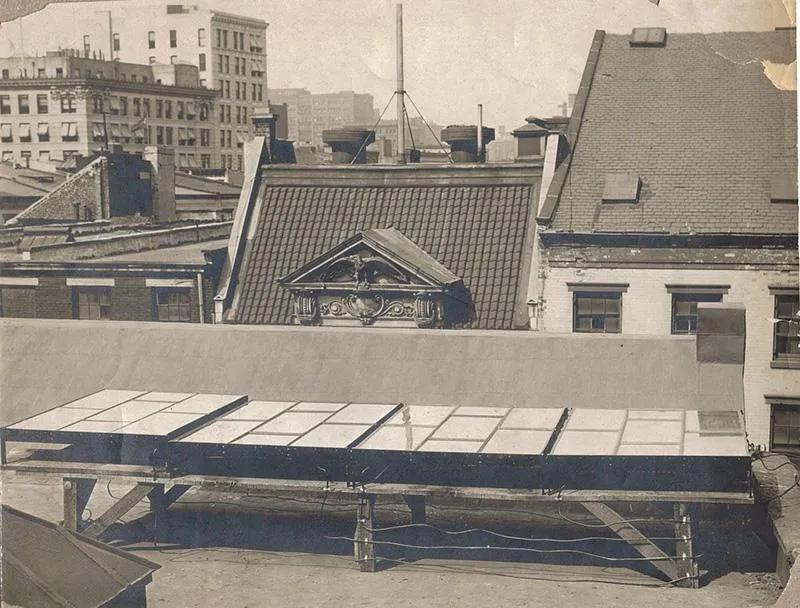
Brooklyn SolarWorks was founded to change that. While our installations today look a little different than back in 1884, NYC is quickly becoming a solarized city. We’ve developed custom solar system design methods specifically for flat roofed brownstones and townhouses in NYC, while also figuring out how to navigate NYC’s complex permitting process. As a result, we’ve had the opportunity to contribute to the growth of solar in NYC with over 3,000 solar installations.
How is solar energy obtained?
The sun’s energy can be obtained and converted using a variety of solar technologies, creating electricity for home use, thermal energy for solar heating, or other purposes.
In a home solar system setup, energy from the sun is harnessed using the technology of photovoltaic (PV) panels. When sunlight shines on a solar PV panel during the day, the energy is absorbed by solar cells and converted into DC electricity. When the current flows through an inverter, it is converted into AC electricity which is usable in your home.
Want to know how solar could work for your NYC home? Get in touch with us.
6 Reasons Why Solar Energy is Important in NYC
1. It’s Good for the Environment
It’s no secret that one of the most important things about solar power is that it’s a clean, renewable energy source. To mitigate the effects of the climate crisis, we need to transition to alternative energy sources that don’t emit greenhouse gasses – especially in our buildings. A recent study found that the buildings here in NYC are responsible for 70% of our total emissions.
Solar is one of the best renewable energy options available, particularly for individual households and buildings.
2. It Reduces Energy Costs
Another important feature of solar energy is that it’s cost-effective. Rather than purchasing natural gas and electricity powered by fossil fuels from the utility grid, solar PV systems allow you to convert the sun’s energy into electricity right in your own home. Through a program called net metering, you’ll receive full retail energy credits on your electric bills from Con Edison for all of the excess energy your system produces and exports to the grid.
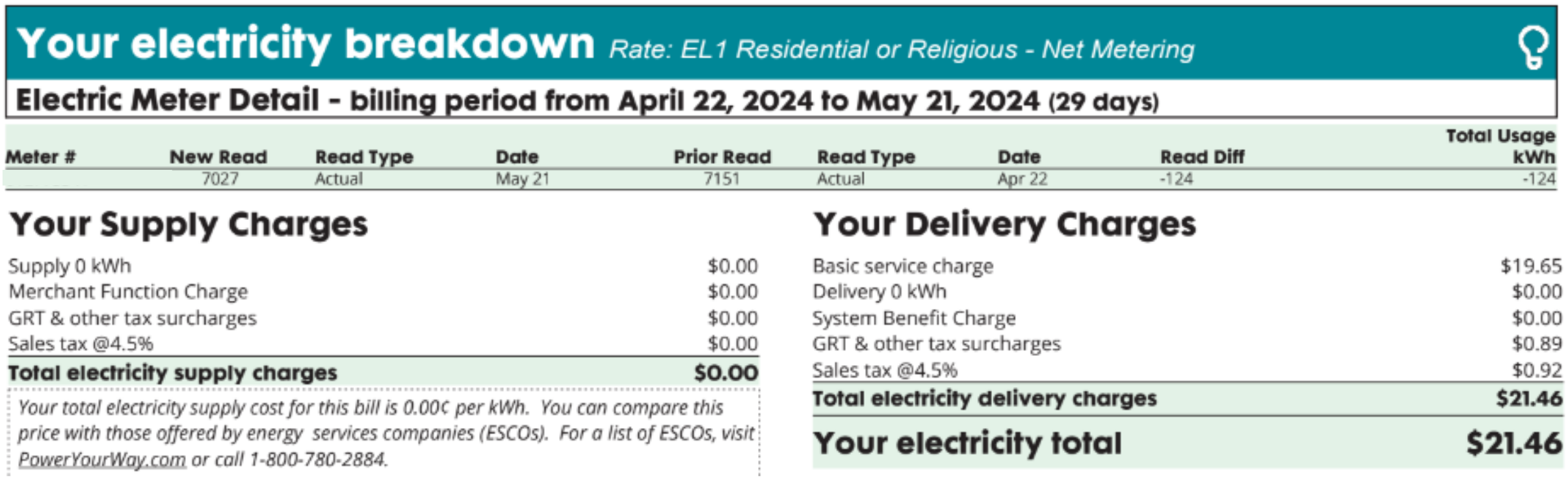
Powering your home with solar means you can say goodbye to the volatility of the fossil fuel market and unexpected utility rate hikes – something us New Yorkers are all too well aware of. Solar panels provide a free, renewable energy source that lasts for decades.
Plus, by electrifying your home with all-electric appliances (air source heat pumps, electric hot water heaters, or induction cooktops) after going solar, the cost savings become even more valuable – and your dependence on fossil fuels decreases even further.
3. It Provides Health Benefits
When it comes to energy sources, “clean” doesn’t just mean good for the environment. Transitioning to clean energy is a necessity for our health. The burning of fossil fuels produces harmful greenhouse gases like carbon dioxide, sulfur dioxide, methane, and nitrogen oxides. In fact, a study by Stanford University found that gas stoves leak methane into homes even when they’re not in use.
These gases are linked to various problems, like premature deaths, heart attacks, asthma, and other cardiovascular and respiratory issues. This is on top of the health effects of weather events exasperated by climate change, like extreme storms and even allergy season.
New York City is particularly vulnerable to these impacts. As of 2017, New York had the highest rate of premature deaths and health impacts due to fuel combustion pollution, with NYC being responsible for a significant portion. And not all New Yorkers experience these effects the same way – lower income communities and communities of color are more likely to be negatively impacted.
With our buildings being the top greenhouse gas emissions source, it’s imperative that we transition them to clean energy sources like solar.
4. It Promotes Energy Independence
Producing your own energy at home means reducing your dependence on electricity coming from the power grid, which promotes energy independence on an individual level. Rooftop solar energy systems give home and building owners the ability to produce their own power, which reduces energy costs and provides a greater sense of security.
This applies on a national level, too. Transitioning to solar and wind energy on a large scale would reduce the United States’s dependence on imports of foreign fossil fuels, which would provide greater economic and political stability.
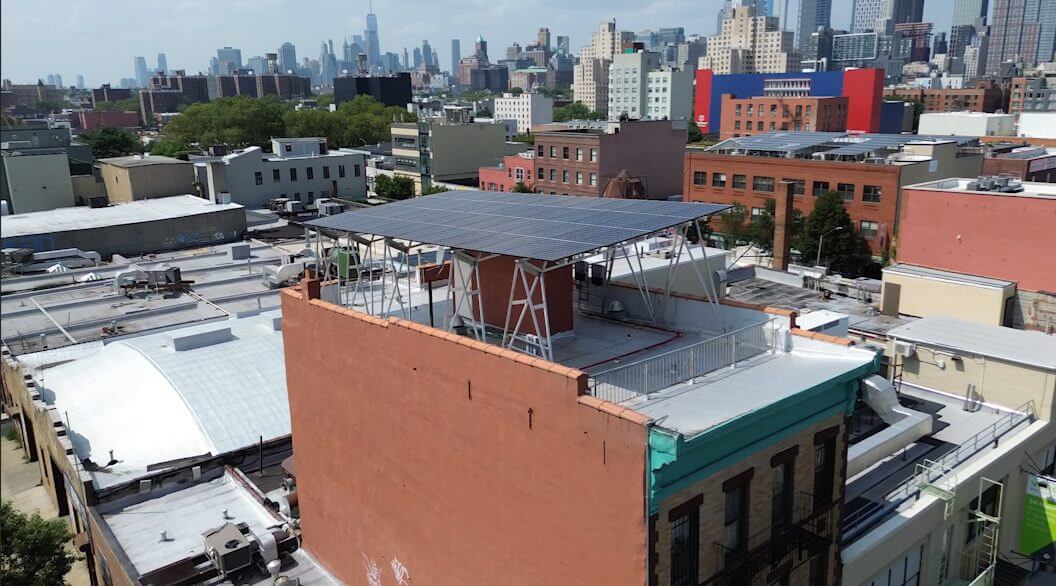
5. It Provides Financial Incentives
Solar energy provides financial benefits in addition to energy cost savings. Solar installation is heavily incentivized by the government on the federal, state and local levels. This means that not only will you see cost savings in the long run, but you’ll also see savings on the initial investment of your solar installation.
The tax incentives available to New Yorkers specifically make our city one of the best places in the country to go solar. Through a federal income tax credit, state solar tax credit, a state rebate, a local property tax abatement, and other incentives, a New York City homeowner can see their upfront contract price reduced by around 70 percent.
Additionally, a study released by Zillow.com in 2019 determined that across the country, homes with solar panels see a significant boost in value, averaging a 4.1% premium. But the increase in property value for homes with solar in the New York City metropolitan area was even greater, topping out at 5.4%. This translates to a premium of almost $24,000.
Want to learn more about what incentives your solar installation could qualify for? Chat with us today.
6. It Creates Jobs
Solar is important for the economy of New York. The solar industry here has experienced incredible growth over the past decade, and it’s only continuing to grow.
New York was the 8th largest state solar industry in 2021, employing 10,214 people across 645 companies. The state has over 3,380 MW of solar installed currently, and is projected to install an additional 4,877 MW over the next 5 years. In fact, Governor Hochul announced that as of March 2022, New York is the largest community solar market in the country with more than 1 gigawatt installed – enough to power 200,000 homes.
The growth of the solar industry means overall economic growth for the city and state. Green jobs are the way of the future for NYC.
The Power of Solar Energy in NYC
Solar is important for countless reasons. Whether environmental, economic, or health-related, the importance of solar energy in NYC cannot be understated. New York City is leading the charge when it comes to the clean energy transition with the goal of achieving carbon neutrality by 2050.
Realizing this goal means installing solar panels on buildings big and small across the city, from the Javits Center to your single family brownstone. And installing solar means job creation, greater cost efficiency, and protecting the health of our neighbors and the earth.
Get Started with Solar Energy Today
If you’re considering solar for your NYC home, trust an expert. Brooklyn SolarWorks has been custom designing solar systems for NYC roofs and expertly navigating the city’s complex permitting process since 2015.
Join over 3,000 of your neighbors and flip the switch to solar today! Schedule a free consultation now.
Solar energy provides a lot of benefits to New Yorkers – environmental, financial, and otherwise. But like any kind of investment, there are both pros and cons of solar energy. Installing a rooftop solar system is an investment unlike any other home improvement project, and it’s important to make an informed decision.
In this article, we’ll break down the top advantages and disadvantages of switching to solar energy in NYC.
Background of Solar Power in NYC
For many years, New York City was stuck in limbo when it came to solar. On one hand, there are over a million rooftops primed and ready to soak up the sun. But on the other hand, the conventional solar business model was developed with suburban homes in mind – those with roofs that are pitched and free of obstructions.
That’s where Brooklyn SolarWorks came in: our mission was to make solar possible on the flat, obstructed rooftops of NYC. With two solar racking options at our disposal – the tilt rack and the Brooklyn Solar Canopy – we’re bringing solar to the flat roofed buildings of our city.
Solar Panel Installation on Brownstone Homes
In addition to skyscrapers, New York City is known for its iconic brownstones, townhouses, and rowhouses. These homes are our strength – we got our start making solar appealing and accessible for the city’s residential neighborhoods.
A typical solar installation in NYC is relatively simple, requiring only a day to complete with minimal interruption to a homeowner’s routine.
NYC Solar Energy Advantages and Disadvantages
What are the top 5 advantages of solar energy?
One of the main advantages of solar energy is that is greatly reduces your personal carbon footprint. But there are plenty of other reasons to install home solar too, including excellent financial benefits. We’ve outlined them below.
1. Clean Energy Reduces Your Carbon Footprint
Needless to say, the most important benefit of solar energy is its environmental impact. Solar power is generated by capturing the sun’s energy, making it completely clean. Rather than burning fossil fuels and producing greenhouse gas emissions, you can power your home through a clean alternative. This is better for the planet and for the safety of your family, too.
New York City has some of the most ambitious carbon neutrality goals in the country. By switching to solar, your household’s carbon footprint will be reduced drastically and you’ll be doing your part in the fight against climate change.
2. Solar Decreases Your Electricity Bills from Con Edison
If you’ve been hit with sticker shock upon receiving your Con Edison bill, you’re not alone. As New Yorkers, increasing energy costs have been an unfortunate part of life for us for years. But this doesn’t have to be the case! Producing your own electricity via solar panels means greater energy independence because you’ll be reducing your dependence on natural gas and electricity coming from the power grid.
Through a program called net metering, your energy bill can be reduced or even eliminated with solar. Your solar system will likely produce more energy than your home needs. The excess energy your system produces is exported into the grid, and Con Edison compensates you for it with retail energy credits applied to your future electric bills.
Plus: because the utility company values solar power at the retail rate, that means that as their electric rates rise, the value of your solar power will too.
3. Rich Solar Tax Incentives Are Available to New Yorkers
Going solar in New York City is more affordable than you think. NYC solar incentives are some of the best in the country. From federal and state income tax credits, to rebates, to property tax abatements, the incentives available can cover 75% or more of the cost of your solar power system.
When you go solar with Brooklyn SolarWorks, we’ll make sure you get the savings your project qualifies for.

4. Solar Panels Increase NYC Property Value
A study released by Zillow.com in 2019 determined that across the United States, homes with solar panels see a significant boost in value, averaging a 4.1% premium. But the increase in property value for homes with solar in the New York City metropolitan area was even greater, topping out at 5.4%. This translates to a premium of almost $24,000.
The reason for this boost in value, according to Zillow, is the future electric savings that rooftop solar provides. Producing your own renewable energy through solar panels means having a free, reliable source of energy for decades. For those looking to buy a home, the initial solar premium is worth it because of the savings they’ll see down the road.
5. Solar Systems Last for Decades with Little Maintenance
Rooftop solar energy systems generally require little to no maintenance across their lifetimes. Solar systems are relatively simple with no moving parts. It’s not required that you clean your solar panels – they’re angled so that rainwater and debris can run off naturally. Solar panels are designed to withstand all forms of extreme weather, including heavy snow, hurricanes, and hail. Once your system is installed, it should be the least of your worries.
In the rare case that there are issues with your solar system, Brooklyn SolarWorks provides 24/7 real-time monitoring and a 30 year total system warranty.
Want to learn more about our monitoring & warranty package?
What are the 5 disadvantages of solar energy?
Although solar energy has many benefits, there are a few reasons you may hesitate to make the switch. We’ve noted these disadvantages (and their solutions) below.
1. Can Be a Large Initial Investment
Despite the tax incentives and cost savings, it’s no secret that purchasing a solar panel system carries a significant upfront price tag. Like any home improvement project, solar is an investment. In New York City, the contract price of a residential solar system can be around $35k on average.
Solution: Finance Your Solar System and Avoid Con Ed’s Rate Hikes
We understand that the initial cost of a solar system can seem like a lot. However, it’s an investment in your home that not only increases your property value, but also provides free electricity for decades and reduces your household’s carbon footprint. The savings from relying less on the grid and avoiding utility rate increases typically exceeds $50,000 over time.
Plus, there are a number of financing options available that give you the ability to swap out your monthly payment to Con Ed with a payment on your rooftop solar system. And when it comes time to file your taxes after going solar, you’ll see your contract price reduced by around 75%.
2. Permitting Takes a While in NYC
As New Yorkers, we know all too well the reality of construction in the city. All construction projects here involve a complex permitting process which can take a while to complete. Depending on the building, like those in designated historic and landmarked districts, there may be extra steps involved too.
When you sign on to go solar, don’t expect to have your system installed the next day. From contract signing, it can take two to three months for all of the permits to go through on a solar panel installation.
Solution: Work with an Expert in NYC Solar Permitting
Solar is a turn-key business, meaning it’s on the installer to handle all project permitting with various city entities. When it comes to the language of NYC building code and project permitting, the Brooklyn SolarWorks team is fluent. We’ve developed a mastery of city codes over the years. We know how to work with the DOB, Con Edison, NYC’s Landmarks Commission, and other entities to get a solar project permitted.
When you go solar with us, you can rest assured that even if it takes a couple months, your solar installation will be approved by the city.
Learn more:
3. Aesthetic Concerns
When it comes to home improvement projects, everyone has their own taste. Rooftop solar is no different – we respect that homeowners may have aesthetic concerns.
Solution: Custom Solar Designs to Fit Your Needs
We customize our solar system designs to fit our customers’ needs, aesthetic included.
Our canopy design is our pride and joy. It’s a patented, award-winning design that we created in collaboration with Situ Studio to make solar accessible on city rooftops. Many of our customers love it because it allows you to create a living space on your rooftop while still producing energy from sunlight.
But canopies aren’t everyone’s cup of tea, and sometimes aren’t the best option for every roof anyway. Tilt racks, for example, are angled, closer to the roof surface, and can be installed so that the system is not visible from the street. If aesthetic concerns are at the top of your mind, no need to worry – we’ll work to make solar fit your vision for your home.


4. Solar Battery Storage is Unavailable in NYC
For many homeowners, having the ability to store the solar energy they produce in a battery is a top priority. Since solar batteries store energy at your home, they offer short-term backup power in the event that there’s an outage, providing homeowners with an extra level of energy security.
Unfortunately, current FDNY fire code makes obtaining a permit to install solar batteries in residential buildings impossible. We’re hoping this will change in the near future.
Solution: Take Advantage of Net Metering and Retrofit Later On
Although we can’t install batteries now, all Brooklyn SolarWorks systems can be retrofitted to accommodate them once they’re allowed.
Plus, we consider net metering to be a virtual battery. Because your smart meter tracks the energy your solar system exports to the grid and Con Edison credits you for it, you can still utilize your excess solar production at night, on rainy days, or during the winter months when the sun isn’t shining as bright.
5. Some Roofs in NYC Aren’t Ideal
Solar is not a one-size-fits-all solution. The truth is, some rooftops here in the city aren’t fit for solar. The urban environment can naturally shade or obstruct a roof. If your roof is too small, has too much shade, or experiences other environmental factors, solar may not make sense for you financially.
Solution: Have a Free Roof Analysis Done
The good news is that Brooklyn SolarWorks assesses each and every roof for free prior to proceeding with a solar installation. Customers are often told by other solar companies that their roofs are too small or have too many obstructions to make solar work. But because we survey each roof, we’ll be able to tell for sure whether or not solar makes sense. (In most cases, it does!)

Reducing Your Carbon Footprint in New York
Even considering these potential disadvantages of solar power, it is still an excellent investment in your home and in the community. If you’re a homeowner in New York City, one of the best ways to reduce your carbon footprint is to switch to solar energy. With the buildings in our city creating the majority of our emissions, it’s important that we transition our power supply to renewable energy sources.
Are you ready to flip the switch to solar? Talk with solar energy pros today:

Solar Energy FAQ
What are the pros and cons of using solar energy for your home?
Some of the main pros of solar energy are that it’s great for the environment, it reduces electricity costs, it provides excellent tax incentives, and it has been proven to increase a home’s resale value. One of the main cons of solar is that the upfront cost can be prohibitive for some, though tax incentives and energy savings overtime can balance that out. Also, not every home is fit for solar panels, but it’s best to have a professional determine your roof’s viability.
Do solar panels increase your property taxes?
Solar panels increase your property value, and can actually reduce your New York City property taxes. The NYC Property Tax Abatement for solar allows NYC homeowners to claim 20% of solar energy system costs as a property tax abatement with the NYC Department of Finance. When you go solar, your property taxes are significantly reduced over a 4 year term.
Can you still have a high electric bill with solar panels?
In most cases, solar energy drastically reduces or eliminates an average home’s monthly electric bills. Many solar owners in New York City produce enough power to fully cover their family’s energy needs and then some.
Are there tax benefits for solar panels?
The federal government provides a 30% tax credit for installing home solar. On top of that, New York City has some of the best tax benefits for solar panels in the country on the state and city level. NYC homeowners can see their installation covered by around 75% through tax incentives.
Is solar energy good for the environment?
Solar energy is great for the environment. It’s a renewable source of energy that reduces greenhouse gas emissions and air pollution. By switching your home’s power source to solar, you’ll greatly reduce your individual carbon footprint.
New York City’s Local Laws 92 and 94 were passed by the City Council in 2019 as part of the Climate Mobilization Act (CMA). The CMA, otherwise known as NYC’s Green New Deal, aims to guide our city towards carbon neutrality by 2050 through various initiatives towards developing energy efficiency in buildings.
NYC Local Law 92 and 94 are a pair of legislation under the CMA requiring building owners to install sustainable roofing systems – solar photovoltaic systems or green roofs – on all new roofs. Here’s what you need to know about the requirements of these laws and how to comply.
What are Local Laws 92 and 94 in NYC?
NYC Local Law 92 and 94 are a pair of laws mandating the installation of sustainable roofing zones on all rooftops undergoing major construction, both for new and existing roofs. These two pieces of legislation are grouped together because they both set forth the requirements for this specific mandate.
- LL 94 requires sustainable roofing zones on all new construction and major roof renovations.
- LL 92 adjusts those requirements for smaller buildings.
Sustainable Roofing Zones
A “sustainable roofing zone” is defined by these laws as “areas of a roof assembly where a solar photovoltaic electricity generating system, a green roof system, or a combination thereof, is installed.”
Why were Local Laws 92 and 94 created?
Data collected by the City Council estimates that 70% of NYC’s carbon emissions come from buildings. Local Law 97, one of the main parts of the CMA, focuses on improving the all-around efficiency of buildings 25,000 square feet or larger. LL 92/94 were created to help this effort, by requiring solar panels or green roofs to be built on new rooftop installations of all sizes (with some exceptions).
Benefits of Sustainable Roofing for NYC
Solar panels are an essential part of moving towards true energy efficiency. While upgrading to electric appliances – like air source heat pumps or induction cooktops – improve a building’s overall efficiency, running those appliances, and the rest of the building, off of clean solar energy is even better.
Want to learn more about the benefits of rooftop solar?
Green roofs provide a number of benefits to urban environments, including:
- Improvements in air quality and biodiversity
- Creation of recreational space
- Increased energy efficiency by acting as an insulator, reducing the energy needed for heating and cooling

What are the building requirements of NYC Local Law 92 and 94?
LL 92 and 94 mandated that beginning November 15, 2019, all new buildings and roof replacements in NYC must install a solar photovoltaic system or green roof (or a combination of the two). There are some exceptions and different requirements based on the size, classification, and slope of the roof.
- For continuous roof area greater than 200 square feet (100 square feet or more in Group R buildings up to five stories), and a slope below 2:12
- A solar system, green roof, or a combination of both, must be installed.
- If the solar power capacity cannot reach 4 kW due to conditions like shading, a green roof is the only option.
- A minimum solar panel efficiency of 15% must be used for all calculations.
- For continuous roof area of less than 200 square feet (less than 100 square feet in Group R buildings up to five stories), and a slope below 2:12
- A solar system reaching 4 kW must cover the entire area
- If solar capacity cannot be reached, the entire area must be covered by a green roof
- A combination of a solar PV system and green roof is not allowed
- Continuous roof area with a slope higher than 2:12
- A solar PV system is the only option because the slope is too great for a green roof
- However, if a solar capacity of 4 kW cannot be reached, that roof section is exempt from LL92/94
Exceptions to LL 92 and 94
The requirements of this law apply to all new roof installations in the city and are based on the square footage of “continuous” or available space on the roof. In some cases, a roof or sections of a roof may be exempt from the requirements of these laws. Here are some exceptions:
- If the slope of the roof is greater than 2:12 and a solar system would not reach a capacity of 4 kW
- Too much of the roof area is occupied by other structures such as water towers, mechanical equipment, or stormwater management systems
- The roof is already occupied by recreational spaces
- If you’re making simple repairs to your roof, rather than replacing it altogether
Solar Panels vs. Green Roofs
Solar systems and green roofs are both great tools for improving energy efficiency, but are not necessarily interchangeable in terms of their environmental benefits.
With just a solar PV system, you’ll be improving your building’s energy use by changing the power supply. Rather than relying on nonrenewable fossil fuels to power the building, your solar panels would provide clean, renewable electricity. This is energy that doesn’t pollute, will always be available and won’t face supply price hikes. Solar PV systems are especially beneficial for energy efficiency when used in conjunction with electric appliances like hot water heaters and air source heat pumps.
Green roofs are versatile spaces with a variety of environmental benefits. They can provide recreational areas, house agriculture and biodiversity, and improve air quality and urban heat island effects. When it comes to energy efficiency, green roofs act as insulation for buildings, reducing energy consumption for heating and cooling. Decreasing the use of heating and cooling systems also means saving energy costs and extending the longevity of HVAC systems.
If your roof allows it, a combination of green roof and solar PV system can be a great upgrade for your building. Our patented Brooklyn Solar Canopy is elevated nine feet above the roof surface to avoid obstructions. As a result, it also provides shade and living space underneath.
Check out this green roof-canopy combo that one of our customers created:

How to Calculate Your Roof Area Covered by LL 92 & 94
Because some areas of your roof, like FDNY fire paths and other structures, are exempt from LL 92 and 94 coverage, you’ll need to calculate the area of your roof that needs to comply. It’s best to work with a certified design professional or contractor on this, but you can expect to subtract the following areas from your total roof area:
- Required FDNY roof access: for every 100 square feet of rooftop, there should be a clear path of at least 6 feet in width stretching across the building.
- HVAC equipment and existing structures like stormwater management systems
- Recreational spaces
How to Be Compliant with NYC’s Sustainable Roof Policies
In order to comply with LL 92 and 94 (NYC green roof law), you should work with a contractor or design professional to determine if your roof is suitable for solar panels, a green roof, or both, or if it’s exempt from the requirements of the mandate. From there, you can choose a solar or green roof installer that best fits your building’s needs.
Interested in installing solar panels on your new roof? Learn about how we can help you comply with LL 92 and 94:
Building permits filed with the DOB must submit a Local Laws 92/94 of 2019 Solar and Green Roof Systems form certifying their compliance with, or exemption from, the requirements of Local Laws 92 and 94 prior to approval.
New York City Sustainability and Energy Efficiency
NYC has some of the most ambitious sustainability goals in the country, which is a great thing for our fight against climate change. A major part of achieving carbon neutrality is reducing the carbon emissions of our buildings by choosing renewable energy sources and increasing energy efficiency.
While NYC Local Law 92 and 94 apply only to new buildings and roofs, energy efficient upgrades are a great idea for any building or home. If you’re making the switch to clean energy, choose an expert. Brooklyn SolarWorks has made solar energy appealing and accessible for over 3,000 property owners across the city.
Need solar panels to comply with LL 92 and 94? Get started:
If you’ve been considering installing solar on your flat roof, you might have been wondering about how the condition of your existing roof could impact an installation. Many homeowners have concerns about whether they need to make repairs or get a new roof before installing solar power, but most of the information available is geared toward pitched roofs with shingles as opposed to our flat roofs in NYC.
We want you to know that while these concerns are legitimate – it’s one of the first things we’ll look at, in fact – roof condition is typically not an obstacle to going solar on a flat roof. In the case that your roof needs repairs or replacement, you have options that do not prevent you from proceeding with your residential solar panel installation. Let’s dive into the details.
The Importance of a Quality Roof When Installing Solar Panels
Needless to say, your roof is the foundation of a flat roof solar installation. Naturally, having a stable foundation is of the utmost importance when installing solar panels – in fact, one of the first things we’ll evaluate before moving forward with your solar project is the condition of your roof. But in most cases, there are no issues that require roof replacement or repair before going solar. Our solar installations are lightweight, and do not require a rooftop to be reinforced.
Every project we do is approved by a structural engineer, and the details we collect on site are used in their calculations. When we perform a site evaluation, there’s a few main things we check to ensure stability and optimal solar performance.
Your Flat Roof’s Age
When you contact us about solar, one of the first questions we’ll ask is how old your roof is. With that said, there is no true “ideal” age for a solar installation as every roof has a unique aging experience depending on wind exposure and weathering over time. We’ve installed solar systems on roofing membranes that are 15 years or older without issue. Because every roof is different, we’ll want to evaluate your specific roof to determine its current condition.
Damages to the Flat Roof Surface
Over the course of a roof’s lifetime, it will likely incur damages to its surface. When we evaluate your roof, we’ll keep an eye out for things like curled or corroded flashing, water damage or “ponding,” cracks in the surface, and broken seals. These are generally of little concern and can be repaired at any point before or after going solar.
Flat Roof Orientation and Layout
Another important quality we evaluate is a roof’s solar potential. When it comes to flat roofs, this is often dictated by the amount of shade casted by neighboring buildings and any obstructions on the roof’s surface. Because we have two different solar panel mounting options, both the solar canopy and tilt racks, we can typically work around obstructions and angle your panels for the maximum energy output.
Questions about solar potential on your flat roof? Contact us to speak with a solar specialist.
Why You Don’t Need a New Flat Roof Before Installing Solar Panels
It is generally not necessary to fully replace a flat roof before choosing to go solar. The damages we see most often with our customers’ roofs are minimal and can be repaired at any point, even after the installation.
In this way, flat roofs have an advantage over pitched roofs when it comes to solar. Flat roofs allow for easy maintenance after a solar installation, while solar panel removal is required for repairs on pitched roofs.
But, there are some exceptions. In the rare case that your flat roof has more serious deterioration – an area is sunken in, there are recurring leaks, the surface feels uneven or unstable – we would always advise you to do what is necessary for the health of your roof before offering a solar installation. Though these issues are not common, the condition of your roof comes first. We would not move forward with an installation of solar panels if we believe your roof to be unstable.
What options are available for repairing or replacing your roof before or after your solar installation?
Many of the issues we see are the more slight surface level damages needing minor repairs. In these cases, you have options that don’t delay your flat roof solar installation. For example, many of our customers choose to reseal their roofs while waiting for the permitting process to be completed (which can take three to four months).
If parts of your roof need to be reflashed after installation for instance, solar panel removal is not necessary. Our solar panel systems use standard roofing materials and equipment that can be flashed around just like any other protruding objects on the roof.
Many homes in NYC have complex HVAC systems that make repairs and roof replacement far more challenging than solar does – and those rooftops are maintained just fine.


Are the additional costs of my roof repairs included in my solar installation cost when filing for the federal solar tax credit?
You may wonder if any roof repairs you have done before your solar installation can be claimed when you file for the federal solar tax credit. In past iterations of the solar Investment Tax Credit (ITC), there has been some gray area as to what expenses are covered. However, the IRS currently has a clear definition of qualifying expenses:
“Qualified solar electric property costs are costs for property that uses solar energy to generate electricity for use in your home located in the United States…
Some solar roofing tiles and solar roofing shingles serve the function of both traditional roofing and solar electric collectors, and thus serve functions of both solar electric generation and structural support. These solar roofing tiles and solar roofing shingles can qualify for the credit…
This is in contrast to structural components such as a roof’s decking or rafters that serve only a roofing or structural function and thus do not qualify for the credit.“
IRS Instructions for Form 5695
By this definition, the following expenses are covered:
- The cost of the system, including panels, racking, inverters, and other equipment
- Labor costs, including installation and permitting and inspection fees
- Solar batteries
- Any applicable sales taxes
Further, the tax code explicitly states that “structural components such as a roof’s decking or rafters that serve only a roofing or structural function” do not qualify for the credit. For this reason, it is our interpretation that roof replacement is not a qualifying expense.
Some solar companies may tell you that you can repair or replace your roof in tandem with installing solar panels and claim the roofing costs under the ITC. It’s a good idea to be cautious of this – we don’t want you and your family to be audited. Consult with a tax professional for guidance.
Who can repair or replace a roof in NYC?
If you do choose to have roof repairs or replacement done, it’s important to recognize that roofing and solar are two separate jobs. Some solar installation companies offer roofing services and some roofing companies offer solar installations for cost-saving purposes. We do not – we believe in leaving roof work to the roofing experts while we handle the solar. We install almost exclusively on hundred year old flat buildings in the city, and are experts in how to safely and effectively attach to century-old homes.
Because roofing and solar are two separate projects, it’s best that you choose a quality installer for each one. You wouldn’t want a roofer installing solar as an afterthought, or vice versa – you’ll want to make the best choice of each type of contractor. We’ve worked alongside a number of local roofing contractors that we are happy to recommend if you choose to go that route.
Installing Solar Panels on Your Flat Roof in New York City
We want to reiterate that although we don’t deny the necessity of a quality, stable roof before installing solar, flat roof condition is generally not something that will impede your ability to go solar. In the case that your roof has a broken seal or needs to be reflashed, for example, there are options that won’t delay your solar installation.
Brooklyn SolarWorks is committed to a high-quality solar panel installation in NYC. This means starting with the foundation. If we determine your flat roof to be in need of replacement or bigger repairs before installing solar, we won’t rush into a solar installation until your roof is complete.
Ready to go solar on your flat roof? Schedule a free consultation today!
