How Well Do Solar Panels Work in NYC During the Winter?
Dec 17, 2025One of the biggest myths about solar panels is that they don’t work in the winter. Solar panels need light, not heat, to produce electricity, which means they can still…


Subscribe to our monthly newsletter to keep up with us and learn about the latest in solar and sustainability in New York City.
Installing solar panels on commercial properties in New York City is not just an eco-friendly choice—it’s becoming a legal necessity. With the higher starting costs associated with solar energy systems, navigating the financial landscape can be daunting for property owners.
Fortunately, New York City offers some of the best solar incentives and rebates in the country and makes compliance with local laws easier and more affordable. This guide provides an in-depth look at the key New York City solar incentives available, helping you maximize your investment while meeting regulatory requirements.
Navigating the landscape of solar energy for commercial properties in New York City can be challenging. Local laws and building codes are requiring solar and energy efficiency measures, adding a significant cost burden, especially for large buildings. However, local solar incentives and other government funding mechanisms are being put in place to help property owners comply with these regulations without breaking the bank.
If you’re the owner or developer of a commercial property in New York City, you may be subject to several local laws that mandate solar installations and energy efficiency upgrades. These laws are part of the city’s broader efforts to reduce carbon emissions and promote sustainable building practices.
Local Laws 92 and 94 require that newly constructed buildings and buildings undergoing major roof renovations install solar photovoltaic systems or green roofs. These laws aim to increase energy efficiency and reduce the urban heat island effect, ensuring that new developments contribute to the city’s sustainability goals.
Local Law 97 is one of the most ambitious climate laws in the country, setting strict carbon emission limits for large buildings. Commercial properties that exceed these limits will face hefty fines, making it essential for building owners to adopt energy efficient measures, including solar installations, to comply with the law and avoid penalties.
Local Law 154 mandates that certain new buildings be all-electric, with few exceptions. For new buildings under 7 stories, compliance began in January 2024; for taller buildings, it will begin in 2027. This law is part of the city’s plan to phase out fossil fuels in building operations like HVAC and hot water heating, and promote the use of clean energy sources like solar power. Compliance with Local Law 154 is crucial for property owners looking to future-proof their buildings against increasingly stringent environmental regulations.
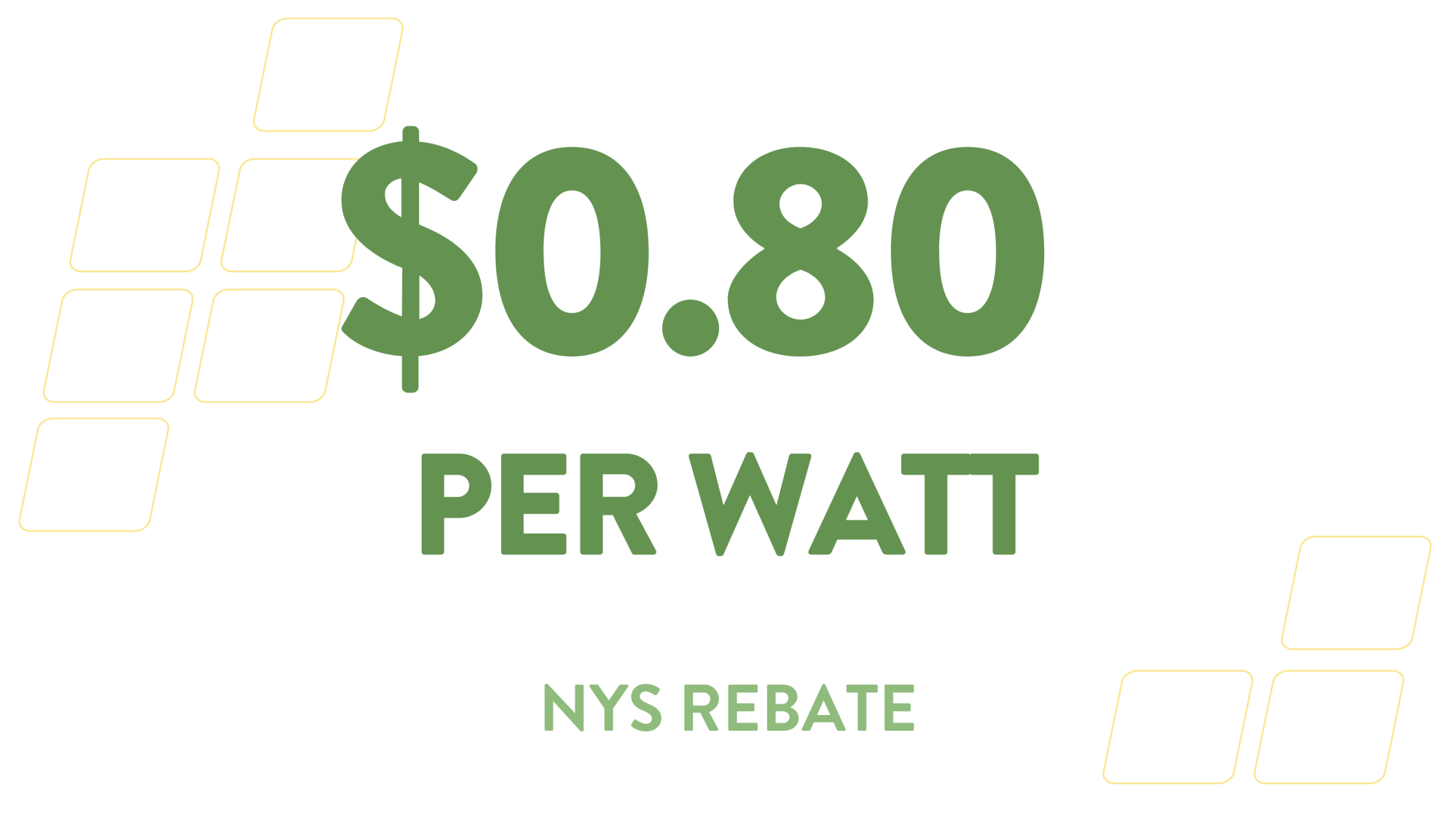
Through the NY-Sun Program, the New York State Energy Research and Development Authority (or NYSERDA) provides cash incentives to build solar in different regions of the state. This incentive is a rebate that reduces the upfront contract price of New York State solar projects.
The rebate for NYC commercial projects is currently $0.80 per Watt of solar installed. Note that the rebate amount declines over time based on how much solar is installed in each region of the state.
In addition to the rebate, NYSERDA also provides a number of solar panel financing options for New York property owners looking to invest in solar for their commercial building.
Unlike income tax credits, which are claimed by property owners on their taxes, this rebate is paid directly to the solar installer. In order to receive this rebate, you must work with a NYSERDA-approved contractor. At Brooklyn SolarWorks, we handle the filing process on your behalf, ensuring that all necessary documentation is submitted accurately and on time.

The NYC Solar Property Tax Abatement (PTA) provides a reduction in property taxes for buildings that install solar energy systems. The abatement covers up to 30% of the installation costs, which is spread out over four years, helping to offset the initial investment required for solar projects.
Brooklyn SolarWorks claims the PTA on your behalf during the permitting process. Building permits signed off by March 15th will have their property tax abatements initiated the following July.
For more information, you can view the DOB’s Form PT4: Property Tax Abatement for Solar Electric Generating System.
 Federal Solar Tax Credit
The Federal Solar Tax Credit, also known as the Investment Tax Credit (ITC), allows property owners to deduct a percentage of the cost of installing a solar energy system from their federal taxes. Currently, the credit covers 30% of the total project cost, providing substantial savings on the initial investment. This credit applies to both residential and commercial properties, making it one of the most widely used incentives for solar energy adoption.
Time is running out to claim the 30% ITC. The “One Big Beautiful Bill Act” brings an early end to this long-standing commercial solar tax incentive. To qualify, commercial projects must now either start construction by July 4, 2026 and be completed within four years, or be placed in service by December 31, 2027.
Those deadlines are coming up fast, especially when factoring in project permitting and city approvals. To guarantee ITC eligibility, start your solar journey soon. Reach out to Brooklyn SolarWorks today to kick things off with a free consultation.
Under certain conditions, nonprofit organizations are eligible for direct pay instead of a tax credit. This provision allows nonprofits, which typically do not pay federal taxes, to receive a direct payment equivalent to the tax credit. This option makes solar energy more accessible to organizations that otherwise wouldn’t benefit from traditional tax incentives.
Direct pay will expire alongside the solar tax credit. Tax-exempt organizations that want to claim this incentive need to start construction on their solar installation by July 4, 2026 and finish within four years, or place their system in service by December 31, 2027 to qualify. Don’t miss out on this chance to save 30% on solar panels for your non-profit. Schedule a free consultation today to start your project before the deadline hits.
Filing for the Federal Solar Tax Credit involves several steps, including gathering documentation and completing the necessary IRS forms. To claim this credit, you’ll need to fill out IRS Form 3468 Section B when filing your federal taxes.
Accelerated Depreciation under MACRS allows businesses to depreciate their solar energy systems over a shorter period, typically five years, instead of the traditional longer depreciation schedule. This accelerated schedule means that businesses can deduct a larger portion of the system’s cost from their taxable income in the early years of the system’s life. By reducing your taxable income, MACRS can provide substantial tax savings, improving the overall financial viability of your solar project.
It’s important to talk to your accountant or tax professional to fully understand how MACRS can benefit your specific financial situation. They can guide you on how to best take advantage of this depreciation method, ensuring you maximize the financial returns from your solar investment.
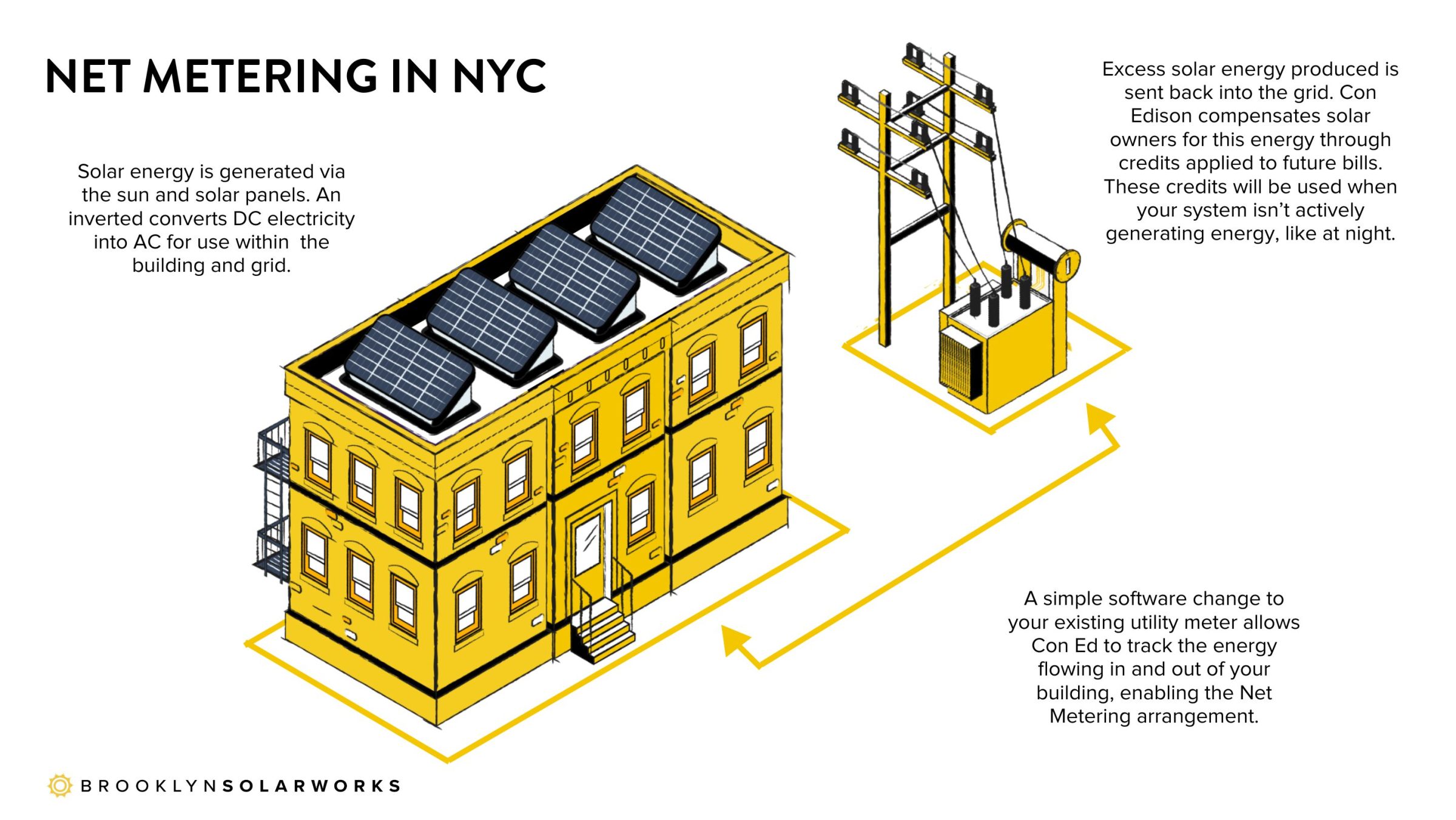
Beyond tax incentives, one of the other great benefits of going solar in NYC is net metering in New York. Net metering is a billing mechanism that allows you to store your solar energy as a retail energy credit to be used at a later date. In NYC, we’re fortunate to have 1-to-1 net metering, meaning your solar power is valued at the same rate as electricity supplied by Con Edison.
In other words, your solar system will likely produce more energy than your home needs. That excess energy is sent back into the grid, and Con Edison compensates you for it in the form of retail energy credits that are applied to your future bills. So even though solar battery installations aren’t permitted in NYC yet, you can still utilize the extra solar energy your system produces.
Because of net metering, our customers reduce their monthly electricity bills and stabilize their energy costs over time.
From providing information on financial incentives to understanding local laws and regulations, Brooklyn SolarWorks is here to make the solar process easy, allowing you to focus on your business. Contact us today to learn more about how we can help you leverage these incentives and make your solar investment as cost-effective as possible.
Disclaimer: Brooklyn SolarWorks are not financial professionals. As much as we’ll always strive to provide our customers with the most accurate information regarding solar tax incentives, we are not tax experts. Please consult your tax advisor for guidance on filing for credits with respect to your specific circumstances.
One of the biggest myths about solar panels is that they don’t work in the winter. Solar panels need light, not heat, to produce electricity, which means they can still…
If you’re an NYC homeowner considering rooftop solar panels, questions like these may have crossed your mind: How do I store the energy my system produces? What happens at night…
If you’ve opened a utility bill lately, you know electricity costs are going up in New York City. The best way to avoid rising costs is by generating your own…